Join us on a literary world trip!
Add this book to bookshelf
Grey
Write a new comment Default profile 50px
Grey
Subscribe to read the full book or read the first pages for free!
All characters reduced
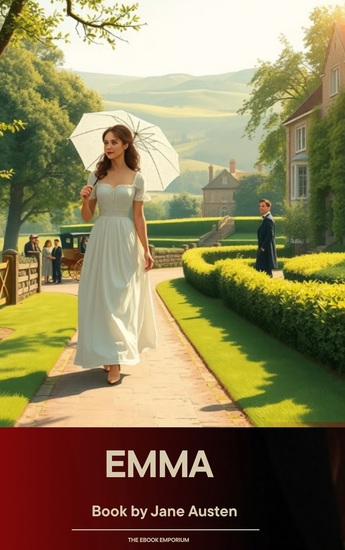
Emma - cover

Emma

Jane Austen

Publisher: The Ebook Emporium

  • 0
  • 0
  • 0

Summary

"I am going to take a heroine whom no one but myself will much like." — Jane Austen

Emma Woodhouse is perfectly content with her life in the quiet village of Highbury. Wealthy, independent, and perhaps a bit too sure of her own judgment, she occupies her time by orchestrating the romantic lives of those around her. However, her well-intentioned meddling—particularly with her protégé, Harriet Smith—leads to a comedy of errors that threatens the happiness of her friends and herself. As Emma navigates a maze of social blunders and misplaced affections, she must confront the wisdom of her longtime friend and mentor, Mr. Knightley, and finally recognize the true desires of her own heart.

The Art of the "Comedy of Manners": Austen's sharp wit shines as she satirizes the social pretensions and gossip of 19th-century provincial life. Through Emma's eyes, we see a world where a misunderstood glance or a misinterpreted letter can change a person's fate. It is a brilliant study of human nature that remains as relevant today as it was in the Regency era.

A Heroine's Growth: Unlike many romantic leads of her time, Emma doesn't need to marry for money or status. Her journey is internal—it is a transformation from a spoiled, self-important young woman into a mature adult who understands the weight of her influence on others. The tension between her and the stoic, honorable George Knightley provides one of the most satisfying "slow-burn" romances in fiction.

Rediscover the wit and warmth of Austen's most playful work. Purchase "Emma" today.
Available since: 01/12/2026.
Print length: 577 pages.

Other books that might interest you

  • Cousin Bette - cover

    Cousin Bette

    Honoré de Balzac

    • 0
    • 0
    • 0
    Cousin Bette is one of Honoré de Balzac's most intense and psychologically penetrating novels, a dark and compelling exploration of envy, ambition, betrayal, and the destructive power of resentment. As a central work in Balzac's monumental series La Comédie Humaine, this gripping narrative dissects the moral decay beneath the glittering surface of Parisian high society in the 19th century.
    
    At the heart of the story is Lisbeth Fischer—known as Cousin Bette—a poor relation of the wealthy Hulot family. Overlooked, unmarried, and long overshadowed by her more beautiful and fortunate relatives, Bette harbors a quiet but growing bitterness. Years of neglect and humiliation ferment into a calculated desire for revenge. Intelligent, patient, and ruthlessly observant, she waits for the perfect moment to strike.
    
    The Hulot family, outwardly respectable and socially prominent, is already weakened by hidden excesses and moral failings. Baron Hulot's reckless indulgence and financial irresponsibility threaten the family's stability, while vanity and ambition blind its members to the dangers gathering around them. Into this fragile environment steps Bette, who forms a strategic alliance with the captivating and manipulative Valérie Marneffe—a woman equally skilled in deception and social maneuvering.
    
    Together, they orchestrate a web of emotional manipulation, financial exploitation, and calculated betrayal that slowly ensnares the Hulots and their associates. Balzac masterfully traces how greed, lust, pride, and vengeance intertwine, exposing the vulnerability of those who believe themselves secure. What unfolds is not merely personal revenge but a broader commentary on the corrosive effects of unchecked desire and social ambition.
    
    Through vivid characterization and intricate plotting, Balzac reveals the fragile foundations of wealth and respectability. The novel examines the shifting social structures of post-Napoleonic France, where fortunes rise and fall with alarming speed and moral compromise often replaces virtue. In this world, appearances mask desperation, loyalty is tested by self-interest, and even family bonds can become battlegrounds.
    
    Yet Cousin Bette is more than a tale of vengeance. It is a profound study of human psychology. Balzac portrays Bette not as a simple villain, but as a deeply wounded individual shaped by exclusion and disappointment. Her calculated schemes are driven by long-suppressed pain, making her both terrifying and tragically human. Likewise, the weaknesses of her adversaries render them complicit in their own downfall.
    
    Balzac's prose is rich, incisive, and unflinching in its realism. With remarkable detail, he captures the rhythms of Parisian life—its salons, studios, households, and financial dealings—while dissecting the moral tensions beneath them. The novel's emotional intensity and sharp social critique make it one of Balzac's most enduring and modern works.
    
    Dark, dramatic, and deeply insightful, Cousin Bette remains a powerful meditation on envy, power, and the consequences of hidden resentment. It is a timeless exploration of how personal grievances, when nurtured in silence, can erupt into forces capable of destroying families, fortunes, and lives. For readers who appreciate classic literature rich in character depth and social commentary, this unforgettable novel offers a gripping and thought-provoking journey into the complexities of the human heart.
    Show book
  • Concerning the American Language - From their pens to your ears genius in every story - cover

    Concerning the American Language...

    Mark Twain

    • 0
    • 0
    • 0
    Samuel Langhorne Clemens was born in Florida, Missouri on the 30th November 1835 and is far better known by his pen name of Mark Twain.  An American writer and humorist of the first order he is perhaps best known for his novels ‘The Adventures of Tom Sawyer’ and its sequel ‘The Adventures of Huckleberry Finn’ which are often described with that mythic line The Great American Novel. 
    Twain grew up in Hannibal, Missouri which would later provide the backdrop to these great novels.  Apprenticed to a printer he also became a typesetter and then a master riverboat pilot on the Mississippi.  Later, heading west with his brother Orion to make his fortune, he failed at gold mining and instead turned to journalism and thence his true calling as a writer of humorous stories where his wit and humor sparkled from every paragraph, his craft evident with every page and punctured target. 
    A staunch supporter of copyright protections this helped him keep much of the wealth his writing created, though much money was also lost on investments that he pursued in his love for science and technology as well as investing in his own inventions. 
    Twain was born during a visit by Halley’s comet, and he predicted that he would go out with it as well.  He died the day after its subsequent return on 21st April 1910, at his house, Stormfield, located in Redding, Connecticut.
    Show book
  • 40+ Ernest Hemingway Collection Signature Classics Novels Stories and Poems - A Farewell to Arms The Sun Also Rises The Torrents of Spring Men Without Women and others - cover

    40+ Ernest Hemingway Collection...

    Ernest Hemingway

    • 0
    • 0
    • 0
    The Ernest Hemingway Collection: Illustrated Signature Classics, Novels, Stories, and Poems features over 40 of Hemingway's works, encompassing his most renowned novels, short stories, and poems. This volume includes celebrated titles like A Farewell to Arms, The Sun Also Rises, The Torrents of Spring, and Men Without Women, alongside other literary treasures that showcase his unique style and insight into human experience. Known for his powerful prose and realistic, often adventurous themes, Hemingway's collection spans stories of love, war, and resilience. Through atmospheric illustrations, this edition enriches Hemingway's classic works, immersing readers in the settings and sentiments of each story. This comprehensive anthology serves both newcomers and devoted Hemingway enthusiasts, offering an unparalleled exploration of his influential contribution to American literature.
     
    Novels
    • A Farewell to Arms
    • The Sun Also Rises
    • The Torrents of Spring
     
    Stories 
    Men Without Women 
    • The Undefeated
    • In Another Country
    • Hills Like White Elephants
    • The Killers
    • Che Ti Dice La Patria?
    • Fifty Grand
    • A Simple Enquiry
    • Ten Indians
    • A Canary for One
    • An Alpine Idyll
    • A Pursuit Race
    • Today is Friday
    • Banal Story
    • Now I Lay Me
     
    Three Stories and Ten Poems 
    • Up in Michigan
    • Out of Season
    • My Old Man
    • The ten poems are:
    • Mitraigliatrice
    • Oklahoma
    • Oily Weather
    • Roosevelt
    • Captives
    • Champs d'Honneur
    • Riparto d'Assalto
    • Montparnasse
    • Along With Youth
    • Chapter Heading
     
    In Our Time 
    • On the Quai at Smyrna
    • Chapter I
    • Indian Camp
    • Chapter II
    • The Doctor and the Doctor's Wife
    • Chapter III
    • The End of Something
    • Chapter IV
    • The Three-Day Blow
    • Chapter V
    • The Battler
    • Chapter VI
    • A Very Short Story
    • Chapter VII
    • Soldier's Home
    • Chapter VIII
    • The Revolutionist
    • Chapter IX
    • Mr. and Mrs. Elliot
    • Chapter X
    • Cat in the Rain
    • Chapter XI
    • Out of Season
    • Chapter XII
    • Cross-Country Snow
    • Chapter XIII
    • My Old Man
    • Chapter XIV
    • Big Two-Hearted River: Part I
    • Chapter XV
    • Big Two-Hearted River: Part II
    • L'Envoi
    Show book
  • Crime and Punishment - cover

    Crime and Punishment

    Fyodor Dostoevsky

    • 0
    • 0
    • 0
    Crime and Punishment tells the story of Rodion Raskolnikov, an ex-student who plans to murder a pawnbroker to test his theory of personality. Having accomplished the deed, Raskolnikov struggles with mental anguish while trying to both avoid the consequences and hide his guilt from his friends and family.
    Dostoevsky's original idea for the novel centered on the Marmeladov family and the impact of alcoholism in Russia, but inspired by a double murder in France he decided to rework it around the new character of Raskolnikov. The novel was first serialized in The Russian Messenger over the course of 1866, where it was an instant success. It was published in a single volume in 1867. Presented here is Constance Garnett's 1914 translation.
    Show book
  • Edward Mills and George Benton - A Tale - cover

    Edward Mills and George Benton -...

    Mark Twain

    • 0
    • 0
    • 0
    These two were distantly related to each other seventh cousins, or something of that sort. While still babies they became orphans, and were adopted by the Brants, a childless couple, who quickly grew very fond of them. The Brants were always saying: “Be pure, honest, sober, industrious, and considerate of others, and success in life is assured.” The children heard this repeated some thousands of times before they understood it; they could repeat it themselves long before they could say the Lord's Prayer; it was painted over the nursery door, and was about the first thing they learned to read. It was destined to be the unswerving rule of Edward Mills's life. Sometimes the Brants changed the wording a little, and said: “Be pure, honest, sober, industrious, considerate, and you will never lack friends.”
    Show book
  • Death in the Woods - From their pens to your ears genius in every story - cover

    Death in the Woods - From their...

    Sherwood Anderson

    • 0
    • 0
    • 0
    Sherwood Anderson was born on 13th September 1876 in Camden, Ohio. 
    When his father’s business failed the family was forced to move on a regular basis before finally settling in Clyde, Ohio.   
    Anderson, one of 7 children, left school at 14 to take a number of jobs to help with the family finances. These were difficult years. 
    He moved to Chicago in search of opportunities before joining the Army for the US-Spanish War of 1898.  He then entered Wittenberg Academy in Springfield, Ohio to complete his education before moving back to Chicago to take up a writing job. 
    In 1904 he married Cornelia Lane, her family had resources and Anderson was keen, with this family backing, to run a business. 
    The early years of their marriage produced 3 children but a nervous breakdown in 1907 and another in 1912, despite his success as a business entrepreneur, resulted in him abandoning his family and deciding that a literary career would be best for him.   
    A move back to Chicago resulted in a job in advertising, a divorce from Cornelia and marriage to Tennessee Mitchell.  
    That same year his first book ‘Windy McPherson’s Son’ was released and in 1919, his most famous book, ‘Winesburg, Ohio’, a collection of short stories about life in an Ohio town was released. 
    Anderson continued to write short stories, novels and non-fiction but his only true bestseller came with ‘Dark Laughter’.  His influence on writers that followed, from Faulkner to Hemingway, was immense. He also married a further two times.   
    Sherwood Anderson died in in Colón, Panama, on the 8th March, 1941. He was 64. An autopsy revealed that a swallowed toothpick had resulted in peritonitis. 
    His headstone epitaph reads ‘Life, Not Death is the Great Adventure.’
    Show book