Join us on a literary world trip!
Add this book to bookshelf
Grey
Write a new comment Default profile 50px
Grey
Subscribe to read the full book or read the first pages for free!
All characters reduced
The 1906-1910 Cubs Dynasty - Rowdy Times and Rugged Men in Cutthroat Chicago - cover

The 1906-1910 Cubs Dynasty - Rowdy Times and Rugged Men in Cutthroat Chicago

Gary D Santella

Publisher: The History Press

  • 0
  • 0
  • 0

Summary

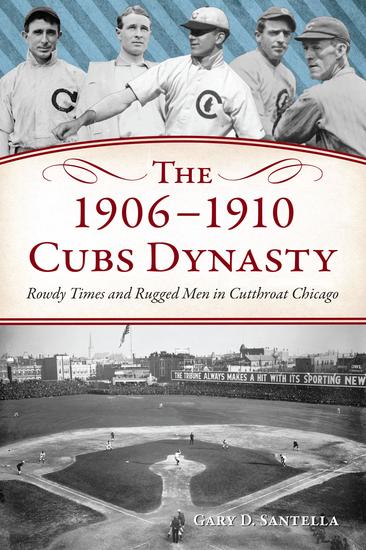
A Cubs dynasty founded on fastballs and fisticuffs.   Unlike today's Chicago Cubs, the Cubs of 1906-1910 were not at all lovable, and certainly did not always display traits customarily linked with a winning team. Their manager would brawl with his own players, and the players brawled with each other. Their second baseman and shortstop hated each other and didn't speak for years. Their best pitcher pitched with a mutilated hand. Their star catcher got into a spat with management and left the team for a year to play professional billiards. Their manager over time grew to despise the team owner. Yet, this group of brawlers, bickerers, and battlers dominated the National League and established a baseball dynasty, winning four National League pennants and two world championships in 5 years. Author Gary D. Santella follows the story of a team whose toughness and tenacity was a fitting reflection of early twentieth-century Chicago.
Available since: 04/08/2024.
Print length: 192 pages.

Other books that might interest you

  • A History of the Undead - Mummies Vampires and Zombies - cover

    A History of the Undead -...

    Charlotte Booth

    • 0
    • 1
    • 0
    A history of Western culture’s fascination with undead creatures in film and television. 
     
    Are you a fan of the undead? Watch lots of mummy, zombie and vampire movies and TV shows? Have you ever wondered if they could be “real?” 
     
    This book, A History of the Undead, unravels the truth behind these popular reanimated corpses. 
     
    Starting with the common representations in Western media through the decades, we go back in time to find the origins of the myths. Using a combination of folklore, religion and archaeological studies we find out the reality behind the walking dead. You may be surprised at what you find . . .
    Show book
  • Meditations - cover

    Meditations

    Marcus Aurelius

    • 0
    • 0
    • 0
    Meditations is a series of personal writings by Marcus Aurelius, Roman Emperor from AD 161 to 180, recording his private notes to himself and ideas on Stoic philosophy. Marcus Aurelius wrote the 12 books of the Meditations in Koine, Greece as a source for his own guidance and self-improvement.
    Show book
  • Learning Our Names - Asian American Christians on Identity Relationships and Vocation - cover

    Learning Our Names - Asian...

    La Thao, Linson Daniel, David de...

    • 0
    • 0
    • 0
    What's your name? 


    Asian Americans know the pain of being called names that deny our humanity. We may toggle back and forth between different names as a survival strategy. But it's a challenge to discern what names reflect our true identities as Asian Americans and as Christians. In an era when Asians face ongoing discrimination and marginalization, it can be hard to live into God's calling for our lives. 


    Asian American Christians need to hear and own our diverse stories beyond the cultural expectations of the model minority or perpetual foreigner. A team from East Asian, Southeast Asian, and South Asian backgrounds explores what it means to learn our names and be seen by God. They encourage us to know our history, telling diverse stories of the Asian diaspora in America who have been shaped and misshaped by migration, culture, and faith. As we live in the multiple tensions of being Asian American Christians, we can discover who we are and what God may have in store for us and our communities.
    Show book
  • Protagoras - cover

    Protagoras

    Plato

    • 0
    • 0
    • 0
    "Protagoras" is a dialogue by Plato, believed to have been written in the 4th century BCE. The dialogue centers around the character of Protagoras, a renowned sophist who claims to be able to teach virtue and excellence to others. Socrates, the main character and interlocutor in the dialogue, engages with Protagoras and his followers, challenging their ideas and methods. Throughout the dialogue, Protagoras and his followers argue that virtue can be taught and that all knowledge is relative to the individual. They use a variety of rhetorical techniques and arguments to defend their position, including the famous statement, "man is the measure of all things." Socrates, however, challenges their ideas, arguing that virtue cannot be taught and that there must be some objective standard of knowledge and truth. Read in English, unabridged.
    Show book
  • Executive Functioning and Psychotherapy - The New Neuroscience of Adaptive Intelligence - cover

    Executive Functioning and...

    Carly Trissler, Louis Cozolino,...

    • 0
    • 0
    • 0
    A new model of executive functioning which illuminates the somatic, social, and emotional influences on how we make decisions. 
     
    Executive functioning (EF) can be defined as a person's ability to successfully navigate their physical, intellectual, and social worlds. Interest in EF is expanding within psychotherapy, but like many scientific concepts which are adapted to the consulting room, there is a great deal of confusion and misinformation surrounding EF within clinical and lay communities. 
     
    In this book, Louis Cozolino—a master of translating complex neuroscientific concepts into digestible, applicable literature for therapists and laypeople alike—is joined by experts Chloe Drulis and Carly Trissler to illuminate how our brains and minds successfully navigate the challenges of day—to—day life. The book offers a new, neurodynamic model of EF that explains the three main executive systems in the brain and the specific ways that they influence how we think, focus, and solve problems. This neurobiological framework highlights the interconnectedness of cognition, emotion, and relationships, providing readers with a deeper understanding of how humans function and strategies to improve outcomes in therapy, parenting, executive coaching, and personal development.
    Show book
  • Too Much Sea for Their Decks - Shipwrecks of Minnesota's North Shore and Isle Royale - cover

    Too Much Sea for Their Decks -...

    Michael Schumacher

    • 0
    • 0
    • 0
    Against the backdrop of the extraordinary history of Great Lakes shipping, Too Much Sea for Their Decks chronicles shipwrecked schooners, wooden freighters, early steel-hulled steamers, whalebacks, and bulk carriers all lost in the frigid waters of Lake Superior. 


    Included are compelling accounts of vessels destined for infamy, such as that of the Stranger, a slender wooden schooner swallowed by the lake in 1875; an account of the whaleback Wilson, rammed by a large commercial freighter in broad daylight and in calm seas; and the mysterious loss of the Kamloops, a package freighter that went down in a storm and whose sailors were found on the Isle Royale the following spring, having escaped the wreck only to die of exposure on the island. Then there is the ill-fated Steinbrenner, plagued by bad luck from the time of her construction to her eventual sinking in 1953. These tales and more represent loss of life and property—and are haunting stories of brave and heroic crews. 


    Arranged chronologically and presented in three sections covering Minnesota's North Shore, Isle Royale, and the three biggest storms in Minnesota's Great Lakes history (the 1905 Mataafa storm, the 1913 hurricane on the lakes, and the 1940 Armistice Day storm), each shipwreck documented within provides a piece to the history of shipping on Lake Superior.
    Show book