Join us on a literary world trip!
Add this book to bookshelf
Grey
Write a new comment Default profile 50px
Grey
Subscribe to read the full book or read the first pages for free!
All characters reduced
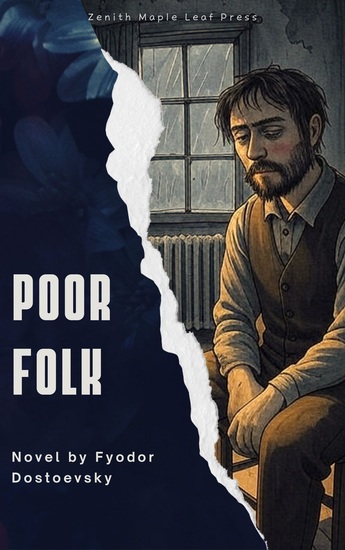
Poor Folk - A Heartfelt Epistolary Novel of Poverty Dignity and the Human Spirit - cover

Poor Folk - A Heartfelt Epistolary Novel of Poverty Dignity and the Human Spirit

Fyodor Dostoevsky, Zenith Maple Leaf Press

Publisher: Zenith Maple Leaf Press

  • 0
  • 0
  • 0

Summary

Two souls bound by letters, love, and hardship.
In Poor Folk, Fyodor Dostoevsky's debut novel, the struggles of poverty are brought vividly to life through an intimate exchange of letters between Makar Devushkin, a humble government clerk, and Varvara Dobroselova, a young woman facing her own trials. Through their correspondence, we witness a tender friendship—and possibly love—blossoming in the shadow of social inequality.

First published in 1846, Poor Folk earned Dostoevsky immediate acclaim and introduced the compassion, psychological insight, and social awareness that would define his later masterpieces. This deeply human story captures the dignity, resilience, and quiet tragedies of everyday life among Russia's poor.

"The novel that announced Dostoevsky's genius to the world."
– The Guardian

"A compassionate and timeless portrait of the human condition."
– The New York Times

✅ Why Readers Love It:
💌 Told entirely through moving personal letters

🇷🇺 A touching glimpse into 19th-century Russian life

📚 Dostoevsky's remarkable literary debut

🎯 Click 'Buy Now' to discover the heartfelt story that began Dostoevsky's journey as one of literature's greatest voices.
Available since: 08/12/2025.
Print length: 133 pages.


Other books that might interest you

  • Tristram Shandy - cover

    Tristram Shandy

    Laurence Sterne

    • 0
    • 0
    • 0
    "Tristram Shandy" is a satirical and comedic novel that explores the life and adventures of its protagonist, Tristram Shandy. The narrative is characterized by its unconventional structure, including extensive digressions, metafictional elements, and a playful engagement with the reader. The novel is considered a groundbreaking work in the development of the English novel and is known for its wit, humor, and innovative narrative techniques.
    Show book
  • Diary of a Lunatic - From their pens to your ears genius in every story - cover

    Diary of a Lunatic - From their...

    Leo Tolstoy

    • 0
    • 0
    • 0
    Leo Tolstoy was born in 1828 in the Russian province of Tula to a wealthy noble family. As a child, he had private tutors but he showed little interest in any formal education. When he went to the University of Kazan in 1843 to study oriental languages and law, he left without completing his courses.  Life now was relaxed and idle but with some writing also taking place.  Gambling debts forced an abrupt change of path and he joined the army to fight in the Crimean War.  He was commended for his bravery and promoted but was appalled at the brutality and loss of life.  He recorded these and other earlier experiences in his diaries which formed the basis of several of his works. 
    In 1852 ‘Childhood’ was published to immediate success and was followed by ‘Boyhood’ and ‘Youth’. 
    His experience in the army and the horrors he witnessed resulted in ‘The Cossacks’ in 1862 and the trilogy ‘Sevastopol Tales’. After the war he travelled around Europe, visiting London and Paris and meeting such luminaries as Victor Hugo and Charles Darwin.  
    It was now that Tolstoy began his masterpiece, ‘War and Peace’. Published in 1869 it was an epic work that changed literature. He quickly followed this with ‘Anna Karenina’.  
    These successes made Tolstoy rich and helped him accomplish many of his dreams but also brought problems as he grappled with his faith and the lot of the oppressed poor. These revolutionary views became so popular that the authorities now kept him under surveillance.  
    He led a life of asceticism and vegetarianism and put his socialist ideals into practice by establishing numerous schools for the poor and food programmes. He also believed in giving away his wealth, which caused much discord with his wife.  
    His writing continued to bring forth classics such as ‘The Death of Ivan Ilyich’ and many brilliant and incisive short stories such as ‘How Much Land Does A Man Need’.  
    In 1901 Tolstoy was excommunicated from the Church and controversially deselected for the Nobel Prize for Literature. 
    Whilst undertaking a pilgrimage by train in October 1910 with his daughter Aleksandra he caught pneumonia in the nearby town of Astapovo.  Leo Tolstoy died on November 9th, 1910, he was 82.
    Show book
  • MS Found In A Bottle - cover

    MS Found In A Bottle

    Edgar Allan Poe

    • 0
    • 0
    • 0
    MS. Found In A Bottle is an adventure short story by Edgar Allan Poe that first appeared in the May 1833 edition of Baltimore Saturday Visiter. The plot follows an unnamed narrator at sea who finds himself in a series of harrowing circumstances. As he nears his own disastrous death while his ship drives ever southward, he writes an "MS.", or manuscript, telling of his adventures which he casts into the sea. Some critics believe the story was meant as a satire of typical sea tales.
    Show book
  • Love of Life - cover

    Love of Life

    Jack London

    • 0
    • 0
    • 0
    Jack London — a writer whose works are enthusiastically read all over the world. His collection "Love of Life" is one of the brilliant pearls of his Northern stories cycle. Alaska is the place where each person should reveal their own real features. The North makes equal the poor and the rich; the intense cold does not take into account the infirmity; harsh, biting wind is indifferent to the social status, and a wild beast does not discriminate between social standings. In the confrontation with the severe nature, the heroes of the adducted works vanquish not only thanks to their courage, endurance, energy, but first and foremost, due to the strength of mind, an obsession with life, the capability even in the extreme situations to remain a Human.
    Show book
  • Bartleby the Scrivener (Unabridged) - cover

    Bartleby the Scrivener (Unabridged)

    Herman Melville

    • 0
    • 0
    • 0
    The tale is one of the final works of fiction published by Melville before, slipping into despair over the continuing critical dismissal of his work after Moby-Dick, he abandoned publishing fiction. The work is presented here exactly as it was originally published in Putnam's magazine to, sadly, critical disdain.
    Show book
  • The Man of the Crowd - cover

    The Man of the Crowd

    SAMPI Books, Edgar Allan Poe

    • 0
    • 0
    • 0
    In "The Man of the Crowd" by Edgar Allan Poe, the narrator becomes obsessed with following a mysterious old man through the bustling streets of London, intrigued by his enigmatic presence. This pursuit reveals the complexity of human nature and the impenetrability of urban anonymity.
    Show book