Join us on a literary world trip!
Add this book to bookshelf
Grey
Write a new comment Default profile 50px
Grey
Subscribe to read the full book or read the first pages for free!
All characters reduced
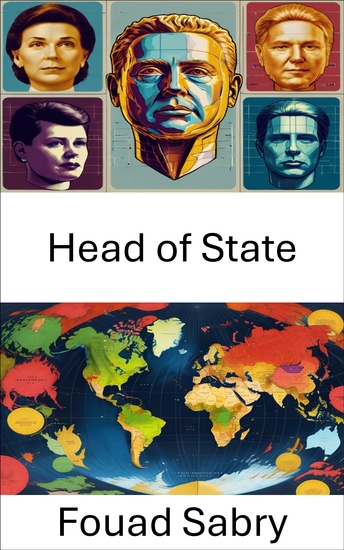
Head of State - Understanding the Role and Influence of National Leaders - cover

Head of State - Understanding the Role and Influence of National Leaders

Fouad Sabry

Publisher: One Billion Knowledgeable

  • 0
  • 0
  • 0

Summary

What is Head of State?
 
Head of State delves into the apex of political power, exploring the roles, powers, and functions of the highest office in various political systems. It examines the influence of this position on governance, diplomacy, and national identity, providing readers with a clearer understanding of global politics and the structures that shape executive leadership.
 
Overviews:
 
1: Head of State – Learn the core concept of the head of state and its key role in leadership.
 
2: Constitutional Monarchy – Explore how tradition meets governance in constitutional monarchies.
 
3: Prime Minister – Understand the intersection of the prime minister's role with the head of state.
 
4: President (Govt Title) – Discover the global variations of the president’s role and authority.
 
5: Separation of Powers – Learn about how governments balance power to prevent abuses.
 
6: Westminster System – Explore how the Westminster model influences many democracies.
 
7: Head of Government – Differentiate the distinct roles of head of state and head of government.
 
8: Veto – Investigate how veto power serves as a legislative check.
 
9: Parliamentary System – Understand how heads of state function in parliamentary frameworks.
 
10: Presidential System – Explore the independent authority of the president in such systems.
 
11: President of India – Case study of a non-executive head of state with key constitutional duties.
 
12: Reserve Power – Uncover discretionary powers of heads of state in extraordinary cases.
 
13: Commander-in-Chief – Learn about heads of state’s military roles ensuring national security.
 
14: List of Countries by System of Government – Compare governmental systems across nations.
 
15: President of Sri Lanka – Case study of a semi-presidential head of state.
 
16: Australian Government – Explore Australia’s federal system and its head of state’s role.
 
17: Parliamentary Republic – Investigate the symbolic but important role of the head of state.
 
18: African Union Member States – Review the diverse political systems of the African Union.
 
19: Constitution of Armenia – Study Armenia’s hybrid political system and its head of state.
 
20: Non-Sovereign Monarchy – Understand the position of heads of state in non-sovereign monarchies.
 
21: Semi-Parliamentary System – Discover systems where executive power is shared.
 
Who is this book for?
 
This book is perfect for professionals, students, and enthusiasts in political science. It offers advanced insights into executive leadership, enhancing understanding of how heads of state shape governance worldwide.
Available since: 09/22/2024.
Print length: 465 pages.
Other books that might interest you

  • Toni Morrison: A short biography - 5 Minutes: Short on time - long on info! - cover

    Toni Morrison: A short biography...

    5 Minutes, 5 Minute Biographies,...

    • 0
    • 0
    • 0
    Toni Morrison, Nobel prize laureate and exceptional writer: Life and works in a short biography! Everything you need to know, brief and concise. Infotainment, education and entertainment at its best!
    Show book
  • French History - Events during the Period of the Gauls and the Huguenots - cover

    French History - Events during...

    Kelly Mass

    • 0
    • 0
    • 0
    This is a combo of 2 books, which are the following: 
    1, the Gauls: This is a book about a people that has often been overlooked. Wallowing in the shadow of the seemingly almighty Romans, and dispersed throughout the ages into other peoples, the Gauls appear as if they had nothing going for them. Quite the opposite is true. The Gauls had a distinct culture, with habits, warfare, and so much more to offer to the intrigued historian and everyday researcher. 
    Throughout the Iron Age and the Roman period, the Gauls were a collection of Celtic tribes from Continental Europe (circa from the fifth century BC to the fifth century advertisement). Gaul was the name of the area where they used to live. Their Gaulish language is the significant branch of the Celtic languages of the continent. 
    2, the Huguenots: An important chapter in history is that in which the Catholic Church was being questioned by the commoners. People were standing up against tyranny and illogical rules. They had had it with hypocrisy and double standards. The abuse in the church wasn’t representing the text in the Bible. Too much corruption had crept into the clergy, or so the narrative went about across the entire European continent. 
    The Huguenots were a spiritual group of French Protestants who complied with the Reformed, or Calvinist, Protestant custom. The expression originates from the name of a Swiss politician, Genevan burgomaster Bezanson Hugues (from about 1491 - 1532) and was commonly used in Europe by the 16th century. Huguenot was a term used throughout the Protestant Reformation to describe members of the Reformed Church of France. It came from the Dutch “huisgenoten” and was used throughout the revolution that led to the entire Reformation.
    Show book
  • Police Deception and Dishonesty - The Logic of Lying - cover

    Police Deception and Dishonesty...

    Luke William Hunt

    • 0
    • 0
    • 0
    In Police Deception and Dishonesty, Luke William Hunt—a philosophy professor and former FBI special agent—argues that many of our assumptions about policing and security are unjustified. Through a rich discussion of literature and case studies, he shows that there are compelling reasons to think that the police's widespread use of proactive deception and dishonesty is inconsistent with fundamental norms of political morality—especially norms regarding fraud and the rule of law. Although there are times and places for dishonesty and deception in policing, Hunt evocatively illustrates why those times and places should be much more limited than current practices suggest.
    Show book
  • George Washington - The Patriot Who Was the First President of the United States - cover

    George Washington - The Patriot...

    Kelly Mass

    • 0
    • 0
    • 0
    George Washington was an American soldier, statesman, and Founding Father who worked as the nation's first president from 1789 to 1797. Washington was called leader of the Continental Army by the Continental Congress, and he led the Patriot forces to triumph in the American Revolutionary War. 
    He also commanded the Constitutional Convention of 1787, which developed the USA Constitution and a federal government. For his different management throughout the nation's developmental years, Washington has been called the "Father of the Country" 
    George Washington has obviously meant a lot to the United States, to the law, the founding documents, and the expansion of the country. Let’s take a look at his life and his legacy.
    Show book
  • Rare Recording of Ludwig von Mises A - Volume 1 - cover

    Rare Recording of Ludwig von...

    Ludwig Von Mises

    • 0
    • 0
    • 0
    Ludwig Heinrich Edler von Mises (September 29, 1881 - October 10, 1973) was an Austrian–American Austrian School economist, historian, logician, and sociologist. Mises wrote and lectured extensively on the societal contributions of classical liberalism and the power of consumers. He is best known for his work on human behavior studies comparing communism and capitalism.
    Show book
  • War Made Invisible - How America Hides the Human Toll of Its Military Machine - cover

    War Made Invisible - How America...

    Norman Solomon

    • 0
    • 0
    • 0
    More than twenty years ago, 9/11 and the war in Afghanistan set into motion a hugely consequential shift in America's foreign policy: a perpetual state of war that is almost entirely invisible to the American public. War Made Invisible, by the journalist and political analyst Norman Solomon, exposes how this happened, and what its consequences are, from military and civilian casualties to drained resources at home. 


    From Iraq through Afghanistan and Syria and on to little-known deployments in a range of countries around the globe, the United States has been at perpetual war for at least the past two decades. Yet many of these forays remain off the radar of average Americans. Compliant journalists add to the smokescreen by providing narrow coverage of military engagements and by repeating the military's talking points. Meanwhile, the increased use of high technology, air power, and remote drones has put distance between soldiers and the civilians who die. Back at home, Solomon argues, the cloak of invisibility masks massive Pentagon budgets that receive bipartisan approval even as policy makers struggle to fund the domestic agenda. 


    Necessary, timely, and unflinching, War Made Invisible is an eloquent moral call for counting the true costs of war.
    Show book