Begleiten Sie uns auf eine literarische Weltreise!
Buch zum Bücherregal hinzufügen
Grey
Einen neuen Kommentar schreiben Default profile 50px
Grey
Jetzt das ganze Buch im Abo oder die ersten Seiten gratis lesen!
All characters reduced
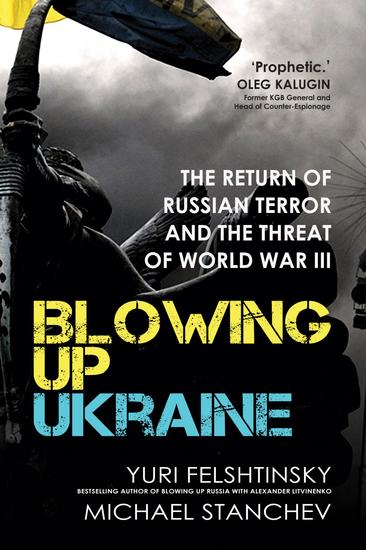
Blowing up Ukraine - The Return of Russian Terror and The Threat of World War III - cover

Blowing up Ukraine - The Return of Russian Terror and The Threat of World War III

Yuri Felshtinsky, Michael Stanchev

Verlag: Gibson Square

  • 0
  • 0
  • 0

Beschreibung

Presciently researched before the invasion of Ukraine, Blowing up Ukraine is the first comprehensive investigation into the lethal methods Russia has used since 1999 to take over Ukraine – culminating in full-blown unprovoked war in 2022 and mounting atrocities. In this chilling, riveting and alarming narrative the authors cite ample evidence, draw historical analogies, and marshal sources that are new, little known, or anonymous by necessity.Over twenty years, Vladimir Putin skilfully manipulated Ukraine's self-serving politicians and oligarchs, only to be thwarted time and again by peaceful revolutions of ordinary Ukrainians – the Maidan – against government corruption and being pushed into Russia's arms. As Putin became obsessed with conquering Ukraine, Blowing up Ukraine shows how the Kremlin has become a threat to global stability and Ukraine is almost certain to be the first battleground of World War III if the West is not careful to take a stance
Verfügbar seit: 12.07.2022.
Drucklänge: 304 Seiten.

Weitere Bücher, die Sie mögen werden

  • Puzzles and Conundrums - The Ultimate Historical Riddles Explained (4 in 1) - cover

    Puzzles and Conundrums - The...

    John Harpoon

    • 0
    • 0
    • 0
    This book is a bundle of several titles which are: 
    - Dawn's Dilemma: Waking up in the morning is supposed to be a fresh start—a chance to begin anew, to seize the day. But for many, it is instead a moment of resistance, a time when the comfort of the bed feels more appealing than the promise of a productive day ahead. This paradox, where the desire to be productive and successful clashes with the reluctance to rise from sleep, is at the heart of what I call the "Awakening Paradox." 
    - The Ultimate Enigma: The story of this enigma begins with a seemingly ordinary event that spiraled into an extraordinary mystery, captivating the minds of people across the globe. What started as an unexplained disappearance soon transformed into one of the most perplexing and widely discussed mysteries in recorded history. The vanishing of this individual—or object, depending on the version of the story one hears—left behind only traces of confusion, a scattering of evidence, and no clear answers. 
    - The Emperor's Edge: Napoleon Bonaparte's journey from a modest Corsican background to one of history's greatest military leaders is nothing short of remarkable. Born on August 15, 1769, in Ajaccio, Corsica, a French territory that had only recently been acquired from the Genoese, Napoleon’s early years were shaped by the turbulent political climate of his homeland.  
    - The Shadow Agents: Covert operations are a cornerstone of modern intelligence and national security strategies. They are defined by their secrecy and the fact that they are often conducted in a manner that prevents any overt acknowledgment of their existence. In essence, covert operations are activities undertaken by government agencies, intelligence services, or other organizations to influence events or gather information while keeping their involvement hidden from the public eye.
    Zum Buch
  • Summary: A People's History of the United States - by Howard Zinn: Key Takeaways Summary & Analysis Included - cover

    Summary: A People's History of...

    Brooks Bryant

    • 0
    • 0
    • 0
    Disclaimer: This is not the official book, but a summary & it does not accompany the official. 
    As you delve into our concise summary of Zinn's monumental work, you will navigate through the turbulent waters of America's history, encountering narratives of resistance, activism, and the fierce struggle for justice and equality. We uncover stories seldom told, spotlighting individuals and movements that challenged the status quo and fought valiantly against oppression and inequality. 
    Our summary accentuates Zinn's commitment to a history that is a source of inspiration, not just a recounting of past events but a living document that resonates in today's society. It challenges readers to question the accepted narratives and to understand that history is not just the story of the victors, but a tapestry woven with the countless stories of everyday people. 
    Join us in exploring a vibrant and starkly different perspective on American history, where the voiceless get a voice and the unsung heroes take the center stage. It is not just a recounting of history; it is a call to consciousness, an invitation to rethink the past, and to forge a future that is inclusive, just, and fair.
    Zum Buch
  • Why Trust Is Dying and What We Can Do About It - "Transform Your Perspective on Trust! Unlock powerful audio lessons that illuminate solutions to pressing concerns" - cover

    Why Trust Is Dying and What We...

    Arden Carrington

    • 0
    • 0
    • 0
    Why Trust Is Dying and What We Can Do About It 
    ⭐⭐ A Simplified Guide with Insights and Explanations ⭐⭐ 
    Are you eager to advance your career and deepen your understanding of trust in today's society? 
    Searching for a comprehensive resource that offers everything you need to foster trust and transform your relationships? 
    Look no further! 
    This guide is your ultimate companion for enhancing your knowledge, applying practical techniques, and engaging in meaningful exercises. With it, you're prepared to make a significant impact. 
    Updated to reflect the latest insights on trust in 2024. 
    Key Features of This Enhanced Guide: 
    - In-depth exploration of trust and its implications for personal and professional growth 
    - Detailed discussions about the dynamics of trust in various contexts 
    - Effective strategies for building and sustaining trust in relationships 
    Our guide stands out through its thorough examination of critical concepts, ensuring you don’t just skim the surface but truly understand the underlying principles. 
    Please note that this guide operates independently and is not affiliated with any official entity. 
    Crafted with a clear structure and accessible language, our guide ensures smooth transitions across topics. Say farewell to complicated jargon and embrace clear, concise, and accurate content. 
    So, why delay? Click the BUY NOW button, secure your copy, and embark on your journey to understanding and reviving trust in 2024!
    Zum Buch
  • Arthashastra or The Playbook of Material Gain - Pragmatic and amoral tips on how to gain defend and expand power from India’s greatest philosopher - cover

    Arthashastra or The Playbook of...

    Chanakya

    • 0
    • 0
    • 0
    Truly radical "Machiavellianism", in the popular sense of that word, is classically expressed in Indian literature in the Arthashastra of Kautilya (written long before the birth of Christ, ostensibly in the time of Chandragupta): compared to it, Machiavelli's The Prince is harmless.— Max Weber, Politics as a Vocation (1919)Chanakya's treatise, written while turning a farmhand into the emperor of the largest empire India had ever seen, focuses on how to manage an empire, covering everything from domestic policy and personal rights to assassination and the dirtier arts of politics. This is not, as with Plato’s Republic, a work of theory. Chanakya’s guidance is entirely practical, and is based on both his education and his experience building an empire. It lacks the philosophical ponderings and moralizing of its equivalent Western works (such as The Prince, The Republic or Leviathan) and instead focuses on how one deals with the messiness of the world in practice.People will occasionally refer to Chanakya as an Indian Machiavelli, but this does some discredit to Chanakya. The Prince is a satire, and focused around exposing the tactics and inhumanity of Cesare Borgia. Arthashastra is a manual for every aspect of statecraft, and while it deals in the unethical it does so only because that is, after all is said and done, one of the options available to a ruler.If you're after a totally pragmatic analysis of leadership, stripped of moralising and focused on what works and how to deal with real-world issues, this is the book for you.
    Zum Buch
  • The Ethiopian Great Famine of 2000 - A Modern Humanitarian Crisis - cover

    The Ethiopian Great Famine of...

    Sarah Willards

    • 0
    • 0
    • 0
    The Ethiopian Great Famine of 2000 was not an isolated event, but rather the culmination of a complex and interconnected set of factors rooted in the country's historical, environmental, and political landscape. To understand the origins of this crisis, it is essential to look back at Ethiopia’s long history of food insecurity and vulnerability to famine. While droughts have long been a natural part of Ethiopia’s climate cycles, the frequency and impact of famine have often been magnified by human elements, particularly governance and socio-economic structures. 
    In the years leading up to 2000, Ethiopia experienced several severe droughts, but the early signs of the looming crisis were evident by the late 1990s. Climatic shifts, including the failure of critical rainy seasons, devastated crop yields and dried up grazing lands, particularly in the country's eastern and southern regions. For a population heavily dependent on subsistence agriculture, these environmental changes meant immediate food shortages and a rapid decline in household resilience. What might have remained a regional hardship quickly evolved into a nationwide emergency due to the lack of sufficient preventative action. 
    Government response in the early stages was slow and limited by bureaucratic challenges and political distractions, including the aftermath of the Ethiopia-Eritrea war that ended in 2000. Resources were stretched thin, and infrastructure remained underdeveloped, particularly in rural areas where the famine was most severe. Early warning systems existed but were either underutilized or their signals ignored, contributing to the delayed mobilization of aid. The country’s centralization of power also complicated coordination with local authorities, which further hindered rapid intervention efforts.
    Zum Buch
  • Killing Kennedy: - Exposing the Plot the Cover-Up and the Consequences - cover

    Killing Kennedy: - Exposing the...

    Jack Roth

    • 0
    • 0
    • 0
    Startling new insights into the JFK assassination 
    In Killing Kennedy: Exposing the Plot, the Cover-Up, and the Consequences, author Jack Roth interviews researchers, scholars, eyewitnesses, and family members of those who were part of the tangled web of US intelligence operations associated with the Cold War and the circumstances surrounding the assassination of John F. Kennedy. The author asks important questions, including why the assassination still matters today and what the lasting ripple effects have been since that fateful day. 
     The Kennedy assassination represents one of the most impactful events in not only American but also world history, and this book represents an important addendum to understanding its enduring significance. On November 22, 1963, the duly elected president of the United States was murdered in cold blood, forever destroying “Camelot” and national optimism for world peace. 
     Gleaning a “people’s history” of the assassination through dozens of insightful and heartfelt interviews, Roth presents a riveting narrative by creating a respectful, well-crafted, and emotionally charged book from which both older and younger generations will gain a greater understanding of our nation’s history and current status in the modern world. 
     
    Zum Buch