

Junte-se a nós em uma viagem ao mundo dos livros!
Adicionar este livro à prateleira
Grey
Deixe um novo comentário Default profile 50px
Grey
Assine para ler o livro completo ou leia as primeiras páginas de graça!
All characters reduced
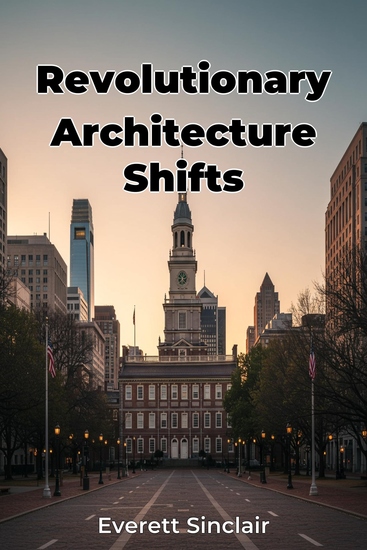
Revolutionary Architecture Shifts - cover
LER

Revolutionary Architecture Shifts

Everett Sinclair

Tradutor A AI

Editora: Publifye

  • 0
  • 0
  • 0

Sinopse

Revolutionary Architecture Shifts explores the profound relationship between political revolutions and architectural design in late 18th-century Paris, London, and Philadelphia. It examines how revolutionary ideals of liberty, equality, and fraternity manifested in urban planning, public buildings, and symbolic design. The book reveals how architecture served as a powerful tool for shaping political ideology and establishing national identity during a period of immense social and intellectual change, such as the Enlightenment. For instance, neoclassical architecture, with its emphasis on order and reason, became a visual representation of these new political concepts. The book uniquely juxtaposes architectural developments in these three distinct cities to highlight the contrasting ways that universal Enlightenment ideals were adapted across different revolutionary contexts.

 
Beginning with an overview of neoclassical architecture and Enlightenment thought, the book dedicates individual sections to Paris, London, and Philadelphia, analyzing specific architectural projects and urban planning initiatives within each city. It culminates in a comparative analysis, highlighting both the common threads and unique divergences in how each city used architecture to reflect its political transformation and to shape its civic identity.
Disponível desde: 25/02/2025.
Comprimento de impressão: 62 páginas.

Outros livros que poderiam interessá-lo

  • The Hour of the Predator - Encounters with the Autocrats and Tech Billionaires Taking Over the World - cover

    The Hour of the Predator -...

    Giuliano da Empoli

    • 0
    • 0
    • 0
    How do you defend democracy when the rules have changed?
    Presidents turning into monarchs. Tech tycoons and autocrats intent on global regime change. Armies of cyber trolls.
    The old order is at an end. The Hour of the Predator has come.
    Former political advisor Giuliano da Empoli takes us on an insider's journey through this new geopolitical reality, from the Glass Palace of the UN to the Riyadh Ritz-Carlton, from top secret meetings to violent power struggles. We encounter dictators and tyrants, strongmen and AI billionaires - geopolitical predators, and the flailing leaders who desperately try to appease them.
     
    Just as in the age of the Borgias or the conquistadors, cynical scheming and brute force increasingly determine the course of international affairs. This is an urgent guide to our new world, and our uncertain future.
    Ver livro
  • William Turner: A short biography - 5 Minutes: Short on time – long on info! - cover

    William Turner: A short...

    5 Minutes, 5 Minute Biographies,...

    • 0
    • 0
    • 0
    William Turner, English painter and inventor of the abstract: Life and work in a short biography! Everything you need to know, brief and concise. Infotainment, education and entertainment at its best!
    Ver livro
  • Grateful Living Feeling Joy in the moment Course Coaching session healing meditations & hypnosis session - conscious awareness everyday growth joy living in the now thankfulness true happiness - cover

    Grateful Living Feeling Joy in...

    Love, And, Bloom

    • 0
    • 0
    • 0
    It is easy for us to catch up on the past or in the future. We often forgot to take time to appreciate the wondering things happening in our daily lives. When your thoughts are constantly in the past or future, you feel more anxious, fearful, or restless. When you appreciate and live in the moment, you give yourself room to receive joy love, and abundance. 
    In this course, we will be your personal coach. We use coaching sessions, and healing meditations to help you be more grateful and stay in the present moment. We let go of any toxic thoughts in your mind through our therapeutic coaching session. We deeply forgive the past and give room for our wonderful future. We take our time to stay in the present moment and be grateful for what we have 
    In this course, we willLet go of toxic thoughtBe your personal coachBring you back from the past to the present momentLet go of anxiousnessDeeply forgive yourself & othersLetting goAnchor your frequencies into gratefulnessSimply live in the momentAnd much more
    Ver livro
  • How to Have a Life - An Ancient Guide to Using Our Time Wisely - cover

    How to Have a Life - An Ancient...

    Seneca

    • 0
    • 0
    • 0
    A vibrant new translation of Seneca's "On the Shortness of Life," a pointed reminder to make the most of our time 


    Who doesn't worry sometimes that smart phones, the Internet, and TV are robbing us of time and preventing us from having a life? How can we make the most of our time on earth? In the first century AD, the Stoic philosopher Seneca the Younger offered one of the most famous answers to that question in his essay "On the Shortness of Life"—a work that has more to teach us today than ever before. In How to Have a Life, James Romm presents a vibrant new translation of Seneca's brilliant essay, plus two Senecan letters on the same theme, complete with an inviting introduction. 


    With devastating satiric wit, skillfully captured in this translation, Seneca lampoons the ways we squander our time and fail to realize how precious it is. We don't allow people to steal our money, yet we allow them to plunder our time, or else we give it away ourselves in useless, idle pursuits. Seneca also describes how we can make better use of our brief days and years. In the process, he argues, we can make our lives longer, or even everlasting, because to live a real life is to attain a kind of immortality.
    Ver livro
  • Crazies to the Left of Me Wimps to the Right - How One Side Lost Its Mind and the Other Lost Its Nerve - cover

    Crazies to the Left of Me Wimps...

    Anônimo

    • 0
    • 0
    • 0
    In Crazies to the Left of Me, Wimps to the Right, Goldberg speaks for the millions of Americans who are saying: Enough! Enough of lunatics like Rosie O'Donnell who think ""Radical Christianity"" is ""as big a threat to America as Radical Islam."" Enough of the hyperbolic liberal rhetoric comparing Bush to Hitler and Abu Ghraib to a Saddam Hussein torture chamber. And please, enough of the military-hating crazies who run San Francisco!  
    But Goldberg has also had it with hypocritical Republicans who say they're for small government but then spend our hard-earned tax money like Imelda Marcos in a shoe store. He's also had it with weak and timid Republicans who won't stand up and fight against racial preferences, too afraid that the Al Sharptons and Jesse Jacksons of the world will call them bigots. In plain English, he's had it with Republicans who are afraid to be conservative! The 2006 election was a wake-up call, he warns, and if the wimps on the Right fail to regain their courage, recover their principles, and reclaim their sense of fiscal responsibility, the crazies on the Left just might win the White House in 2008.
    Ver livro
  • Egyptian Science and Technology - Innovations of the Ancient World - cover

    Egyptian Science and Technology...

    Omar Khalil

    • 0
    • 0
    • 0
    Ancient Egypt, renowned for its monumental architecture and sophisticated culture, was also a hub of intellectual and scientific advancements. At the heart of Egyptian knowledge was a unique blend of practical experience, religious beliefs, and cultural traditions. Understanding the foundations of their knowledge requires examining the interplay between mythology, early scientific thought, and the ways this knowledge was transmitted through generations. 
    The role of religion and mythology in ancient Egypt cannot be overstated. Egyptian cosmology deeply influenced how people understood the world around them. Deities associated with creation, the afterlife, and natural phenomena shaped the Egyptians' perception of science and technology. For example, the god Thoth was believed to be the deity of wisdom, writing, and mathematics, and his influence permeated educational practices. Priests and scribes, who were often part of temple schools, acted as custodians of this sacred knowledge. Their training combined religious teachings with practical subjects like astronomy, mathematics, and medicine. 
    Early scientific thought in ancient Egypt was pragmatic rather than theoretical. Egyptians were skilled observers, and much of their knowledge arose from practical problem-solving. Whether it was calculating the Nile's flooding patterns or designing complex irrigation systems, their science emerged from the need to manage everyday challenges. For instance, their understanding of geometry developed out of the necessity to remeasure fields after the annual inundation of the Nile. Similarly, medical practices were rooted in practical observations of ailments and their treatments, blending empirical knowledge with spiritual beliefs.
    Ver livro
