

Join us on a literary world trip!
Add this book to bookshelf
Grey
Write a new comment Default profile 50px
Grey
Subscribe to read the full book or read the first pages for free!
All characters reduced
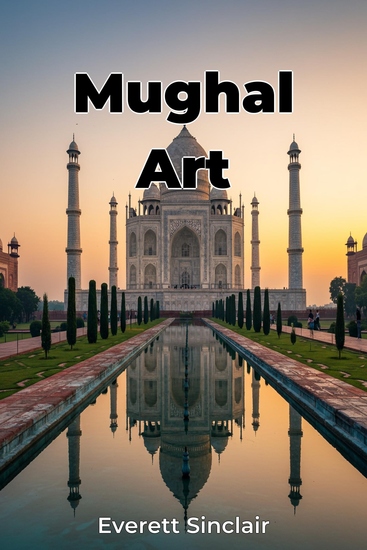
Mughal Art - cover

Mughal Art

Everett Sinclair

Translator A AI

Publisher: Publifye

  • 0
  • 0
  • 0

Summary

"Mughal Art" explores the rich artistic and architectural legacy of the Mughal Empire, revealing how art served as a powerful statement of imperial authority, cultural identity, and religious vision. The book examines the fusion of Persian, Islamic, and Indian styles that defined Mughal artistic expression. The book uniquely synthesizes art historical analysis with cultural and historical context. Mughal painting, particularly miniature painting, served as a crucial medium for documenting court life and illustrating historical events, providing insights into the Mughal worldview. The book argues that the Mughals used art to legitimize their rule and project an image of divinely ordained rulers. 

 
The book progresses by first introducing the historical context of the Mughal Empire. It then delves into three key areas: architecture, painting, and gardens. Each chapter explores the evolution and significance of these art forms, from the grand structures like the Taj Mahal to the intricate details of miniature paintings and the symbolic design of Mughal gardens. Finally, the book examines the decline of the Mughal Empire and its lasting legacy on subsequent artistic movements.
Available since: 03/20/2025.
Print length: 53 pages.

Other books that might interest you

  • Pharus II - Landscapes and Photographic Fictions - cover

    Pharus II - Landscapes and...

    Matilde Marín

    • 0
    • 0
    • 0
    Matilde Marín in Pharus II. Landscapes and Photographic Fictions again embarks on a visual journey that documents and recreates lighthouses of the world. This work illuminates with reddish tones the lighthouses that are the return home - in the reverse journey to Pharus. From the southern hemisphere to the north - now the artist goes from Iceland to the southernmost south of Argentina. In this displacement with documentary images and fictional landscapes Marín presents lighthouses that are not only physical guides at sea, but by their visuality now reveal spaces of fascination and are the occasion to imagine new narratives that revitalise these symbols of memory and history. Laura Malosetti Costa expresses that the lighthouses evoke concepts and narratives such as those of the voyage, shipwreck, tragedy, and are the result of both the artist's experiences and her literary readings. Adriana Musitano analyses the abyssal settings that partially duplicate the lighthouses in their reflections and observes that Marín astonishes with images that create a utopian space by creating photographic fictions that link the landscape of the Salinas Grandes of Argentina with faraway places. The lighthouses and constellations in this ebook illuminate our planet and the planisphere shows them in relation to the cardinal points, seas and continents. Marín narrates his return home and also his trip to Egypt, when he learns about the place where the first lighthouse was, Alexandria. The Lighthouses of affection are added, with photographs of her friends, remembering her.
    Show book
  • Most Dramatic Ever: The Bachelor - cover

    Most Dramatic Ever: The Bachelor

    Suzannah Showler

    • 0
    • 0
    • 0
    The right reasons to fall in love with The Bachelor When it debuted in 2002, The Bachelor raised the stakes of first-wave reality television, offering the ultimate prize: true love. Since then, thrice yearly, dozens of camera-ready young-and-eligibles have vied for affection (and roses) in front of a devoted audience of millions. In this funny, insightful examination of the world’s favorite romance-factory, Suzannah Showler explores the contradictions that are key to the franchise’s genius, longevity, and power and parses what this means for both modern love and modern America. She argues the show is both gameshow and marriage plot ― an improbable combination of competitive effort and kismet ― and that it’s both relic and prophet, a time-traveler from first-gen reality TV that proved to be a harbinger of Tinder. In the modern media-savvy climate, the show cleverly highlights and resists its own artifice, allowing Bachelor Nation to see through the fakery to feel the romance. Taking on issues of sex, race, contestants-as-villains, the controversial spin-offs, and more, Most Dramatic Ever is both love letter to and deconstruction of the show that brought us real love in the reality TV era.
    Show book
  • The Velvet Underground's The Velvet Underground and Nico - cover

    The Velvet Underground's The...

    Joe Harvard

    • 0
    • 0
    • 0
    The Velvet Underground and Nico has influenced the sound of more bands than any other album. And remarkably, it still sounds as fresh and challenging today as it did upon its release in 1967. In this book, Joe Harvard covers everything from Lou Reed's lyrical genius to John Cale's groundbreaking instrumentation, and from the creative input of Andy Warhol to the fine details of the recording process. With input from co-producer Norman Dolph and Velvets fan Jonathan Richman, Harvard documents the creation of a record which - in the eyes of many - has never been matched.
    Show book
  • Curationism - How Curating Took Over the Art World and Everything Else - cover

    Curationism - How Curating Took...

    David Balzer

    • 0
    • 0
    • 0
    Now that we 'curate' even lunch, what happens to the role of the connoisseur in contemporary culture?
       
    ‘Curate’ is now a buzzword, applied to everything from music festivals to artisanal cheese. Inside the art world, the curator reigns supreme, acting as the face of high-profile group shows and biennials in a way that can eclipse and assimilate the contributions of individual artists. Curatorial-studies programs continue to grow, and the business world is adopting curation as a means of adding value to content. Everyone, it seems, is a curator.
       
    But what is a curator, exactly? And what does the explosive popularity of curating say about our culture’s relationship with taste, labour and the avant-garde? In this vibrant, revelatory and original study, David Balzer travels through art history and around the globe to explore the cult of curation, from superstar curator Hans Ulrich Obrist’s war with sleep to Subway’s ‘sandwich artists.’ Recalling such landmark works of cultural criticism as Tom Wolfe’s The Painted Word and John Berger’s Ways of Seeing, Curationism will change the way you look at art – and maybe even the way you see yourself.
       
    ‘This is an unusual art book. It is a book you should read and one that you can. Balzer traces the history and current hegemony of curationism, a practice of jumped-up interior decorators who double as priests explaining the gospel to the unlettered masses. A good read, if you don’t mind reading things that you don’t want to know.’
       
    – Dave Hickey
    Show book
  • Asadah All about her Business - cover

    Asadah All about her Business

    Asadah Carpenter

    • 0
    • 0
    • 0
    Asadah is all excited and ambitious about starting her own business of lip gloss. She works on it day in and day out to make its quality stand out. Her parents believed in her and support this dream of hers to come true. With the help of her parents, Asadah is able to complete all formalities and start her company. Asadah found what she wants to do in her life and she's happy.
    Show book
  • Southern Indian Kingdoms - Dynasties of the Deccan (3 in 1) - cover

    Southern Indian Kingdoms -...

    Rolf Hedger

    • 0
    • 0
    • 0
    The southern Indian kingdoms played a crucial role in shaping the history and culture of the subcontinent. Among them, the Chera, Chola, and Pandya dynasties stood out for their military power, economic influence, and contributions to art and literature.  
    The Chera Dynasty, known for its control over important trade routes, established strong maritime links with Rome, China, and Southeast Asia.  
    The Chola Empire, one of the most formidable powers of medieval India, expanded its influence beyond the Indian subcontinent, boasting a powerful navy and an advanced administrative system.  
    The Pandya Empire, with its deep roots in Tamil culture, was known for its patronage of Sangam literature and its strategic dominance over key trade centers. These dynasties not only shaped the political landscape of southern India but also contributed to its rich artistic, architectural, and literary heritage. Through their extensive trade networks and cultural achievements, the Cheras, Cholas, and Pandyas left an enduring legacy that continues to influence South Indian traditions today.
    Show book
