Join us on a literary world trip!
Add this book to bookshelf
Grey
Write a new comment Default profile 50px
Grey
Subscribe to read the full book or read the first pages for free!
All characters reduced
Egyptian Obelisks Transport - cover

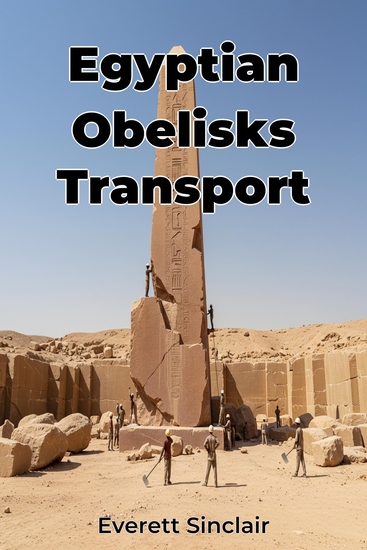
Egyptian Obelisks Transport

Everett Sinclair

Translator A AI

Publisher: Publifye

  • 0
  • 0
  • 0

Summary

Egyptian Obelisks Transport explores the remarkable engineering feats behind the creation of ancient Egyptian obelisks. These monolithic monuments, some weighing hundreds of tons, were quarried, transported, and erected using techniques that continue to fascinate historians and engineers alike. The book uncovers how the ancient Egyptians mastered quarrying techniques without modern machinery, including the use of dolerite tools to extract stone. It further investigates the sophisticated transportation methods employed to move these colossal structures across land and water, revealing the organizational prowess required for such massive undertakings.

 
The book’s approach is structured, beginning with an introduction to obelisks within Egyptian architecture and religion. It then details quarrying operations, followed by an analysis of transportation logistics, erection techniques, and finally, an examination of the symbolism of obelisks. By examining archaeological evidence, historical texts, and recent experimental findings, the book highlights the religious and political significance of obelisks, emphasizing their connection to pharaonic power and their lasting impact on the Egyptian landscape.

 
The successful construction of obelisks reflects the advanced nature of ancient Egyptian civilization and their sophisticated understanding of engineering principles.
Available since: 03/04/2025.
Print length: 53 pages.
Other books that might interest you

  • Life-Changing Cross-Cultural Friendships - How You Can Help Heal Racial Divides One Relationship at a Time - cover

    Life-Changing Cross-Cultural...

    Gary Chapman, Clarence Shuler

    • 0
    • 0
    • 0
    Read by the authors. 
    We can heal our communities--one friendship at a time. 
    Everyone wants to do something to improve race relations, but many of us don't know where to start. In Life-Changing Cross-Cultural Friendships, lifelong friends Gary Chapman and Clarence Shuler will show you how. Through important lessons they have learned, you will learn how to begin and grow authentic friendships across racial and ethnic barriers. 
    Each chapter will guide you toward deeper understanding of what it takes to foster cross-cultural friendships. These powerful lessons include:How to overcome the fear of developing cross-cultural friendshipsHow to differentiate true friends from mere acquaintancesHow Jesus initiated cross-cultural relationshipsThe first two steps to your own cross-cultural friendshipThree ways to resolve conflict in a cross-cultural friendshipHow to make friendships last a lifetime 
    Chapman and Shuler challenge every reader to join a movement, the Cross-Cultural Friendship Challenge, and begin changing the world one friendship at a time. 
    Reflection questions are included in the audiobook companion PDF download.
    Show book
  • Being Cosmopolitan - A Political Approach - cover

    Being Cosmopolitan - A Political...

    Luke Ulas

    • 0
    • 0
    • 0
    What does it mean to be cosmopolitan? Typically, cosmopolitanism is understood as a broad moral orientation, involving some kind of commitment to global moral equality. On this understanding, to be cosmopolitan is simply to evidence that moral orientation oneself. By contrast, Being Cosmopolitan takes up a thoroughly political approach. The focus is on what it might mean, and what it is like, to be political in a distinctly cosmopolitan form. What it means to be cosmopolitan in this thoroughly political sense cannot involve appeal to any particular moral orientation, because politics is about, inter alia, the contestation of such orientations and commitments. Instead, this book offers an account that is based upon the internalization of particular kind of global "social imaginary," involving the imagination of a global public to which certain issues—or global public affairs—are understood to pertain. 


    Within which kind of global order is it possible, or comfortable, for a cosmopolitical agent to live? In answer to this question, the book argues against the viability of both a world of self-determining peoples, and of "pluralist" global visions—both of which are popular with moral cosmopolitan theorists.
    Show book
  • Carrie Kills A Man - A Memoir - cover

    Carrie Kills A Man - A Memoir

    Carrie Marshall

    • 0
    • 0
    • 0
    Carrie Kills A Man* is about growing up in a world that doesn't want you, and about how it feels to throw a hand grenade into a perfect life. It's the story of how a tattooed transgender rock singer killed a depressed suburban dad, and of the lessons you learn when you renounce all your privilege and power.
    
    When more people think they've seen a ghost than met a trans person, it's easy for bad actors to exploit that – and they do, as you can see from the headlines and online. But here's the reality, from someone who's living it. From coming out and navigating trans parenthood to the thrills of gender-bending pop stars, fashion disasters and looking like Velma Dinkley, this is a tale of ripping it up and starting again: Carrie's story in all its fearless, frank and funny glory.
    
    *"Spoiler: That man was me." – Carrie
    "Nasty & funny! HIGHLY RECOMMENDED." - Patton Oswalt
    Show book
  • Mayan Astronomy: The History of the Maya’s Measurements of the Planets and Stars - cover

    Mayan Astronomy: The History of...

    Editors Charles River

    • 0
    • 0
    • 0
    Many ancient civilizations have influenced and inspired people in the 21st century, and the Greeks and Romans continue to fascinate the West today, but of all the world’s civilizations, none have intrigued people more than the Mayans, whose culture, astronomy, language, and mysterious disappearance all continue to captivate people. In the past decade especially, there has been a renewed focus on the Mayans, whose advanced calendar led many to speculate the world would end on the same date the Mayan calendar ended in 2012.  
    	For the Maya, astronomy was not a purely scientific pursuit but intimately linked to religious, mythological, and ideological elements that were of the highest importance. The celestial realm held a sacred nature, as did the many gods and goddesses that dwelt there, so for all Mesoamerican cultures, astronomy was a fundamental part of their everyday lives. Thus, astronomy was present in their calendars, religion, and even agriculture, and in close relation to astronomy, the concept of time was also an essential part of their worldview. The Maya recorded time on almost every surface they could, including lintels, cornices, panels, stelae, friezes, ceramics, and paper. This insistence on capturing dates has led many scholars to suggest the Maya were obsessed with time. 
    The Maya had some of the most advanced astronomical measurements in the world, and their work built upon thousands of years, spanning from around 2500 BCE until the the arrival of the Spanish in 1519. Thanks to their hieroglyphic writing, archaeologists have been able to learn a wealth of information about the way they lived and their complex system of beliefs.
    Show book
  • The American Scholar - cover

    The American Scholar

    Ralph Waldo Emerson

    • 0
    • 0
    • 0
    In 1837, Ralph Waldo Emerson took the stage at Harvard and delivered what would become one of the most influential speeches in American intellectual history. The American Scholar was not just a lecture—it was a manifesto, a call to arms for a young nation searching for its own cultural identity. Emerson challenged his audience to break free from European intellectual traditions, urging them to think for themselves, to create, and to embrace the vast potential of the American mind.
    This work is more than philosophy; it is an invitation to independence—not just political, but intellectual and spiritual. Emerson paints the scholar not as a passive keeper of knowledge, but as an active force, shaped by nature, books, and action. He argues that true learning is not about memorizing the past, but about engaging with the present and forging the future. His words ignited generations of thinkers, from Henry David Thoreau to Walt Whitman, and continue to inspire anyone who dares to challenge convention.
    The American Scholar is a timeless reminder that education is not about repetition, but about revolution. It is a celebration of the individual mind, the courage to question, and the boundless potential of human thought.
    Show book
  • Philippines History - The History of Philippines Retold - cover

    Philippines History - The...

    History Retold

    • 0
    • 0
    • 0
    Are you ready to dive into the history of the Philippines? 
    This audiobook is a comprehensive guide to the island nation's rich past, tracing its heritage back thousands of years. With this audiobook, you'll gain an understanding of the people and cultures that have shaped this country, as well as a better appreciation for its unique identity. 
    From ancient civilizations to modern cities, learn about the many eras that have contributed to Filipino culture and society. Explore the Spanish colonial period and discover how it changed the economy and religion of the Philippines. 
    Learn about various rebellions throughout history, from independence movements to peasant uprisings. Discover how world wars impacted life in the country, and find out how Filipino culture has evolved into what it is today. 
    With this audiobook, you'll be able to gain insight into Filipino culture like never before. Get ready to learn about one of Asia's most fascinating countries get your copy Today!
    Show book