Join us on a literary world trip!
Add this book to bookshelf
Grey
Write a new comment Default profile 50px
Grey
Subscribe to read the full book or read the first pages for free!
All characters reduced
ACE Your Life - Unleash Your Best Self and Live the Life You Want - cover

ACE Your Life - Unleash Your Best Self and Live the Life You Want

Michelle P Maidenberg

Publisher: Morgan James Publishing

  • 0
  • 0
  • 0

Summary

“A clearly written, step by step, and research-based guide to life transformation . . . A fun and helpful ride that will stick with you.” —Steven C. Hayes, PhD, author of A Liberated MindIt’s common for anyone to feel trapped or stuck by their inner commentator, habitual patterns of behavior, and the lessons they’ve learned throughout their lives. Everyone has regrets, with many trying to preserve strained relationships and other difficult parts of their lives. When faced with these hardships, it’s easy for self-worth and confidence to take a nosedive, causing many to wonder where they went wrong and to wish for a “do-over.”ACE Your Life: Unleash Your Best Self and Live the Life You Want offers another way. Michelle P. Maidenberg, PhD, MPH, LCSW-R, explains how to create a life and legacy of love (both of self and others) and fulfillment. Predicated on acceptance, compassion, and empowerment skills, Maidenberg’s approach has transformative range, working for those who feel slightly “stuck” and are seeking personal growth and enhancement as well as those with more complex “stuckness” caused by trauma, cumulative stress, or other significant challenges.Each section of ACE Your Life walks the reader through definitions, benefits, barriers and includes curiosity-based mindfulness questions and exercises to promote growth, healing, and a path toward personal fulfillment. Individuals who want to enhance their life in a significant way and become their best self through the work and wisdom of personal growth will benefit from this encouraging, inspirational, and easily actionable guide.“Dr. Maidenberg nailed it! She has distilled substantive personal change into three key ingredients—acceptance, compassion and empowerment.” —Christopher Germer, PhD, author of The Mindful Path to Self-Compassion
Available since: 09/20/2022.
Print length: 314 pages.


Other books that might interest you

  • Letters To Mikey - Messages of Hope and Optimism for Young Americans - cover

    Letters To Mikey - Messages of...

    Glenn Cort

    • 0
    • 0
    • 0
    In America we have so much, but there is something missing. There is a widespread fear of what we are becoming. Our new normal is indescribable, yet undeniable. Subtle, yet controlling. We can all feel it but we can’t put our finger on what it is. 
    There is a generalized sense of noise and confusion that has dominated our society for years. It’s as if we’ve become unglued from anything — truth or reality — that has formerly held us together. 
    Driven by the fear of the moment, Letters to Mikey (LTM) is the story of a parent and part time teacher who sits down to write a birthday card for his eighteen-year-old son and is at a loss for words for what is happening to society. So, he drops everything, moves to an island and visits a place that he hasn’t been to for years... the local library. What he finds there is truly astonishing! 
    Written for young adults and teenagers, LTM explains truth in a way that kids can rely on to have less frustration and worry about this crazy world we live in. It provides real reasons for optimism for a brighter future as well as coping mechanisms, tools and strategies to enable a future generation to bring an end to terrible disagreement and hate forever. These aren't false promises. It's possible.  
    Geared to start a movement, LTM seeks to tap into our greatest resource — young people.
    Show book
  • What Was It Like To Grow Up in the Nineties? - cover

    What Was It Like To Grow Up in...

    noah pollack

    • 0
    • 0
    • 0
    This book, "90s Nostalgia," aims to evoke a sense of shared experience and fondly revisit the cultural landscape of the 1990s. Its purpose is to provide a lighthearted and engaging exploration of the decade's defining characteristics, allowing readers to reminisce about their childhoods or discover the unique cultural zeitgeist of a bygone era. By capturing the essence of the era through its fashion, music, popular culture, and significant events, the book aims to preserve this cultural heritage and offer a nostalgic journey that resonates with readers. It seeks to bring about a renewed appreciation for the trends, challenges, and overall atmosphere of the 1990s.
    Show book
  • Making Every PE Lesson Count - Six principles to support great physical education teaching - cover

    Making Every PE Lesson Count -...

    James Crane

    • 0
    • 0
    • 0
    Written by James Crane, Making Every PE Lesson Count: Six principles to support great physical education teaching provides realistic and practical strategies that will help teachers make abstract ideas more concrete and meaningful in both practical and theory PE.
    PE provides a unique opportunity for some students to flourish and become professional athletes or achieve excellent academic outcomes. However, if you ask any PE teacher, their main aim is that all students leave school with a love of physical activity and lifelong participation in sport. The benefits on physical, mental and social health are undeniable. The place PE holds in the curriculum is therefore fundamental to society in that it acts as a vehicle to promote resilience, determination and perseverance.
    Writing in the engaging style of the award-winning Making Every Lesson Count series, James Crane articulates the fundamentals of great PE teaching and shares simple and practical strategies designed to challenge students across all aspects of the subject. In an age of educational quick fixes and ever-moving goalposts, this precise and timely book returns to the fundamental questions that all PE teachers must consider: 'What can I do to help my students thrive in the wide world of physical education?'
    Making Every PE LessonCount is underpinned by six pedagogical principles - challenge, explanation, modelling, practice, feedback and questioning. Good PE teaching is littered with all these principles, not as a checklist or plan as such, but to ensure that teaching is well structured and thought out.
    This book aims to bring the evidence around effective teaching linked to the six pedagogical principles to life through the lens of a physical education teacher. It focuses on all aspects of PE in secondary schools with reference to real-life examples from a huge range of sports and physical activities and classroom theory. James links his findings back to the subject throughout and offers reflective questions for teachers to sharpen their practice.
    Making Every PE LessonCount aims to synthesise the latest research on teaching and learning and link it specifically to PE. There is a huge amount of evidence available for teachers, and this book acts as an practical guide that will successfully bridge the gap between the world of academic research and PE teaching.
    Show book
  • Is It Racist? Is It Sexist? - Why Red and Blue White People Disagree and How to Decide in the Gray Areas - cover

    Is It Racist? Is It Sexist? -...

    Betsy Leondar-Wright, Jessi Streib

    • 0
    • 0
    • 0
    Is It Racist? Is It Sexist? Two questions that seem simple on their face, but which invite a host of tangled responses. Jessi Streib and Betsy Leondar-Wright offer a new way of understanding how inequalities persist by focusing on the individual judgment calls that lead us to decide what's racist, what's sexist, and what's not. 


    Racism and sexism often seem like optical illusions, but the lines that most consistently divide our decisions might surprise you. Indeed, white people's views of what's racist and sexist are increasingly up for grabs. As the largest racial group in the country and the group that occupies the most and the highest positions of power, what they decide is racist and sexist helps determine the contours of inequality. 


    By asking white people—Southerners and Northerners, Republicans and Democrats, working-class and professional-middle-class, men and women—to decide whether specific interactions and institutions are racist, sexist, or not, Streib and Leondar-Wright take us on a journey through the decision-making processes of white people in America. The authors are able to distinguish the responses as being characteristic of different patterns of reasoning. They produce a framework for understanding these patterns that invites us all to engage with each other in a new way, even on topics that might divide us.
    Show book
  • The 1960's - A Decade of Change Revolution Resistance and Reform - cover

    The 1960's - A Decade of Change...

    Harry Montgomery

    • 0
    • 0
    • 0
    The 1960s opened with a sense of cautious optimism in America. Following the stability of the postwar 1950s, the country was on the brink of transformation. The seeds of change were being planted by a young and increasingly restless population. The rise of youth culture signaled a break from the conservatism of their parents’ generation. Young people began questioning authority, traditional values, and the social norms that had shaped American life for decades. Television became a powerful force in shaping ideas, music spread messages of rebellion, and college campuses buzzed with debates over justice and freedom. Teenagers and young adults embraced new forms of expression, setting the stage for a cultural revolution. 
    At the heart of this evolving decade was the civil rights movement, which had already begun stirring in the 1950s. In the early years of the sixties, the push for racial justice gained momentum, marked by nonviolent protests, sit-ins, and mass marches. African Americans, particularly in the South, fought against systemic racism and demanded equal treatment under the law. Martin Luther King Jr. became a prominent voice during this time, advocating for civil disobedience and peaceful protest. As the movement grew, so did the urgency for legislation that would challenge segregation and discrimination. The activism of this period began to awaken a broader consciousness about social injustice, laying the groundwork for other rights movements to follow. 
    On the global stage, the Cold War continued to cast a long shadow over American life. The rivalry between the United States and the Soviet Union defined much of the political atmosphere. The threat of nuclear conflict loomed, and the government’s efforts to contain communism influenced both foreign and domestic policy.
    Show book
  • Stanford White and Madison Square Garden: The Shocking History of New York City’s Most Notorious Architect and Most Famous Arena - cover

    Stanford White and Madison...

    Editors Charles River

    • 0
    • 0
    • 0
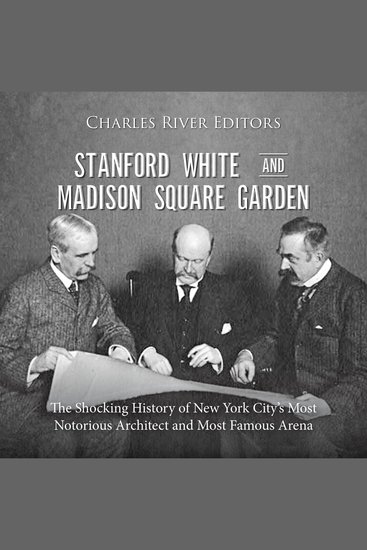
    Of all the great cities in the world, few personify their country like New York City. As America’s largest city and best known immigration gateway into the country, the Big Apple represents the beauty, diversity and sheer strength of the United States, a global financial center that has enticed people chasing the “American Dream” for centuries.  
    	As such, it’s only fitting that Madison Square Garden, the stadium that bills itself as the world’s most famous arena, resides in the heart of Manhattan. Just blocks away from the Empire State Building and situated atop Penn Station, the Garden is always bustling, whether it’s for special events or as the home of the NBA’s New York Knicks and NHL’s New York Rangers, and all the while, performing in the Garden has been a career benchmark for artists as varied as Elvis Presley, The Doors, Led Zeppelin, and Michael Jackson. As Billie Joel put it, “Madison Square Garden is the center of the universe as far as I'm concerned. It has the best acoustics, the best audiences, the best reputation, and the best history of great artists who have played there. It is the iconic, holy temple of Rock and Roll for most touring acts and, being a New Yorker, it holds a special significance to me.” 
    	The Garden is now nearly 50 years old, making it one of the oldest sporting venues used in professional sports, but the current arena was not the first Madison Square Garden, and the area has a history as an entertainment center dating back to the 19th century. Ironically, its location on the less crowded fringes of Manhattan in the 19th century helped establish it as a place for hucksters like P.T. Barnum to hold events. In fact, a previous Garden was one of New York City’s tallest buildings in the early 20th century, and it was bankrolled by business titans like J.P. Morgan and Andrew Carnegie. 
    Show book