Begleiten Sie uns auf eine literarische Weltreise!
Buch zum Bücherregal hinzufügen
Grey
Einen neuen Kommentar schreiben Default profile 50px
Grey
Jetzt das ganze Buch im Abo oder die ersten Seiten gratis lesen!
All characters reduced
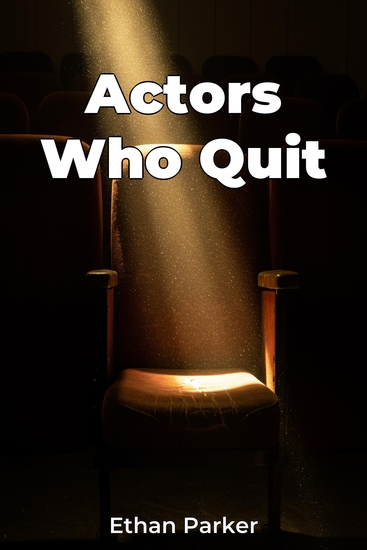
Actors Who Quit - cover

Actors Who Quit

Ethan Parker

Übersetzer A Ai

Verlag: Publifye

  • 0
  • 0
  • 0

Beschreibung

"Actors Who Quit" explores the fascinating stories of actors who voluntarily left Hollywood, offering a unique perspective on the entertainment industry. It delves into why some choose to walk away from fame and fortune, challenging the conventional narrative of unwavering ambition. These departures often stem from disillusionment with the industry's culture, a desire to pursue alternative passions, or a need to prioritize personal well-being. The book reveals that leaving acting isn't always a sign of failure but can be an act of self-determination.

 
The book examines the historical context of the film and television industries and breaks down the reasons for leaving, using case studies of former actors who became entrepreneurs, sought family life, or found creative outlets elsewhere. It highlights the changing social expectations and pressures of maintaining a public image, especially in the age of social media. It also analyzes the broader impact of these choices on celebrity culture and audience expectations.

 
Structured in three parts, "Actors Who Quit" first introduces the concept of voluntary career change. It then offers detailed, thematically grouped case studies. Finally, it analyzes the broader implications of these decisions, ultimately offering practical lessons for anyone contemplating a career shift, not just those in the film and television industry.
Verfügbar seit: 24.02.2025.
Drucklänge: 74 Seiten.

Weitere Bücher, die Sie mögen werden

  • Philadelphia Story & Holiday Inn - Adapted from the screenplay & performed for radio by the original film stars - cover

    Philadelphia Story & Holiday Inn...

    Mr Punch

    • 0
    • 0
    • 0
    Mr Punch Presents: THE PHILADELPHIA STORY, known as Hollywood's most sophisticated and sparkling romantic comedy, telling the story of Philadelphia heiress Tracy Lord who is preparing for her second marriage, when Dexter Haven, her first husband, re-enters her life on the day before her wedding, determined to spoil things. Holiday Inn, is the story of Jim Hardy (Bing Crosby) who is head over heels in love with Linda Mason (Dinah Shore), in this most famous Irving Berlin musical, featuring the smash hit songs White Christmas and Easter Parade. 
     
    This high-quality audiobook has been re-mastered and re-edited from the original radio broadcast. 
      
    Also available as part of the Hollywood Playhouse BOX SET, a collection of 14 Oscar winning ear-movies, adapted from the original screenplays & performed for the radio by many of the original film stars in front of a live studio audience. 
      
    "These radio dramas were….to become as popular as the movies themselves." Hollywood Movie Memories 
      
    "This is an excellent audio product that will appeal to the majority of audiobook listeners." Talking Business 
      
    "A lovely series to add to any film, audio or crime lovers’ collection." Audio World
    Zum Buch
  • Muromachi Period - Ashikaga Shoguns and the Rise of Feudal Japan - cover

    Muromachi Period - Ashikaga...

    Rolf Hedger

    • 0
    • 0
    • 0
    The Muromachi Period, spanning from 1336 to 1573, marked a significant turning point in Japanese history, characterized by the rise of the Ashikaga Shogunate and the gradual shift toward decentralized feudal rule. This period emerged following the fall of the Kamakura Shogunate, as Ashikaga Takauji established his military government in Kyoto. The political, social, and cultural transformations that unfolded during this time laid the foundation for the later Sengoku era, a period of constant warfare among regional warlords. 
    The decline of the Kamakura Shogunate stemmed from mounting dissatisfaction among the samurai class, who had grown discontent with the Hojo regents’ rule. The Mongol invasions of Japan in 1274 and 1281 had placed immense strain on the government, as victory brought no financial rewards for the warriors who had fought to defend the nation. With no lands to distribute as compensation, loyalty to the shogunate weakened, creating an opportunity for ambitious leaders to challenge its authority. Amid this unrest, Emperor Go-Daigo launched the Kenmu Restoration (1333–1336), an effort to reestablish imperial rule. However, his failure to recognize the interests of the samurai led to his downfall. 
    Ashikaga Takauji, originally a supporter of the emperor, turned against him and seized power, defeating both imperial and Kamakura loyalists. In 1336, Takauji established his own military government, known as the Muromachi Bakufu, in Kyoto. Unlike the Kamakura Shogunate, which ruled from a distant military capital, the Muromachi Shogunate was strategically located in the heart of Japan’s cultural and political sphere. Takauji’s rule was solidified in 1338 when he was officially
    Zum Buch
  • Cognitive accesibility architecture and the autism spectrum - Keys to design - cover

    Cognitive accesibility...

    Berta Brusilovsky

    • 0
    • 1
    • 0
    This text deals fundamentally with design and architecture: the route of spatial recognition, which is the least known —or worked on— within the approaches of the autism spectrum given its difficulty in being synthesized in a paradigm or normative set. The objective is to create a framework to approach the design of environments and buildings, in order to facilitate spatial development in everyday life and, especially, in learning situations.
    The spatial route, which is the project, creates:
    - A set of spatial coordinates that liberates the user from the anguish of not recognizing, of not understanding the space in which he is developing. And that offer him the possibility of finding the way, directing him to where he needs or wants to go.
    - Structure of the exterior and interior, with their corresponding activities placed in a comprenssible way through concepts of organization: functional and sensorial sequence of events. And creation of spaces for group and individual tasks, paying special attention to places of transition and recovery between opposite or different activities, both physical and emotional.
    - The aspects that are developed in terms of recommendations are synthesized in a construct that brings together the aspects of general, functional, formal and sensory organization of plans, elevations and details. Achieving with these “person-space” adjustments a  higher quality of personal life and of its affective and learning  environment.
    - Design components that in the case of autism should be considered in order to seek with the project greater facility of understanding, use and space-emotional development of people from childhood to adult life.
    Zum Buch
  • Ride the High Country - cover

    Ride the High Country

    Robert Nott

    • 0
    • 0
    • 0
    Director Sam Peckinpah was just starting out when MGM released Ride the High Country in 1962. He was a new kind of director: young, brash, and in a hurry to help the Western "grow up" by treating it with adult themes. Ride the High Country was something new and different, a changing Western to match a changing West. Stars Randolph Scott and Joel McCrea were old hands at this sort of thing. Ride the High Country gave the two veteran actors one last job to do and a chance to go out with some dignity. 


    Ride the High Country helped the genre mature and adapt to turbulent, changing times. It launched Peckinpah's career by invoking the themes of honor, loyalty, and compromised ideals, the destruction of the West and its heroes, and the difficulty of doing right in an unjust world—themes developed to their pinnacle in Peckinpah's later masterpiece, The Wild Bunch.
    Zum Buch
  • Narrative Textiles - Tell your story in mixed media and stitch - cover

    Narrative Textiles - Tell your...

    Ailish Henderson

    • 0
    • 0
    • 0
    Bring your personal story to life in colourful, vibrant textile art.
    Ailish Henderson is an exciting young textile artist whose work is fun, quirky, tells interesting stories and uses a diverse range of media, though always grounded in cloth. In this gorgeous book, she explains her working methods and how you can harness them in your own work to create unique, deeply personal textile art pieces. She encourages you to draw on your own personal memorabilia to create work that is meaningful to you – the intention is to capture a moment in time, a memory to treasure, a look on a face, a glance of love from a pet.
    Along with work from the author, the book also showcases work from textile artists such as Aran Illingworth, Jenni Dutton, Woo Jin Joo and Jordan Cunliffe. It includes:
    • Materials: where to source cloth, using found and recycled materials, curating vintage fabric, incorporating precious family pieces in your work.
    • Processes: finding inspiration, creating mood boards, keeping sketchbooks, developing work from drawings, capturing character.
    • Techniques: Screenprinting, hand and machine stitching, appliqué, mixed-media collage.
    • Subject matter: the narrative line, self-portraits, family snapshots, history, identity, travel, favourite animals, even famous faces.
    Throughout the book the author encourages you to work with freedom, instinct and honesty, bringing in a wealth of different techniques to create authentic stories in cloth, and most importantly, enjoy yourself along the way.
     
    Zum Buch
  • 100 20th-Century Sports and Leisure Buildings - cover

    100 20th-Century Sports and...

    Society Twentieth Century

    • 0
    • 0
    • 0
    A showcase of Britain's most architecturally significant sports and leisure buildings from the twentieth century and beyond.
    100 20th Century Sports and Leisure Buildings gives a fascinating insight into the spaces where we play: from swimming pools and skate parks to ice rinks and cricket pavilions. These structures are not only an intensely evocative part of our shared social heritage but some of the most architecturally innovative constructions of the past century – as seen here in buildings by architects including Edwin Lutyens, Walter Tapper, John Burnet and Zaha Hadid.
    The twentieth century saw a rapid expansion in the public provision for sports and leisure as workers won the right to paid holiday, prompting a boom in the construction of municipal lidos, pools and sports grounds. Later in the century leisure centres brought together facilities for a whole range of sports with an emphasis on family fun, combining environmentally controlled environments with soaring engineering and playful pop imagery. Space-age geodesic domes, diamond-glazed pyramids, castellated forts, brutalist elephants and Moorish postmodern palaces are just a few of the highlights of this idiosyncratic genre showcased here.
    Expert essays on particular building types, including Alan Powers on lidos and Simon Inglis on sports stadiums, give further context to these spaces. Also included is an introduction with a strong campaigning element – with the decimation of local authority budgets forcing the closure of many centres and pools, this is a timely exploration that provides a crucial record of this key part of our cultural heritage.
    Zum Buch