Join us on a literary world trip!
Add this book to bookshelf
Grey
Write a new comment Default profile 50px
Grey
Subscribe to read the full book or read the first pages for free!
All characters reduced
Absurdist Drama Foundations - cover

Absurdist Drama Foundations

Ethan Parker

Translator A AI

Publisher: Publifye

  • 0
  • 0
  • 0

Summary

Absurdist Drama Foundations delves into the Theatre of the Absurd, a dramatic movement born from post-World War II disillusionment. It explores how playwrights use illogical narratives and existentialist principles to portray the human condition in a world often perceived as meaningless. This book uniquely bridges philosophy and the performing arts, offering a comprehensive look at how playwrights like Samuel Beckett and Eugene Ionesco challenged traditional theatre structures to reflect the absurdity of existence. For example, plays often feature cyclical structures, mirroring the perceived lack of progress in life.

 
The book argues that while seemingly pessimistic, Absurdist drama provides catharsis by confronting the inherent meaninglessness of existence. It begins by laying the philosophical groundwork of existentialism and absurdism, then analyzes key plays, demonstrating how themes of alienation and communication breakdown are conveyed. The analysis includes case studies of plays like Waiting for Godot, Rhinoceros, and The Birthday Party.

 
Finally, the book concludes by examining the lasting impact and modern applications of absurdist principles, including their influence on modern media.
Available since: 05/05/2025.
Print length: 61 pages.

Other books that might interest you

  • On the Parts of Animals - cover

    On the Parts of Animals

    Aristotle

    • 0
    • 0
    • 0
    "On the Parts of Animals" is a biological treatise written by Aristotle, in which he extensively examines the anatomy and physiology of different animals, including humans. The book is divided into four sections, each focusing on a different aspect of animal life. In the first section, Aristotle explores the concept of soul and distinguishes between different types of souls that exist in animals. In the second section, he discusses the structure and function of sensory organs, such as eyes and ears, and how animals use them to interact with their environment. In the third section, he analyzes the digestive system and other internal organs, as well as the reproductive system, to understand how animals sustain themselves and reproduce. Finally, in the fourth section, he looks at the differences between different animal species and the variations in their anatomy and physiology. Read in English, unabridged.
    Show book
  • Understanding anarchism - cover

    Understanding anarchism

    Marcelino Viera, Maxime Foerster

    • 0
    • 0
    • 0
    What are the founding principles of anarchism? What links the philosophy of Proudhon, who introduced this notion in France in 1840, to the act of the Italian Sante Geronimo Caserio, who assassinated President Sadi Carnot in 1894?
    This introduction to anarchism helps us understand the issues and tensions that run through this movement, and to grasp why it could establish itself today as a response to the moral and economic crisis of contemporary societies.
    Show book
  • Quiet Night Think - Poems & Essays - cover

    Quiet Night Think - Poems & Essays

    Gillian Sze

    • 0
    • 16
    • 0
    “One function of the poet at any time is to discover by his own thought and feeling what seems to him to be poetry at that time,” writes Wallace Stevens. In Quiet Night Think, award-winning poet Gillian Sze expresses her own definition.
    		 
    During the remarkable period of early parenthood, Sze’s new maternal role urges her to contemplate her own origins, both familial and artistic. Comprised of six personal essays, poems, and a concluding long poem, Quiet Night Think takes its title from a direct translation of an eighth-century Chinese poem by Li Bai, the subject of the opening essay. Sze’s memory of reading Li Bai’s poem as a child marks the beginning of an unshakable encounter with poetry. What follows is an intimate anatomization of her particular entanglement with languages and cultures.
    		 
    In her most generically diverse book yet, Sze moves between poetry and prose, mother and writer, the lyrical and the autobiographical, all the while inviting readers to meditate with her on questions of emergence and transformation: What are you trying to be? Where does a word break off? What calls to us throughout the night?
    Show book
  • Rare Recording of Father Charles Coughlin A - Vol 3 - cover

    Rare Recording of Father Charles...

    Father Charles Coughlin

    • 0
    • 0
    • 0
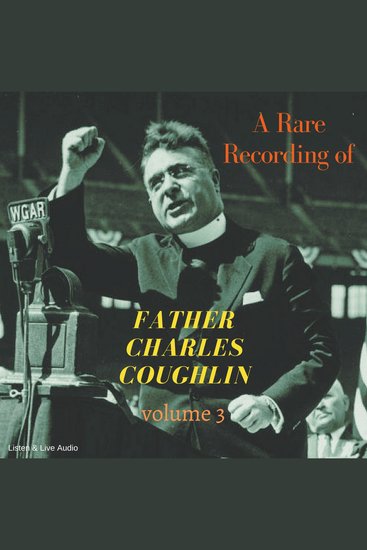
    Father Charles Coughlin was a controversial Canadian-American Catholic priest based in Michigan. Calling for monetary reforms, the nationalization of major industries and railroads, and protection of the rights of labor, Coughlin used weekly radio broadcasts to reach a mass audience of up to thirty million listeners during the 1930s. 
    An early supporter of Franklin D. Roosevelt and his New Deal, Coughlin later became a harsh critic. Coughlin’s commentary also became more anti-semitic, and he supported some of the fascist policies of Hitler, Mussolini, and Hirohito. As a result, many American Catholic leaders, as well as the Vatican, wanted Coughlin silenced. After the outbreak of World War II in 1939, the Roosevelt administration finally forced the cancellation of his radio program and forbade the dissemination of his newspaper, Social Justice. 
    In this recording, Coughlin first discusses Franklin D. Roosevelt, and then the consequences of World War I twenty years after.
    Show book
  • Ageless Living: Secrets to Reverse Aging and Boost Vitality - "Unlock the secrets to ageless living! Discover powerful lessons to rejuvenate your vitality and reverse aging" - cover

    Ageless Living: Secrets to...

    Ronan Sable

    • 0
    • 0
    • 0
    Ageless Living: Secrets to Reverse Aging and Boost Vitality   
    ⭐⭐ Simplified Guide & Explanations Included ⭐⭐ 
    Are you eager to enhance your vitality and unlock your full potential for a healthier life?  
    Are you in search of a comprehensive resource to guide you toward embracing better living and reversing the aging process? 
    Your search stops here! 
    This audiobook serves as your essential companion for deepening your knowledge, applying essential techniques, and engaging in valuable exercises. With this resource, you are equipped for success. 
    Updated for the Latest Strategies in Health and Vitality. 
    Key features of this enhanced guide: 
    - In-depth insights about living agelessly 
    - Detailed exploration of strategies to enhance vitality 
    - Effective methods for preparing and implementing health changes 
    Our guide stands out for its thorough coverage, which is critical for achieving your wellness goals. Concepts are not just touched upon; they are explored in depth with clarity and accuracy. 
    Please remember, this guide is an independent resource and is not linked to any official health organizations. 
    Crafted with a clear structure and easy-to-understand language, our guide ensures smooth transitions across topics. Say goodbye to complex jargon and embrace straightforward, precise, and technically solid content. 
    So, why wait? Click the BUY NOW button, secure your guide, and embark on your journey to enhanced vitality and healthier living today! 
    Take the first step toward ageless living and vitality today!
    Show book
  • Bagavad Gita in Tamil - Chapter 4 - Gnana-Karma-Sanyasa Yoga - cover

    Bagavad Gita in Tamil - Chapter...

    Viyasar

    • 0
    • 0
    • 0
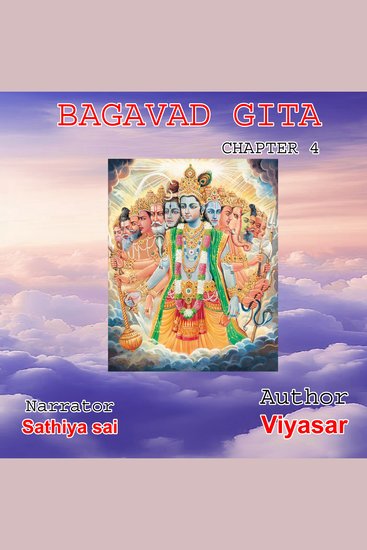
    The Bhagavad Gita is a 700-verse Hindu scripture embedded within the epic Mahabharata, depicting a dialogue between Arjuna and Krishna on the battlefield of Kurukshetra. Arjuna, facing his relatives in battle, experiences despair and a crisis of conscience. Krishna, his charioteer and an avatar of Vishnu, provides philosophical and spiritual guidance, addressing themes of duty (dharma), action (karma), devotion (bhakti), and knowledge (jnana). The Gita explores the nature of the self, the divine, and humanity's place in the world, offering paths to liberation and spiritual fulfillment. 
    Show book