Join us on a literary world trip!
Add this book to bookshelf
Grey
Write a new comment Default profile 50px
Grey
Subscribe to read the full book or read the first pages for free!
All characters reduced
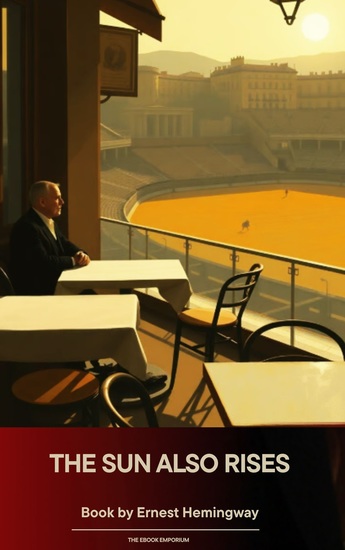
The Sun Also Rises - cover

The Sun Also Rises

Ernest Hemingway

Publisher: The Ebook Emporium

  • 0
  • 0
  • 0

Summary

"You can't get away from yourself by moving from one place to another."

In the wake of World War I, a group of disillusioned American and British expatriates drifts through the cafes of Paris, searching for a purpose that the war stripped away. At the center of this circle are Jake Barnes—a journalist left impotent by a war wound—and the captivating, fiercely independent Lady Brett Ashley. Their journey takes them from the jazz-soaked nights of the Rive Gauche to the raw, sun-drenched intensity of the bullfights in Pamplona.

The Iceberg Theory in Action: Hemingway's revolutionary prose is on full display here. Using his "Iceberg Theory," he conveys deep emotional turmoil through sparse, rhythmic dialogue and direct action. Beneath the surface of every drink ordered and every trout caught lies a profound exploration of masculinity, resilience, and the "lost" nature of a youth that survived the trenches only to find a hollow peace.

The Ritual of the Bullring: The novel reaches its crescendo during the Fiesta de San Fermín. Hemingway contrasts the chaotic, drunken revelry of the expatriates with the "purity" and tragic grace of the bullfight. Through the young matador Pedro Romero, Hemingway explores the "grace under pressure" that becomes the only available virtue in a world where traditional moral structures have collapsed.

Experience the sunlit tragedy of a generation. Purchase "The Sun Also Rises" today and discover the origin of the modern American voice.
Available since: 01/05/2026.
Print length: 237 pages.

Other books that might interest you

  • Mrs Balfame - cover

    Mrs Balfame

    Gertrude Atherton

    • 0
    • 0
    • 0
    Enid Belfame: 42 years old, 22 of them as a married woman; eminently respectable; founder of The Friday Club; small town dignitary; a paragon of virtue. But does she have what it takes to commit murder? And will the young and handsome Dwight Rush benefit if she does?
    Show book
  • Thelma & Louise - cover

    Thelma & Louise

    Susan Kollin

    • 0
    • 0
    • 0
    Thelma & Louise, the 1991 film directed by Ridley Scott and starring Susan Sarandon and Geena Davis, has been described as a road movie, a buddy movie, a feminist parable, and only incidentally as a Western. An Oscar winner for first-time screenwriter Callie Khouri, Thelma & Louise catalyzed a national conversation about women, violence, and self-determination in a Hollywood still shrugging off the West of John Wayne and in an America that still viewed women as accessories to the national mythology. 


    In this latest volume in the Reel West series, Susan Kollin recreates this watershed moment for women's movies in general and women's Westerns in particular.
    Show book
  • From Enlightenment To Revolution - Pitt Burke & Robespierre 1766-1794 - cover

    From Enlightenment To Revolution...

    Maximillian Robespierre, Edmund...

    • 0
    • 0
    • 0
    History is often concentrated into short bursts of change, with long periods of shifting before and waves of alteration afterwards. Nowhere is this more obvious than the thirty year interregnum between the Enlightenment and the Industrial Revolution. In this period, three figures stand tall; Pitt, the elder stateman who saw the need for genuine constitutionalism; Burke, the consummate parliamentarian, speaking for the glory of empire; and Robespierre, the legendary and controversial frontman of the French Revolution.William Pitt The Elder speaks about the need for key changes to the body politic. The first speech here predates the interregnum, being from 1738, when he was merely thirty, and covers a key factor in Britain’s colonial problems for the next two centuries, being the complete internal corruption of the army.Edmund Burke represents the height of Royalist sympathy as the age of revolution gets underway. He speaks on the need for conciliation with America after the disaster of the Stamp Act and revolution, on the need to punish Warren Hastings for treating his Asian holdings as his own empire to fill with his own corruption, and on the end of an era with the passing of Marie Antoinette.Finally, the age of revolution, both industrial and political, has begun. Robespierre argues for the dignity of man; for rejecting the divinity of royal authority in favour of that of the human spirit; against the death penalty, as being below the dignity of a truly humanist state; on enemies, internal and external, who push the people to reject their own interests for those of the powerful. This is but a small selection of the man’s incredible output - in 1791 alone, he gave three hundred and twenty-eight speeches.Spitting bile and flame in his last speech, which closes this volume, Robespierre truly inaugurates the era when revolution against centuries-old powers brought their end, and their nations found their renewal.
    Show book
  • Arctic Paradise - The Paradox of Finnish Happiness - cover

    Arctic Paradise - The Paradox of...

    Susanna Heiskanen

    • 0
    • 0
    • 0
    In the pages of "Arctic Paradise: The Paradox of Finnish Happiness," discover the intricate tapestry of Finland's contented society, where radiant joys intertwine with subtle shadows. This insightful non-fiction journey peels back the layers of Finnish happiness, revealing not just its vibrant facets but also the nuanced complexities shaping the nation's emotional landscape. 
    Beyond the picturesque scenes of communal harmony lies a candid exploration of Finland's reality, bravely addressing prevalent issues like depression and mental health challenges. This isn't your typical travelogue; it's an unfiltered dive into the heart of a society often idealized for its well-being. 
    "Arctic Paradise" fearlessly navigates cultural expectations and societal pressures, shining a light on the silent struggles endured by many. Through intimate stories and thoughtful analysis, the book paints a holistic picture of Finnish happiness, acknowledging the hurdles within a nation known for its high happiness quotient. 
    Get ready to question the paradox of joy amidst adversity, igniting a profound conversation about the true nature of happiness and resilience. Beyond being a testament to Finland's happiness, "Arctic Paradise" serves as a poignant exploration of the human spirit's enduring quest for contentment, even in the face of life's most daunting challenges. 
    What the Readers Say: 
    Arctic Paradise is the best book if you are looking to learn about all things Finnish and why it is known as one of the happiest places to live. However, what makes Susanna's book stand out, is that she also looks at the other side of happiness and that makes life in Finland more real and not just the belief that everyone living there is happy all the time. Fear not, at the end of every chapter Susanna gives suggestions on how you can live a life in a more positive and happy way! 
    Tracy Mills
    Show book
  • The American Operations in WW2: Central Europe - cover

    The American Operations in WW2:...

    History U.S. Army Center of...

    • 0
    • 0
    • 0
    World War II was the largest and most violent armed conflict in the history of mankind. Highly relevant today, World War II has much to teach us, not only about the profession of arms, but also about military preparedness, global strategy, and combined operations in the coalition war against fascism. This book follows military operations of the US Army in Central Europe from 22 March to 11 May 1945. 
    By the early spring of 1945 events favored the Allied forces in Europe. The Anglo-Americans had by January turned back the Germans' December counterattack in the Ardennes, in the famous Battle of the Bulge. The failure of this last great German offensive exhausted much of the Third Reich's remaining combat strength, leaving it ill-prepared to resist the final Allied campaigns in Europe. Additional losses in the Rhineland further weakened the German Army, leaving shattered remnants of units to defend the east bank of the Rhine. By mid-March the western Allies had pushed to the Rhine along most of the front, had seized an intact bridge at Remagen, and had even established a small bridgehead on the river's east bank.
    In the east the Soviets had overrun most of Poland, pushed into Hungary and eastern Czechoslovakia, and temporarily halted at the German border on the Oder-Neisse line. These rapid advances on the Eastern Front destroyed additional veteran German combat units and severely limited Hitler's ability to reinforce his Rhine defenses. Thus, as the western Allies completed their preparations for the final drive into the heart of Germany, victory seemed within sight.
    Show book
  • Borders and Belonging - Toward a Fair Immigration Policy - cover

    Borders and Belonging - Toward a...

    Hiroshi Motomura

    • 0
    • 0
    • 0
    Immigration is now a polarizing issue across most advanced democracies. But too much that is written about immigration fails to appreciate the complex responses to the phenomenon. In Borders and Belonging, Hiroshi Motomura offers a complex and fair-minded account of immigration, its root causes, and the varying responses to it. Taking stock of the issue's complexity, while giving credence to the opinions of immigration critics, he tackles a series of important questions that, when answered, will move us closer to a more realistic and sustainable immigration policy. Motomura begins by affirming a basic concept―national borders―and asks when they might be ethical borders, fostering fairness but also responding realistically to migration patterns and to the political forces that migration generates. In a nation with ethical borders, who should be let in or kept out? How should people forced to migrate be treated? Should newcomers be admitted temporarily or permanently? What is the best role for enforcement in immigration policy? To what extent does the arrival of newcomers hurt long-time residents? What are the "root causes" of immigration and how can we address them?Realistic about the desire of most citizens for national borders, this book is an indispensable guide for moving toward ethical borders and better immigration policy.
    Show book