Join us on a literary world trip!
Add this book to bookshelf
Grey
Write a new comment Default profile 50px
Grey
Subscribe to read the full book or read the first pages for free!
All characters reduced
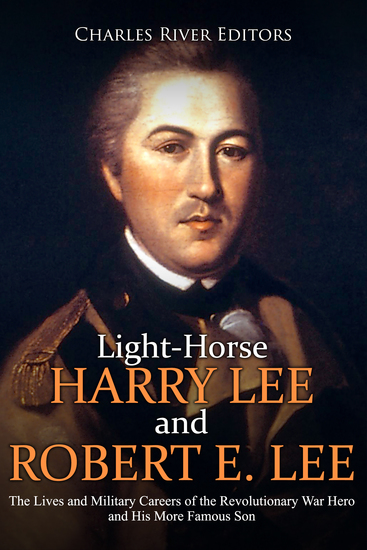
Light-Horse Harry Lee and Robert E Lee - The Lives and Military Careers of the Revolutionary War Hero and His More Famous Son - cover

Light-Horse Harry Lee and Robert E Lee - The Lives and Military Careers of the Revolutionary War Hero and His More Famous Son

Editors Charles River

Publisher: Charles River Editors

  • 0
  • 0
  • 0

Summary

nation demands his saving arm.” – Henry Lee III
 
The proud Virginian entered the war in uncertain times, and there were understandable doubts about how well he could lead soldiers, but through a combination of skill and luck, he became one of his country’s earliest and foremost military heroes. After the war, he would go on to a distinguished political career, and he would find himself caught up in civil unrest toward the end of his life.
 
Some of those details might bring to mind the life story of George Washington, and if those details included the name Lee, most of them would immediately sound like a description of Robert E. Lee’s life. In fact, they only begin to scratch the surface of the life and career of Robert E. Lee’s father, Henry Lee III, who is best known by the nickname “Light-Horse Harry” for the way he excelled as a cavalry officer during the Revolutionary War. 
 
When the Revolution began, the Continental Army sported numerous volunteers from Ireland, Scotland, virtually every European nation between France and Russia, and men from the northern and southern borders of the European continent. This is understandable, given that at the start of the war, military confrontations between the world powers had become so common that combat was raised to the status of a fine art, consuming a large portion of time for adolescent males in training and comprising a sizeable component of the economy. Weaponry was developed to a degree of quality not accessible to most North Americans, and European aristocrats were reared in the mastery of swordsmanship with an emphasis on the saber for military use. Likewise, the cavalry, buoyed by a tradition of expert horsemanship and saddle-based combat, was a fighting force largely beyond reach for colonists, which meant that fighting on horses was an undeveloped practice in the fledgling Continental Army, and the American military did not yet fully comprehend the value of cavalry units. Few sword masters were to find their way to North America in time for the war, and the typical American musket was a fair hunting weapon rather than a military one. Even the foot soldier knew little of European military discipline.
 
All of this helps explain why, aside from George Washington, many Americans are likely able to name just as many foreign generals on the rebel side as American generals. While names like Lafayette, Pulaski, Kościuszko, and Baron von Steuben are quickly associated with the Revolution, American officers like Nathanael Greene, Anthony Wayne, Horatio Gates, Henry Knox, and Light-Horse Harry Lee are often overlooked. Over 200 years later, Lee is best remembered not for his military or political service, but for being Robert E. Lee’s father, and all the attendant controversy that comes with his son’s legacy. This is unfortunate, given that he was one of the most distinguished individuals of the age.
 
With the exception of George Washington, perhaps the most famous general in American history is Light-Horse Harry’s son, despite the fact Robert E. Lee led the Confederate Army of Northern Virginia against the Union in the Civil War. Lee was imbued with a strong sense of honor and duty from the beginning, and as a top graduate of West Point, Lee had distinguished himself so well before the Civil War that President Lincoln asked him to command the entire Union Army. Lee famously declined, serving his home state of Virginia instead after it seceded.
 
Lee is remembered today for constantly defeating the Union’s Army of the Potomac in the Eastern theater from 1862-1865, considerably frustrating Lincoln and his generals. His leadership of his army led to him being deified after the war by some of his former subordinates, especially Virginians, and he came to personify the Lost Cause’s ideal Southern soldier. His reputation was secured in the decades after the war as a general who brilliantly led his men to amazing victories against all odds.
Available since: 05/01/2025.
Print length: 116 pages.
Other books that might interest you

  • Gossip Men - J Edgar Hoover Joe McCarthy Roy Cohn and the Politics of Insinuation - cover

    Gossip Men - J Edgar Hoover Joe...

    Christopher M. Elias

    • 0
    • 0
    • 0
    J. Edgar Hoover, Joseph McCarthy, and Roy Cohn were titanic figures in midcentury America, wielding national power in government and the legal system through intimidation and insinuation. Hoover’s FBI thrived on secrecy, threats, and illegal surveillance, while McCarthy and Cohn will forever be associated with the infamous anticommunist smear campaign of the early 1950s, which culminated in McCarthy’s public disgrace during televised Senate hearings. In Gossip Men, Christopher M. Elias takes a probing look at these tarnished figures to reveal a host of startling new connections among gender, sexuality, and national security in twentieth-century American politics. Elias illustrates how these three men solidified their power through the skillful use of deliberately misleading techniques like implication, hyperbole, and photographic manipulation. Just as provocatively, he shows that the American people of the 1950s were particularly primed to accept these coded threats because they were already familiar with such tactics from widely popular gossip magazines. 
     
    By using gossip as a lens to examine profound issues of state security and institutional power, Elias thoroughly transforms our understanding of the development of modern American political culture.
    Show book
  • Magic Words - cover

    Magic Words

    Jonah Berger

    • 0
    • 0
    • 0
    New York Times bestselling author Jonah Berger’s cutting-edge research reveals how six types of words can increase your impact in every area of life: from persuading others and building stronger relationships, to boosting creativity and motivating teams. 
    Almost everything we do involves words. Words are how we persuade, communicate, and connect. They’re how leaders lead, salespeople sell, and parents parent. They’re how teachers teach, policymakers govern, and doctors explain. Even our private thoughts rely on language. 
    But certain words are more impactful than others. They’re better at changing minds, engaging audiences, and driving action. What are these magic words, and how can we take advantage of their power? 
    In Magic Words, internationally bestselling author Jonah Berger gives you an inside look at the new science of language and how you can use it. Technological advances in machine learning, computational linguistics, and natural language processing, combined with the digitization of everything from cover letters to conversations, have yielded unprecedented insights. 
    Learn how salespeople convince clients, lawyers persuade juries, and storytellers captivate audiences; how teachers get kids to help and service representatives increase customer satisfaction; how startup founders secure funding, musicians make hits, and psychologists identified a Shakespearean manuscript without ever reading a play. 
    Supplemental enhancement PDF accompanies the audiobook. 
    This book is designed for anyone who wants to increase their impact. It provides a powerful toolkit and actionable techniques that can lead to extraordinary results. Whether you’re trying to persuade a client, motivate a team, or get a whole organization to see things differently, this book will show you how to leverage the power of magic words.
    Show book
  • Time explained - Exploring the World of Becoming - cover

    Time explained - Exploring the...

    Tenzin Trepp

    • 0
    • 0
    • 0
    Time governs every heartbeat, every memory, every dream of tomorrow. Yet, what is it really? A river we drift through, or a fabric we weave ourselves? In this book, Tenzin C. Trepp invites us on a journey through history, science, and culture to confront the mystery of time. From ancient civilizations and Indigenous worldviews to Einstein’s relativity and today’s cutting-edge physics, we discover that time is never just measured—it is lived, shaped, and endlessly re-imagined. Combining clarity with depth, Time Explained makes one of humanity’s oldest riddles vivid, surprising, and profoundly relevant to our own lives.
    Show book
  • Sparking Connections: Exploring the Intricacies of Desire and Attraction - "Elevate your journey of love with engaging audio insights from 'Sparking Connections': Unravel the mysteries of attraction!" - cover

    Sparking Connections: Exploring...

    Sullivan Ashwick

    • 0
    • 0
    • 0
    Sparking Connections: Exploring the Intricacies of Desire and Attraction 
    ⭐⭐ Simplified Audio Guide with Explanations Included ⭐⭐ 
    Are you eager to deepen your understanding of human relationships and effectively navigate the complexities of attraction and desire? 
    Searching for a comprehensive resource that encompasses everything you need to enhance your knowledge of attraction dynamics? 
    Your quest ends here! 
    This guide acts as your essential companion for enhancing your insights, honing your skills, and engaging in practical exercises. With this resource, you're set for success. 
    Updated to reflect the latest findings in the dynamics of attraction. 
    Key Features of this Enriched Guide: 
    - Profound insights into human attraction dynamics  
    - In-depth explanations of how desire influences relationships 
    - Effective strategies for examining and understanding interpersonal connections 
    Our guide stands out with its thorough approach, which is crucial for understanding the intricacies of attraction. Concepts are explored in depth, not just touched upon superficially. 
    Please note that this guide is an independent resource and not affiliated with any official entity related to attraction studies. 
    Crafted with a clear structure and easy-to-understand language, our guide ensures seamless transitions between topics. Bid farewell to complex jargon and embrace clear, precise, and technically accurate content. 
    So, why hesitate? Click the BUY NOW button, secure your guide, and embark on your journey toward mastering the dynamics of desire and attraction!
    Show book
  • Lady Jane Grey and the Succession Crisis of 1553 - A Tudor Quick Studies Book on the Nine Day's Queen - cover

    Lady Jane Grey and the...

    Heather Teysko

    • 0
    • 0
    • 0
    This course explores the dramatic events of the 1553 Succession Crisis, a pivotal moment in Tudor history. It begins with Edward VI’s declining health and the controversial "Devise for the Succession," leading to Lady Jane Grey's nine-day reign. You’ll follow Mary I’s determined campaign to reclaim the throne, examine the trials and executions of key figures, and understand the broader impact on the Tudor dynasty. The course also delves into the complex religious and political dynamics of the era, highlighting lessons about legitimacy, power, and governance.
    Show book
  • Jugurthine War The: The History of the Roman Republic’s Controversial Conflict with the Numidians - cover

    Jugurthine War The: The History...

    Editors Charles River

    • 0
    • 0
    • 0
    Before the Numidians were conquered by the Romans and Numidia was officially made part of Roman Africa, they developed a culture that was as sophisticated and unique as any in the ancient world. The Numidians were a Berber people who emerged from the edge of the desert in the late 2nd millennium BCE, and despite the harshness of their environment (or perhaps because of it), they eventually became the most powerful people in North Africa. The Numidians found success on the backs of horses, which they rode to countless military victories, and when they could not defeat their enemies with conventional tactics, they were not afraid to resort to asymmetrical warfare.  
    	The most famous conflict with the Romans was the Jugurthine War, even though the Romans do not appear to have officially declared war on Numidia. The Romans entered Numidia determined to defeat Jugurtha and his Numidian army in a very conventional way, but having fought alongside and against the Numidians in the Punic Wars, the Romans should have known better, as Jugurtha knew that he had little chance of defeating the Romans in head-to-head combat. Numidia was rich, but it was not as rich as Rome in resources or people, and although the Numidian military was among the best in the Mediterranean at the time, it was not equipped to defeat the Romans.  
    	The most significant aspect of the Jugurthine War was the rivalry that it produced between Marius and Sulla. As was tradition, the commander, Marius, received the credit for the victory, but Sulla resented that his own part was downplayed, in particular his personal success in taking Jugurtha into custody. Sulla had a celebratory ring made to commemorate the event, and he, and the aristocratic faction that supported him, did all they could to enhance the role he had played while minimizing that of Marius.
    Show book