Join us on a literary world trip!
Add this book to bookshelf
Grey
Write a new comment Default profile 50px
Grey
Subscribe to read the full book or read the first pages for free!
All characters reduced
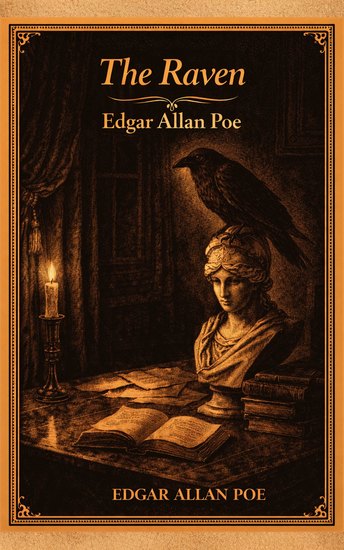
The Raven - cover

The Raven

Edgar Allan Poe

Publisher: CLXBX

  • 0
  • 0
  • 0

Summary

Step into the shadowed chamber of grief and longing in The Raven, Edgar Allan Poe's most celebrated and haunting poem. First published in 1845, this timeless masterpiece of gothic literature explores the fragile boundary between memory and madness, love and despair, reason and the supernatural.

On a bleak December night, a solitary scholar sits alone, mourning the loss of his beloved Lenore. As he attempts to distract himself with old books and fading embers, a mysterious tapping at his chamber door disrupts the silence. What begins as a faint sound soon becomes an unforgettable encounter when a dark, stately raven enters and perches above his door—an uninvited guest who utters only a single, chilling word: "Nevermore."

With each question the grieving narrator asks, the raven's refrain deepens his anguish. Is the bird merely a mindless creature repeating what it has learned? Or is it a supernatural messenger sent to torment him with the permanence of his loss? As the night stretches on, hope dissolves into obsession. The scholar's fragile composure unravels, and readers are drawn into a psychological descent where sorrow transforms into despair.

Poe's masterful use of rhythm, repetition, and musical language creates a hypnotic atmosphere that lingers long after the final line. The poem's intricate structure and haunting refrain mirror the narrator's spiraling thoughts, building an emotional intensity that is both beautiful and devastating. Through vivid imagery and rich symbolism, The Raven captures the universal pain of lost love and the terrifying power of memory.

More than a poem, The Raven is an experience—an immersion into the human soul at its most vulnerable. Its themes of grief, longing, isolation, and the search for meaning continue to resonate with readers across generations. The mysterious raven itself has become one of literature's most iconic figures, symbolizing both unrelenting sorrow and the shadowy depths of the mind.

Darkly lyrical, emotionally charged, and unforgettable, The Raven stands as a cornerstone of gothic poetry and a testament to Poe's genius. Whether encountered for the first time or revisited anew, this classic work invites readers to listen closely in the quiet of the night—where a single whispered word can echo forever.
Available since: 02/24/2026.
Print length: 4 pages.
Other books that might interest you

  • Short Poetry Collection 032 - cover

    Short Poetry Collection 032

    Various

    • 0
    • 0
    • 0
    LibriVox’s Short Poetry Collection 032: a collection of 20 public-domain poems.
    Show book
  • The Je Ne Scai Quoi - cover

    The Je Ne Scai Quoi

    William Whitehead

    • 0
    • 0
    • 0
    LibriVox volunteers bring you 7 different recordings of The Je Ne Scai Quoi by William Whitehead. This was the weekly poetry project for the week of March 30th, 2008.
    Show book
  • The Red Sand - A short science fiction story - cover

    The Red Sand - A short science...

    Dr. Amr Mounir

    • 0
    • 0
    • 0
    In a futuristic world where Earth faces an unprecedented threat, a fierce war breaks out between humans and giants from a distant alien planet. In an epic struggle for survival, the fates of heroes and villains intertwine, and tensions rise to unprecedented levels.
    Show book
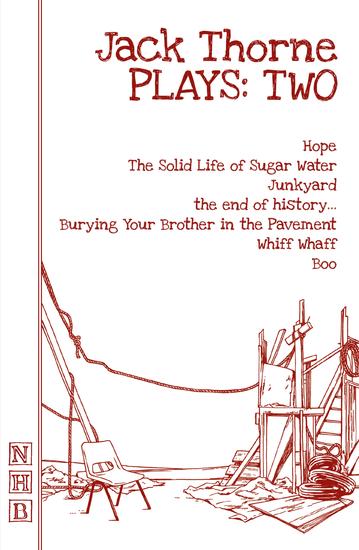
  • Jack Thorne Plays: Two - cover

    Jack Thorne Plays: Two

    Jack Thorne

    • 1
    • 0
    • 0
    After the breakout success of his early work for stage and screen, Jack Thorne turned for inspiration to his own family for a series of plays about hope, idealism and domestic politics. The work in this collection – five full-length plays and two shorts – showcases his extraordinary ability to combine electrifying dialogue with heartfelt warmth, candour and humour.
    Hope(Royal Court Theatre, 2014) is a funny and scathing fable about the leaders of a local council faced with savage funding cuts. 'A surprisingly entertaining state-of-the-nation drama' The Stage
    The Solid Life of Sugar Water (Graeae/Theatre Royal Plymouth, 2015) is an intimate, tender play about loss, hurt and rediscovery. 'Startlingly good... an adult play in the very best sense' The Times
    Junkyard(Headlong, 2017) is a joyful celebration of imaginative play, a musical drama about a group of young people tasked with building a playground out of junk. 'Genuinely funny and poignant' WhatsOnStage
    the end of history... (Royal Court, 2019) is a moving and sophisticated portrait of the impact of political idealism on a family. 'Clever and highly intriguing' Independent
    Also included are Burying Your Brother in the Pavement, written for the National Theatre Connections Festival in 2008, which tackles complex themes of grief, violence and sexuality with fierce compassion and wild imagination; and two short plays: Whiff Whaff and Boo.
    'I think these plays are about love, about heroes, about trying to understand how to be heroic, about trying to understand how to lead a good life' Jack Thorne, from his Introduction
    'Jack Thorne is Britain's hottest playwright and screenwriter'The Times
    'Jack Thorne never ceases to stimulate and entertain'Evening Standard
    'Thorne is a writer of immense emotional intelligence and his dialogue regularly devastates'The Stage
    Show book
  • Selected poems of Fenton Johnson - cover

    Selected poems of Fenton Johnson

    Fenton Johnson

    • 0
    • 0
    • 0
    Fenton was born on May 7th' 1888 in the American state of Chicago. He represented the Harlem Renaissance writers in the early 20th century, and self-published three poetry collections: A Little Dreaming in 1913, Visions of the Dusk in 1915, and Songs of the Soil in 1916. Having made quite a name as a poet, essayist, author, editor and educator, he expired in 1958.
    Show book
  • Love's Labour's Lost - cover

    Love's Labour's Lost

    William Shakespeare

    • 0
    • 0
    • 0
    This new edition of Shakespeare's Love's Labour's Lost presents a highly readable text of the play based on the first quarto of 1598. A thorough but concise critical commentary and a comprehensive introduction illuminate the significant elements of the play, its remarkable use of language, and its performance history.
    Show book