¡Acompáñanos a viajar por el mundo de los libros!
Añadir este libro a la estantería
Grey
Escribe un nuevo comentario Default profile 50px
Grey
Suscríbete para leer el libro completo o lee las primeras páginas gratis.
All characters reduced
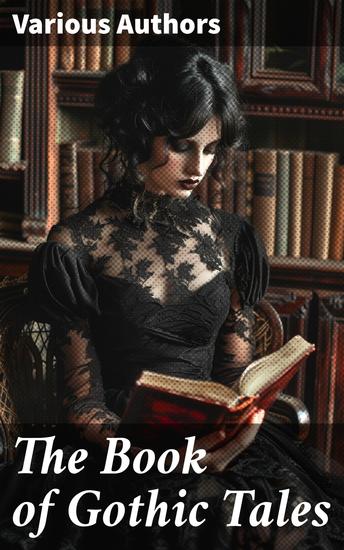
The Book of Gothic Tales - Dark Fantasy Novels Supernatural Mysteries Horror Tales & Gothic Romances - cover

The Book of Gothic Tales - Dark Fantasy Novels Supernatural Mysteries Horror Tales & Gothic Romances

Charles Dickens, Oscar Wilde, Robert Louis Stevenson, Edgar Allan Poe, William Hope Hodgson, Joseph Sheridan Le Fanu, Anna Katharine Green, George MacDonald, Bram Stoker, Charlotte Brontë, Emily Brontë, William Godwin, Henry James, Victor Hugo, Théophile Gautier, Arthur Conan Doyle, Jane Austen, John Meade Falkner, Guy de Maupassant, George Eliot, Robert Hugh Benson, Horace Walpole, Frederick Marryat, Thomas Love Peacock, Washington Irving, Nathaniel Hawthorne, Gaston Leroux, Grant Allen, Arthur Machen, Wilkie Collins, Thomas Peckett Prest, James Malcolm Rymer, Charles Brockden Brown, James Hogg, Charlotte Perkins Gilman, Richard Marsh, Charles Robert Maturin, John William Polidori, H. G. Wells, W. W. Jacobs, William Thomas Beckford, Nikolái Gógol, Mary Shelley, Ann Radcliffe, Matthew Gregory Lewis, Eliza Parsons

Traductor C. J. Hogarth, Samuel Henley, Isabel F. Hapgood

Editorial: Good Press

  • 0
  • 0
  • 0

Sinopsis

The Book of Gothic Tales offers a diverse and poignant exploration into the world of Gothic storytelling, collecting numerous treasures from the pantheon of influential authors who have shaped this haunting genre. Through tales steeped in mystery, horror, and romanticism, this anthology delves into the intricate tapestries of human emotion and the sublime. The collection spans a vast array of literary styles, from the chilling atmospheres conjured by Edgar Allan Poe to the nuanced character studies in the tales of Henry James. Standout stories challenge the boundaries between the real and the supernatural, immersing the reader in a world where moonlit castles, ghostly whispers, and untamed passions reign supreme. The anthology is enriched by the profound insights and distinctive voices of the various authors, each contributing a unique narrative strand to the Gothic tradition. The literary tapestry woven by the likes of Mary Shelley and Charlotte Brontë reflects vital movements including Romanticism and early feminism, together with the existential inquiries posed by authors such as Victor Hugo and Guy de Maupassant. This eclectic gathering of voices spans continents and centuries, providing a diverse forum for reflection on universal human fears and desires. The Book of Gothic Tales is a treasure for readers seeking to immerse themselves in the depth and breadth of Gothic literature. This collection not only enlightens but also entertains with its unending variety of themes and styles, each piece contributing to a larger dialogue about the human condition. It is a vital resource for anyone interested in the genre's development and its ongoing influence on literature and culture, offering an unparalleled journey through the shadowed reaches of the literary imagination.
Disponible desde: 29/12/2023.
Longitud de impresión: 10773 páginas.

Otros libros que te pueden interesar

  • Keeping Noisettes - A Good Women Story - cover

    Keeping Noisettes - A Good Women...

    Halle Hill

    • 0
    • 0
    • 0
    A knock on the door interrupts the quiet lives of a middle-aged woman and her daughter.Keeping Noisettes is a short story from Halle Hill’s Good Women, which delves into the lives of twelve Black women across the Appalachian South. Darkly funny and deeply human, Good Women observes how place, blood ties, generational trauma, obsession, and boundaries―or lack thereof―influence how we navigate our small worlds, and how those worlds so often collide in ways we don’t expect.
    Ver libro
  • A Thing That Glistened - From their pens to your ears genius in every story - cover

    A Thing That Glistened - From...

    Frank R. Stockton

    • 0
    • 0
    • 0
    Frank Richard Stockton was born in Philadelphia on 5th April 1834.  
    His father, a Methodist minister, discouraged Stockton’s literary career from an early age.  Feeling unable to go against those wishes it was for many years that Stockton’s income was maintained as a wood engraver.   
    His first work was published in 1867 and his first collection only appeared in 1870.  Despite this late arrival Stockton’s innovative and often far-fetched stories, with a gentle ‘poking fun’ humour were very popular.  Like his contemporary Mark Twain he avoided the scolding, hectoring and moral tones of many other authors and instead gently teased and cajoled his reader to open their eyes to the ills, the greed and the ambitions of the world around them.  His sci-fi stories in particular were far-seeing and inventive including a tale of negative gravity and a bloodless Anglo-US war won by technological feats.  
    Perhaps his most enduring tale though is ‘The Lady, or the Tiger?’ from 1882.  A condemned man is given a choice of being eaten alive or marrying his princess lover.  But he has to choose which door each is behind. 
    Frank R Stockton died in Washington, DC, on 20th April 1902, of a cerebral haemorrhage.  He is buried at The Woodlands in Philadelphia.
    Ver libro
  • Hello Darkness My Old Friend - cover

    Hello Darkness My Old Friend

    Rachel Lawson

    • 0
    • 0
    • 0
    a few short gothic Magicians poems and stories
    Ver libro
  • Her Turn - From their pens to your ears genius in every story - cover

    Her Turn - From their pens to...

    D H Lawrence

    • 0
    • 0
    • 0
    David Herbert Lawrence was born on the 11th September 1885 in Eastwood, Nottinghamshire, a coal mining town where the reality of a harsh life was only useful as experiences for future literary works. 
    He was educated at Beauvale Board School and became the first local boy to receive a scholarship to attend Nottingham High School. After 3 years he became a junior clerk in Haywood’s surgical appliances factory. He was also attempting a literary career which, in the short term, led to a teacher training position in Eastwood and later a teaching qualification from University College, Nottingham.  
    Lawrence’s first efforts were poems, short stories and a draft of ‘The White Peacock’. Moving to London and a teaching position in Croydon his writing attracted the attention of Ford Madox Ford, editor of The English Review, and he commissioned him to write ‘Odour of Chrysanthemums’.  
    Wanting to write full-time he now began work on what would become ‘Sons and Lovers.   
    In 1912 he met the older and married mother-of-three Frieda Weekley. They eloped to Germany and here Lawrence could see for himself the growing tensions with France.  So keen was his interest that he was arrested and accused of being a British spy.  
    In early 1914 Frieda obtained her divorce and they returned to Britain to be married just days before the outbreak of war. Owing to her German parentage, and his own public dislike of militarism and violence, the couple were treated with contempt and suspicion throughout the war years.  
    Despite this he continued to write but his reputation in England was so tarnished and, mirrored by his own disdain for the country, he and Frieda left England in November 1919, first for Europe and then America via Ceylon and Australia. 
    They bought a ranch in Taos, New Mexico and visited Mexico several times. The third visit in March 1925 caused a near fatal attack of malaria. To convalesce they moved to Florence. Here he continued work on ‘Lady Chatterley’s Lover’ which for many years would cause controversy. A renewed interest in oil painting resulted in an exhibition in 1929 which was raided by the police and several works were confiscated.  
    D H Lawrence died of complications arising from a bout of tuberculosis on the 2nd of March 1930 in Vence, France.  He was 44.
    Ver libro
  • August Heat - From their pens to your ears genius in every story - cover

    August Heat - From their pens to...

    W F Harvey

    • 0
    • 0
    • 0
    William Fryer Harvey AM was born on 14th April 1885 into a wealthy Quaker family in Leeds, West Yorkshire. 
    He was educated at the Quaker Bootham School in Yorkshire and Leighton Park School in Reading before university at Balliol College, Oxford.  
    His health was fragile and he poured his energies into writing short stories and in 1910 published his first collection ‘Midnight House’. 
    In the Great War he was with the Friends' Ambulance Unit and then served as a surgeon-lieutenant in the Royal Navy.  There he received the Albert Medal for Lifesaving but lung damage received at that time troubled him for the rest of his life. 
    He continued to write short stories, and even a memoir, but by 1925 ill health had forced his retirement to any outside work.  Three years later he published his second collection which contained his macabre classic ‘The Beast with Five fingers’, only one more collection would come from his pen in his lifetime. 
    For many years of his life he now lived in Switzerland with his wife but a yearning to be home saw them come back to England in 1935. 
    W F Harvey died in Letchworth on the 4th June 1937. He was 52.
    Ver libro
  • The Grudge - cover

    The Grudge

    Rachel Lawson

    • 0
    • 0
    • 0
    "I can't see you attacking a woman why don't you defend yourself Blake," said Blake's lawyer. "I never said I did, Gabriel," said Blake Alexander, "everyone is accusing me of fighting with her but she started the scuffle messed up herself attacked me and screamed I was attacking her on a crime scene." 
    "I believe you!" said the lawyer. 
    "I pay you to believe me," said Blake gruffly 
    "and yet I still believe you," said Gabriel. 
    "thank you no one else does," said Blake. 
    "Jnr does too we'll help clear your name," said Gabriel. 
    "thank you," said Blake not putting much hope in the help. 
    "Who called for a delivery of chicken," shouted 
    snr after he saw Gabriel in his masked chicken suit at the door. 
    "Hilarious Lance, where is jnr?" said the Chicken. 
    "I had an idea to clear your grandad's name," said the chicken. 
    "what is it?" asked Jnr. 
    "I need some help I found out where the woman who accused Blake of attacking her goes dancing and I need your help," said the chicken. 
    "Hello do you want to dance?" a handsome young man ask a lonely wallflower sitting watching the dancers. 
    "Yes thank you, sir," replied Fiona Lambert standing up. 
    They walked to the dance floor and waltzed.
    Ver libro