Join us on a literary world trip!
Add this book to bookshelf
Grey
Write a new comment Default profile 50px
Grey
Subscribe to read the full book or read the first pages for free!
All characters reduced
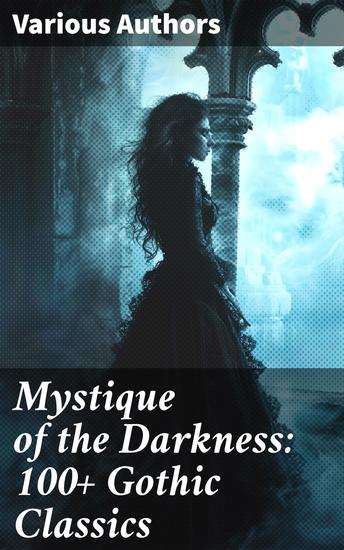
Mystique of the Darkness: 100+ Gothic Classics - Exploring the Shadows: A Treasury of Gothic Tales - cover

Mystique of the Darkness: 100+ Gothic Classics - Exploring the Shadows: A Treasury of Gothic Tales

Charles Dickens, Friedrich Schiller, Oscar Wilde, Robert Louis Stevenson, Edgar Allan Poe, William Hope Hodgson, Joseph Sheridan Le Fanu, George MacDonald, Percy Bysshe Shelley, Bram Stoker, Charlotte Brontë, Emily Brontë, William Godwin, Henry James, Victor Hugo, Théophile Gautier, Arthur Conan Doyle, Joseph Conrad, Guy Boothby, Jane Austen, Mayne Reid, John Meade Falkner, Guy de Maupassant, George Eliot, Samuel Taylor Coleridge, Robert Hugh Benson, Horace Walpole, Frederick Marryat, Thomas Love Peacock, Washington Irving, Nathaniel Hawthorne, Gaston Leroux, Grant Allen, Arthur Machen, Wilkie Collins, Thomas Peckett Prest, James Malcolm Rymer, Robert Browning, Walter Hubbell, Marie Corelli, Charles Brockden Brown, James Hogg, William Blake, Charlotte Perkins Gilman, John Keats, Richard Marsh, Clara Reeve, Charles Robert Maturin, John William Polidori, Lord Byron, W. W. Jacobs, E.F. Benson, M.R. James, E. T. A. Hoffman, George W. M. Reynolds, William Thomas Beckford, Christina Rossetti, Tobias Smollett, Nikolai Gogol, Mary Shelley, Edward Bulwer-Lytton, Ann Radcliffe, Matthew Gregory Lewis, Eliza Parsons, Eleanor Sleath, Emile Erckmann, Alexandre Chatrian

Translator C.J. Hogarth, Samuel Henley, Isabel F. Hapgood

Publisher: Good Press

  • 0
  • 0
  • 0

Summary

Mystique of the Darkness: 100+ Gothic Classics is an unparalleled anthology that delves deep into the shadowy corridors of the Gothic tradition. Encompassing a vast spectrum of literary styles, from the hauntingly romantic to the chillingly sinister, this collection explores the themes of human folly, supernatural dread, and the fragile boundaries between life and death. Etching a tapestry of fear and fascination, the anthology includes pieces that, while crafted by different hands, collectively evoke a shivering intimacy with the unknown'Äîhighlighted by tales of gothic horror and melancholic beauty that hook the reader from the first sentence. The collection is a testament to the collective genius of its contributors, including luminaries such as Charles Dickens, Edgar Allan Poe, and Mary Shelley, all of whom have left an indelible mark on gothic literature. Their careers span a wide arc of literary movements, from Romanticism to Victorian anxiety, each contributing threads to the pattern that defines the Gothic genre. Diverse in voice and rich in historical context, these authors provide a multifaceted exploration of the uncanny and the sublime, grounded in the specific fears and fantasies of their times. Scholars, literary enthusiasts, and casual readers alike are invited to embark on this journey through "Mystique of the Darkness." This carefully curated volume offers a unique portal into the depths of the dark, allowing readers to immerse themselves in the beauty of linguistic expression and thematic insight. As you traverse the myriad worlds within, be prepared for an enlightening experience that nourishes the intellect and stirs the soul, showcasing the timeless allure of these gothic masterpieces. Whether for educational pursuit or sheer appreciation of the arts, this anthology promises to enrich every reader's literary landscape.
Available since: 12/29/2023.
Print length: 18745 pages.
Other books that might interest you

  • The Devil in the Belfry - From their pens to your ears genius in every story - cover

    The Devil in the Belfry - From...

    Edgar Allan Poe

    • 0
    • 0
    • 0
    Edgar Poe was born in Boston Massachusetts on 19th January 1809. His father abandoned his family the following year and within a year his mother had died leaving him an orphan.   
    He was taken in by the Allan family but never formally adopted although he now referred to himself as Edgar Allan Poe.  His father alternatively spoiled or chastised him and tension was frequent over gambling debts and monies for his education.  His university years to study ancient and modern languages was cut short by lack of money and he enlisted as a private in the army claiming he was 22, it is more probable he was 18. After 2 years he obtained a discharge in order to take up an appointment at the military academy, West Point, where he failed to become an officer. 
    Poe had released his 1st poetry volume in 1827 and after his 3rd turned to prose and placing short stories in several magazines and journals.  At age 26 he obtained a licence to marry his cousin.  She was a mere 13 but they stayed together until her death from tuberculosis 11 years after. 
    In January 1845 ‘The Raven’ was published and became an instant classic.  Thereafter followed the prose works for which he is now so rightly famed as a master of the mysterious and the macabre. 
    Edgar Allan Poe died at the tragically early age of 40 on 7th October 1849 in Baltimore, Maryland. Newspapers at the time reported Poe's death as ‘congestion of the brain’ or ‘cerebral inflammation’, common euphemisms for death from disreputable causes such as alcoholism but the actual cause of death remains a mystery. 
    Poe is also one of a number of authors credited with inventing the detective genre with his Parisian sleuth C. Auguste Dupin.  He featured in three stories including the legendary ‘Murders in the Rue Morgue’ and by sheer deduction, logic and a touch of Gallic arrogance revealed what was hidden to the rest of us.
    Show book
  • Night Poetry - Read & Written By - cover

    Night Poetry - Read & Written By

    Rachel Lawson

    • 0
    • 1
    • 0
    A book of poems of the night and a gift short story Stand and Deliver - In the Moonlight 
    Read by the Author
    Show book
  • This Side of Paradise - cover

    This Side of Paradise

    F Scott itzgerald

    • 0
    • 0
    • 0
    Embark on a captivating journey into the Jazz Age with "This Side of Paradise" by F. Scott Fitzgerald, now available as a mesmerizing audiobook. In this groundbreaking novel, listeners will be transported to the vibrant world of post-World War I America, where they'll follow the tumultuous life of the enigmatic protagonist, Amory Blaine. 
    As the story unfolds, listeners will be swept up in Amory's quest for love, success, and meaning in a rapidly changing world. From his days as a privileged young man at Princeton University to his adventures in New York City's high society, Fitzgerald's evocative prose captures the spirit of a generation grappling with the promise and disillusionment of the American Dream. 
    Perfect for fans of classic literature and coming-of-age stories, this audiobook delivers a compelling performance that will transport listeners to another time and place. Whether you're a longtime admirer of Fitzgerald's work or new to his writing, "This Side of Paradise" promises to enchant and captivate. 
    So, if you're ready to experience the glamour, romance, and tragedy of the Roaring Twenties, start listening to "This Side of Paradise" today and immerse yourself in the timeless allure of F. Scott Fitzgerald's masterpiece. Start Listening to "This Side of Paradise" today!
    Show book
  • A Slav Soul - From their pens to your ears genius in every story - cover

    A Slav Soul - From their pens to...

    Alexander Kuprin

    • 0
    • 0
    • 0
    Alexander Kuprin was born in Narovchat, Penza in Russia on 7th September 1870. 
    At 3 his Father died and he and mother moved to Moscow. By 10 he was enrolled at the Second Moscow Military High School and there his interest in literature began. The Alexander Military Academy followed and two years later he was a sub-lieutenant and posted to an Infantry Regiment for a further four years. 
    Despite his duties he was a now a keen writer and published his first short story at this time. His military duties also garnered him experiences for his breakthrough work ‘The Duel’.  Leaving the military he left for Kiev to work for local newspapers.  He continued to publish both stories and novels and by 1901 he was in St Petersburg becoming part of a group that included Chekhov, Ivan Bunin, Maxim Gorky and Leonid Andreyev.  
    In the years that followed further controversial works and acclaim followed.  His comments on the regime meant he was also put under secret police surveillance.   
    As World War I erupted, Kuprin opened a military hospital but was then given command of an infantry company in Finland. He was soon discharged on grounds of ill health.  
    The October Revolution saw him praise Lenin, but he warned that the Bolsheviks threatened Russian culture and might cause further widespread suffering to the peasants.  As Civil War raged he took his family to Helsinki and then on to Paris. 
    Exile saw his talents decline further and his succumbing to alcoholism. He became lonely and withdrawn. The family's poverty increased his malaise.   
    In May 1937, the Kuprin’s returned to Moscow.  He now saw his work published but wrote almost nothing new.  In 1938 his health rapidly deteriorated.  Already suffering from a kidney problems and sclerosis, he had now developed cancer of the oesophagus.  
    Alexander Kuprin died on 25th August 1938.
    Show book
  • Drowning In Their Darkness - cover

    Drowning In Their Darkness

    M.H. Lee

    • 0
    • 0
    • 0
    What If You Couldn't Say No To Others But They Never Knew?Empathy should have its limits. But for Freya it doesn't. When others are around she finds herself bending to their will, unable to tell anyone what she wants, unable to assert herself or defend herself. Can she find a way forward or will she forever be drowning in their darkness?PG-13
    Show book
  • Pretty Ugly - cover

    Pretty Ugly

    Kirsty Gunn

    • 0
    • 0
    • 0
    Contradictions (both real and apparent), oppositions, enigmas, provocations, challenges——this is the kind of material that makes a life, and is the kind of material that, in fiction, one is never quite sure of. With Pretty Ugly, Kirsty Gunn reminds us again that she is a master of just such stuff, presenting ambiguity and complication as the essence of the storyteller's endeavour.
    The sheer force of life that Gunn is able to load these stories up with is both testament to her unrivalled skill and an exercise in what she describes as 'reading and writing ugly', in order to pursue the deeper truths that lie at the heart of both the human imagination and human rationality.
    So here we have all the strange and seemingly impossible dualities that make up real life——and pretty ugly it can be, as well as beautiful, hopeful, bleak, difficult, exhilarating. But never, ever dull.
    Show book