¡Acompáñanos a viajar por el mundo de los libros!
Añadir este libro a la estantería
Grey
Escribe un nuevo comentario Default profile 50px
Grey
Suscríbete para leer el libro completo o lee las primeras páginas gratis.
All characters reduced
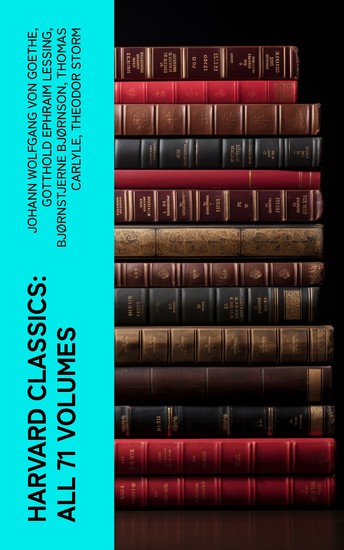
Harvard Classics: All 71 Volumes - cover

Harvard Classics: All 71 Volumes

Edgar Allan Poe, George Eliot, William Shakespeare, Juan Valera, Pedro Calderón de la Barca, Mark Twain, Jane Austen, Jonathan Swift, Daniel Defoe, Henry David Thoreau, Washington Irving, Niccolò Machiavelli, Nathaniel Hawthorne, Henry James, Adam Smith, Hans Christian Andersen, Michel de Montaigne, John Stuart Mill, Samuel Taylor Coleridge, Guy de Maupassant, David Hume, Thomas De Quincey, Saint Augustine, Immanuel Kant, René Descartes, Martin Luther, Marcus Aurelius, Francis Bacon, John Bunyan, Christopher Marlowe, Richard Henry Dana, William Makepeace Thackeray, Laurence Sterne, Ralph Waldo Emerson, Plutarch Plutarch, Oliver Goldsmith, Dante Alighieri, Pliny the Younger, Robert Burns, Benvenuto Cellini, Robert Louis Stevenson, Thomas Carlyle, John Ruskin, Edward Everett Hale, Percy Bysshe Shelley, George Berkeley, Oliver Wendell Holmes, John Dryden, Robert Browning, Joseph Addison, Bret Harte, Samuel Johnson, William Hazlitt, Edmund Burke, Alphonse Daudet, Alfred de Musset, Thomas Babington Macaulay, George Sand, Gotthold Ephraim Lessing, Pierre Corneille, Wilhelm Grimm, Henry Fielding, Richard Steele, William Penn, Jean-Jacques Rousseau, John Fletcher, Francis Beaumont, John Locke, Philip Massinger, Sydney Smith, Aeschylus Aeschylus, Charles Lamb, Benjamin Franklin, Richard Brinsley Sheridan, James Russell Lowell, Walter Scott, Theodor Storm, Simon Newcomb, Alessandro Manzoni, Ivan Turgenev, Thomas More, Theodor Fontane, Leigh Hunt, Abraham Cowley, Izaak Walton, Blaise Pascal, Thomas Hobbes, Virgil Virgil, Plato, Jean Racine, Bjørnstjerne Bjørnson, Gottfried Keller, Ernest Renan, Thomas A'kempis, Friedrich von Schiller, Tacitus Tacitus, Honore Balzac, John Webster, Victor Hugo, Fyodor Dostoevsky, Thomas Brown, Michael Faraday, Giuseppe Mazzini, Johann Wolfgang von Goethe, George Gordon Byron, William Harvey, Thomas Dekker, Hippocrates Hippocrates, Charles Darwin, Ben Jonson, Joseph Lister, Francis Drake, Walter Bigges, Walter Raleigh, Charles W. Eliot, William Henry Harrison, Francis Pretty, Edward Haies, Jean Froissart, Miguel de Cervantes, Philip Sidney, John Woolman, Ambroise Paré, Louis Pasteur, Alexander L. Kielland, Leo Tolstoy, Marcus Tullius Cicero, William Roper, Charles-Augustin Sainte-Beuve, John Milton, David Garrick, Philip Nichols, Hermann Ludwig Ferdinand von Helmholtz, Archibald Geikie, William A. Neilson, Euripides, Sophocles, Aristophanes, Herodotus, Voltaire, Epictetus, Molière Molière, Thomas Malory, Aesop Aesop, Homer Homer

Editorial: e-artnow

  • 0
  • 0
  • 0

Sinopsis

e-artnow presents to you this unique and meticulously edited collection by Dr. Eliot:  The Harvard Classics: V. 1: Franklin, Woolman & Penn V. 2: Plato, Epictetus & Marcus Aurelius V. 3: Bacon, Milton, Browne V. 4: Poems by John Milton V. 5: R. W. Emerson V. 6: Poems by Robert Burns V. 7: St Augustine & Thomas á Kempis V. 8: Nine Greek Dramas  V. 9: Cicero and Pliny V. 10: The Wealth of Nations V. 11: The Origin of Species V. 12: Plutarch's Lives V. 13: Æneid V. 14: Don Quixote V. 15: Bunyan & Walton V. 16: Thousand and One Nights V. 17: Folklore & Fable V. 18: Modern English Drama V. 19: Goethe & Marlowe V. 20: The Divine Comedy V. 21: I Promessi Sposi V. 22: The Odyssey V. 23: Two Years Before the Mast V. 24: Edmund Burke V. 25: J. S. Mill & T. Carlyle V. 26: Continental Drama V. 27 & 28: English and American Essays V. 29: The Voyage of the Beagle V. 30: Scientific Papers V. 31: The Autobiography of Benvenuto Cellini V. 32: Literary and Philosophical Essays V. 33: Voyages & Travels V. 34: French & English Philosophers V. 35:  Chronicle and Romance V. 36: Machiavelli, Roper, More, Luther V. 37: Locke, Berkeley, Hume V. 38: Harvey, Jenner, Lister, Pasteur V. 39: Prefaces and Prologues V. 40–42: English Poetry V. 43: American Historical Documents V. 44 & 45: Sacred Writings V. 46 & 47: Elizabethan Drama V. 48: Blaise Pascal V. 49: Epic and Saga V. 50: Reader's Guide V. 51: Lectures The Shelf of Fiction: V. 1 & 2: The History of Tom Jones V. 3: A Sentimental Journey & Pride and Prejudice  V. 4: Guy Mannering V. 5 & 6: Vanity Fair V. 7 & 8: David Copperfield V. 9: The Mill on the Floss V. 10: Hawthorne, Irving, Poe, Harte, Twain, Hale V.11: The Portrait of a Lady V. 12: Notre Dame de Paris V. 13: Balzac, Sand, de Musset, Daudet, de Maupassant V. 14 & 15: Goethe, Keller, Storm, Fontane V. 16–19: Tolstoy, Dostoevsky, Turgenev V. 20: Valera, Bjørnson, Kielland
Disponible desde: 13/12/2023.
Longitud de impresión: 30498 páginas.


Otros libros que te pueden interesar

  • The Turn - cover

    The Turn

    Dennis Joiner

    • 0
    • 0
    • 0
    This book looks at American life during a pivotal time (1950-2024) in American history: the Turn. It covers the postwar booms, social movements, the Reagan revolution, the Gulf wars, the war on terror as well as counterculture, protest movements, and the election of two unique presidents. The Turn looks at 75 years from the perspective of social change and modes of thought and the concomitant tension, conflict, and controversy that disaffected Americans who, despite their best efforts to live normal lives, could not escape from a miasma of discontent. The wars, the violence associated with protests, financial crises and a global pandemic, all came at great human cost to many Americans families. This book looks at effects of these occurrences on American society: examining such topics as illiberal religions, the corrupt media, the trappings of greed in politics, globalism, the woke culture; the role of film, television, and music; and more.
    Ver libro
  • The Gods of the Nile - Exploring Ancient Egyptian Deities and Their Stories - cover

    The Gods of the Nile - Exploring...

    Julia Blacksmith

    • 0
    • 0
    • 0
    Ancient Egypt was a civilization deeply rooted in religion, where gods and goddesses played an essential role in shaping daily life, governance, and the afterlife. The Egyptian pantheon was vast, with deities representing natural forces, human emotions, and cosmic order. These gods were not distant or abstract figures but were actively involved in the lives of the people, influencing everything from the flooding of the Nile to the fate of the soul after death. The Egyptians believed that by honoring their gods through rituals, prayers, and temple offerings, they could maintain harmony in the universe.  
    One of the defining aspects of Egyptian religion was its polytheistic nature. Unlike monotheistic faiths, which center around a single divine being, the Egyptians worshipped hundreds of gods, each with unique attributes, symbols, and responsibilities. Some, like Ra, the sun god, were powerful and widely revered, while others, such as Taweret, the hippo goddess of childbirth, had more specialized roles. Many deities evolved over time, merging with others or taking on new characteristics as different cities and dynasties rose to prominence. This fluidity allowed Egyptian religion to remain relevant for over three thousand years.  
    The gods were not only worshipped in grand temples but were also deeply integrated into the personal lives of the people. Pharaohs were believed to be divine or semi-divine figures, ruling as representatives of the gods on Earth. Priests conducted elaborate ceremonies in temple complexes dedicated to major deities, ensuring their favor and protection over the land. Ordinary Egyptians also kept small shrines in their homes, prayed to household gods for blessings, and wore protective amulets bearing sacred symbols. Magic and mythology were intertwined with religious practice, with spells and sacred texts often invoking the names of gods for healing, guidance, and protection. 
    Ver libro
  • The Outline Of Sanity - cover

    The Outline Of Sanity

    G.K. Chesterton

    • 0
    • 0
    • 0
    The experiments of both Capitalism and Communism are almost complete, and they both lead to one big organization controlling everything you do. In 1925, when this book was first published, it was true, and it is even truer today.If you desire an alternative, consider this book, which considers Distributism, a philosophy whereby the actual people own the actual means of production, and produce and sustain themselves with it. A philosophy summed up in Chesterton's famous proposal of "Three acres and a cow" as being catalyst to an ideal peasant state.For such a simple idea, it has proven very contrary to the ideas of those in power, which is to say, to those who want power.  But for the rest of us, for the sane humans who desire peace and liberty, this book is a call to action against monopoly and the inevitability of global standardization, which the magazines call the Supply Chain and the Bible might call Babel and Babylon. Narrated in an accent based upon Chesterton's own, this performance expresses Chesterton's words as he himself might have, delivering them to an audience of his time.
    Ver libro
  • Social Skills Guidebook Bundle 2 in 1 Bundle - cover

    Social Skills Guidebook Bundle 2...

    Nathan Quincy, Steven Arnold

    • 0
    • 0
    • 0
    Social Skills Guidebook Bundle, 2 in 1 Bundle: The Art and Science of Small Talk and Read People Like a BookIf you feel you are lacking in social skills, this bundle can help you overcome some of your shortcomings. Interacting with other people and making small talk is one of the things most people are having trouble doing. Small talk is a powerful yet underutilized tool that can go a long way if done gracefully. In this bundle, you will learn the techniques to gracefully jumpstart a conversation with anyone in any situation. Whether we like it or not, there’s no way we can escape small talk because it is part of everyday interactions. Humans are social creatures and we use conversation as our way to emotionally connect with each other. Another thing that can help our social skills is learning how to read people and their body language.. In this bundle, you will learn ways to improve not just your communication skills but also your social skills through the art and science of small talk. It will help you improve your communication and social skills through the art of small talk. You will also learn the true power of reading and analyzing other people and how it can help you create more meaningful relationships in your life.This 2 in 1 bundle includes the following audiobooks:1. The Art and Science of Small Talk: Learn How to Talk to Anyone with Grace and Charisma2. Read People Like a Book: A Cheat Code to Forge Strong Connections With the People Around YouIf you want to learn more, download your copy of the Social Skills Guidebook Bundle today!
    Ver libro
  • History of African Kingdoms - Civilizations of Ancient Africa including the Kingdom of Kush the Land of Punt Carthage the Kingdom of Aksum the Mali Empire - cover

    History of African Kingdoms -...

    Will Forrest

    • 0
    • 0
    • 0
    Unlock The Mysteries Of Ancient African Kingdoms 
    Are you ready to embark on a journey through time? 
    With this book, you can explore some of Africa’s most mysterious and powerful ancient kingdoms - from the Land of Punt to the Kingdom of Kush - unlocking their secrets with every page. 
    This book delves deep into each kingdom's culture, society and leadership. You'll uncover the stories behind their rise to power and learn how they influenced history long after they fell from grace. Plus, you'll gain valuable insight into why these ancient civilizations are still so important today. 
    So don't wait any longer! Get your copy now and start discovering all that Ancient African Kingdoms have to offer!
    Ver libro
  • How God Thinks - Revealing God's Heart through the Language of Symbolism - cover

    How God Thinks - Revealing God's...

    David Vancelette

    • 0
    • 0
    • 0
    God created us in his image. This places a great burden on each person to not break that image of God within us. God thinks in symbols and so do we. There is always punishment for broken symbolism. Questions considered are, what does God think about: Gender, marriage, sex, the Cross as broken, not fulfilled symbolism? Why did God punish Moses so harshly when he struck the Rock in the wilderness the second time? Why is God allowing seemingly innocent victims to die by random shooters? Why does God see the climate change movement as idolatry? Why did Satan devise homosexuality? Why did God assign the death penalty for male but not female homosexuality? Why is having multiple wives acceptable in the Old Testament, but not having multiple husbands? All these topics, and many others, have to do with symbolism and are explained by How God Thinks.
    Ver libro