Join us on a literary world trip!
Add this book to bookshelf
Grey
Write a new comment Default profile 50px
Grey
Subscribe to read the full book or read the first pages for free!
All characters reduced
30 Mystery & Investigation masterpieces - cover

30 Mystery & Investigation masterpieces

Edgar Allan Poe, Mark Twain, Wilkie Collins, William Le Queux, Carolyn Wells, Maurice Leblanc, Arthur Conan Doyle, Hanns Heinz Ewers, Catherine Louisa Pirkis, Frank R. Stockton, Gilbert Keith Chesterton, Ryūnosuke Akutagawa, Fred Merrick White, Thomas Hardy, Hollis Godfrey, Jules Verne, Gaston Leroux, Zenith Ivory Tower Publications

Publisher: Zenith Ivory Tower Publications

  • 0
  • 0
  • 0

Summary

Mysterious murders. Brilliant detectives. Twisting plots.
30 Mystery & Investigation Masterpieces is your ultimate collection of legendary crime fiction—packed with shadowy suspects, cunning sleuths, and unforgettable suspense.

From foggy Victorian London to quiet country manors, these thirty timeless tales feature some of the most iconic figures in detective fiction, including Sherlock Holmes, Hercule Poirot, and Father Brown. With crimes to solve, clues to follow, and secrets to uncover, every page invites you deeper into the mystery.

📚 Includes works by:

Arthur Conan Doyle (Sherlock Holmes)

Agatha Christie (Poirot short stories)

Edgar Allan Poe (The Murders in the Rue Morgue)

G.K. Chesterton (Father Brown)

Wilkie Collins (The Moonstone, The Woman in White)

Anna Katharine Green

Émile Gaboriau (Monsieur Lecoq)

R. Austin Freeman (Dr. Thorndyke)

E.W. Hornung (Raffles)

Mary Roberts Rinehart (The Circular Staircase)

And many more...

This anthology spans the golden age of detective fiction and beyond—bringing you everything from locked-room puzzles and psychological thrillers to courtroom dramas and clever alibis.

"An essential library for any fan of mystery fiction." — The Crime Reader's Review
"Every classic detective story you need—in one thrilling volume." — Goodreads Reviewer
"This is where mystery began—and where it shines brightest." — Mystery Writers of America

Perfect for fans of Sherlock Holmes, Agatha Christie, and vintage whodunits, this collection offers hours of clever storytelling and page-turning suspense.

Click 'Buy Now' and dive into 30 thrilling mysteries where every page brings you closer to the truth.
Available since: 07/24/2025.
Print length: 6171 pages.
Other books that might interest you

  • The Secret Agent - cover

    The Secret Agent

    Joseph Conrad

    • 0
    • 0
    • 0
    The Secret Agent is Joseph Conrad's darkly ironic and unsettling novel of espionage, terrorism, and political hypocrisy, set in the heart of late Victorian London. Blending psychological insight with grim satire, the novel exposes the emptiness of extremist ideologies and the devastating human cost of political manipulation.
    
    The story centers on Adolf Verloc, a seemingly idle shopkeeper who secretly works as an informant and agent provocateur. Pressured by foreign officials to commit an act of political violence, Verloc becomes entangled in a plot that spirals beyond his control. At the center of the tragedy is his wife, Winnie Verloc, whose quiet endurance and unspoken strength mask a life shaped by sacrifice and moral compromise.
    
    Told through a fragmented, non-linear narrative, Conrad reveals events from multiple perspectives, deepening the novel's atmosphere of inevitability and dread. London itself becomes a character—fog-bound, indifferent, and oppressive—mirroring the moral darkness of the plot unfolding within it.
    
    Rather than glorifying revolution or espionage, The Secret Agent dismantles the romantic myths surrounding political violence. Conrad portrays anarchists, officials, and ordinary citizens alike as trapped in systems of fear, deception, and self-interest. The novel's chilling climax underscores the destructive consequences of apathy, fanaticism, and moral blindness.
    
    Sharp, provocative, and disturbingly relevant, The Secret Agent stands as one of the earliest and most penetrating novels about modern terrorism. It is a masterwork of political fiction and psychological realism that continues to resonate in a world still shaped by ideological conflict and hidden power.
    Show book
  • Hunchback of Notre-Dame The (Book 4) - cover

    Hunchback of Notre-Dame The...

    Victor Hugo

    • 0
    • 0
    • 0
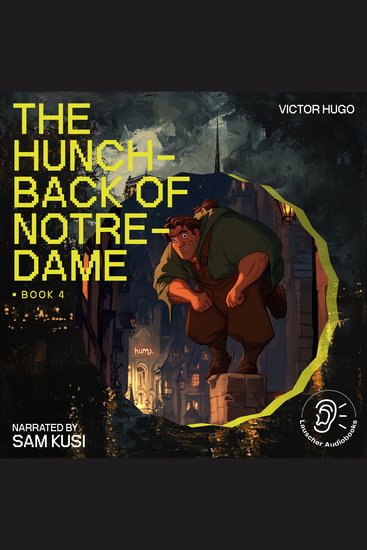
    Book 4: The Hunchback of Notre-Dame or Notre-Dame de Paris is a French Gothic novel by Victor Hugo, published in 1831. - The story is set in Paris in 1482 during the reign of Louis XI. The gypsy Esmeralda (born as Agnes) captures the hearts of many men, including those of Captain Phoebus and Pierre Gringoire, but especially Quasimodo and his guardian Archdeacon Claude Frollo. Frollo is torn between his obsessive lust for Esmeralda and the rules of Notre Dame Cathedral. He orders Quasimodo to kidnap her, but Quasimodo is captured by Phoebus and his guards, who save Esmeralda. Gringoire, who attempted to help Esmeralda but was knocked out by Quasimodo, is about to be hanged by beggars when Esmeralda saves him by agreeing to marry him for four years.
    Show book
  • Boarding House The (Unabridged) - cover

    Boarding House The (Unabridged)

    James Joyce

    • 0
    • 0
    • 0
    James Augustine Aloysius Joyce (2 February 1882 - 13 January 1941) was an Irish novelist, short story writer, poet and literary critic. He contributed to the modernist avant-garde movement and is regarded as one of the most influential and important writers of the 20th century.
    THE BOARDING HOUSE: Mrs Mooney was a butcher's daughter. She was a woman who was quite able to keep things to herself: a determined woman. She had married her father's foreman and opened a butcher's shop near Spring Gardens.
    Show book
  • The Western in 10 classics Vol-1 - cover

    The Western in 10 classics Vol-1

    Washington Irving, Samuel...

    • 0
    • 0
    • 0
    What built the legend of the American West?
    
    The Western in 10 Classics Vol. 1 is a powerful collection of classic Western stories that capture the spirit of the frontier—where law was fragile, courage was tested, and survival demanded grit. These timeless tales bring to life vast open landscapes, rugged heroes, dangerous outlaws, and the harsh moral codes of the Old West.
    
    Spanning gunfights, frontier justice, survival, and honor, this anthology showcases how Western literature shaped the myth and reality of America's expansion. Each story reflects a world of dust and determination, where character mattered more than comfort.
    
    Whether you love action, adventure, or the raw drama of frontier life, this collection delivers unforgettable storytelling rooted in American legend.
    
    Inside this eBook, you'll discover:
    
    Ten classic Western stories by influential authors
    
    Tales of frontier justice, bravery, and survival
    
    Rich depictions of the American West and pioneer life
    
    A foundational collection of Western literature classics
    
    Ideal for fans of Western fiction, classic adventure, and American history, this volume offers a thrilling journey into the heart of the Old West.
    
    Ride into the frontier where legends are born. Buy now and experience ten timeless Western classics.
    Show book
  • Dead Souls - Audiobook - cover

    Dead Souls - Audiobook

    Nikolai Gogol, Classic...

    • 0
    • 0
    • 0
    In Dead Souls, Nikolai Gogol crafts a brilliant satirical portrait of 19th-century Russian society. The novel follows the mysterious and cunning Pavel Ivanovich Chichikov as he travels from town to town, attempting to buy the ownership rights to dead serfs in order to gain wealth and status through a bizarre loophole in the Russian system.Through absurdity, irony, and vivid characterization, Gogol exposes the moral decay and bureaucratic nonsense of imperial Russia. At once comedic and deeply philosophical, Dead Souls is considered one of the great masterpieces of Russian literature, a novel that is as relevant and haunting today as it was in Gogol's time.
    Show book
  • Candide - cover

    Candide

    Voltaire

    • 0
    • 0
    • 0
    Candide is characterised by its sarcastic tone, as well as by its erratic, fantastical and fast-moving plot. A picaresque novel with a story similar to that of a more serious bildungsroman, it parodies many adventure and romance clichés, the struggles of which are caricatured in a tone that is mordantly matter-of-fact. Still, the events discussed are often based on historical happenings, such as the Seven Years' War and the 1755 Lisbon earthquake. As philosophers of Voltaire's day contended with the problem of evil, so too does Candide in this short novel, albeit more directly and humorously.    Voltaire ridicules religion, theologians, governments, armies, philosophies, and philosophers through allegory; most conspicuously, he assaults Leibniz and his optimism. Voltaire's men and women point his case against optimism by starting high and falling low. A modern could not go about it after this fashion. He would not plunge his people into an unfamiliar misery. He would just keep them in the misery they were born to. But such an account of Voltaire's procedure is as misleading as the plaster cast of a dance.    Look at his procedure again. Mademoiselle Cunégonde, the illustrious Westphalian, sprung from a family that could prove seventy-one quarterings, descends and descends until we find her earning her keep by washing dishes in the Propontis. The aged faithful attendant, victim of a hundred acts of rape by negro pirates, remembers that she is the daughter of a pope, and that in honor of her approaching marriage with a Prince of Massa-Carrara all Italy wrote sonnets of which not one was passable. We do not need to know French literature before Voltaire in order to feel, although the lurking parody may escape us, that he is poking fun at us and at himself. His laughter at his own methods grows more unmistakable at the last, when he caricatures them by casually assembling six fallen monarchs in an inn at Venice.    A modern assailant of optimism would arm himself with social pity. There is no social pity in "Candide." Voltaire, whose light touch on familiar institutions opens them and reveals their absurdity, likes to remind us that the slaughter and pillage and murder which Candide witnessed among the Bulgarians was perfectly regular, having been conducted according to the laws and usages of war. Had Voltaire lived today he would have done to poverty what he did to war. Pitying the poor, he would have shown us poverty as a ridiculous anachronism, and both the ridicule and the pity would have expressed his indignation.
    Show book