Join us on a literary world trip!
Add this book to bookshelf
Grey
Write a new comment Default profile 50px
Grey
Subscribe to read the full book or read the first pages for free!
All characters reduced
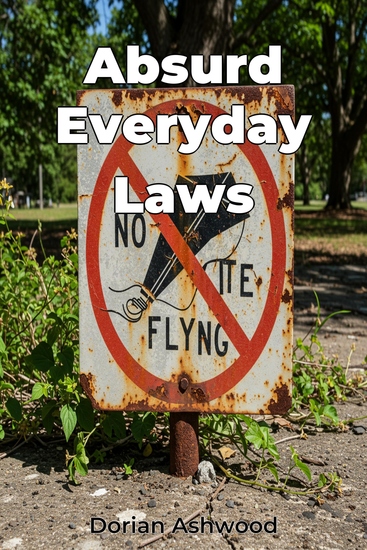
Absurd Everyday Laws - cover

Absurd Everyday Laws

Dorian Ashwood

Translator A AI

Publisher: Publifye

  • 0
  • 0
  • 0

Summary

Absurd Everyday Laws explores the strange and often humorous regulations still in existence today, offering insights into legal history, social control, and the evolution of social norms. It's more than just a list of oddities; it reveals how seemingly nonsensical laws reflect the values and anxieties of past societies, influencing our lives even now. For instance, the book examines how laws governing everything from food and drink to personal conduct originated, and why some, like prohibitions on Sunday alcohol sales, persist.

 
The book approaches its subject by first introducing the concept of absurd laws and their origins, from historical context to unintended legislative consequences. It then delves into themed chapters focusing on laws related to areas such as food, transportation, and public behavior, providing historical context for each.

 
Finally, Absurd Everyday Laws analyzes the implications of these laws, examining their roles in society, the legal challenges they present, and arguments for and against their repeal, ultimately offering a framework for evaluating laws in a changing world, making it valuable for those interested in social science or politics.
Available since: 04/03/2025.
Print length: 69 pages.

Other books that might interest you

  • Emily Dickinson: 15 Poems and Analyses - with an Original Piano Underscore Adapted for each Poem - cover

    Emily Dickinson: 15 Poems and...

    Emily Dickinson, A. M. Bly

    • 0
    • 0
    • 0
    This audiobook is narrated by an AI Voice.   
    "Emily Dickinson: 15 Poems and Analyses; with an Original Piano Underscore Adapted for Each Poem" brings the quiet power of one of America’s greatest poets to life in a fresh, immersive way. Each poem is presented with a uniquely crafted piano backdrop, composed to reflect the emotion, rhythm, and inner music of Dickinson’s words. 
    From the blinding stillness of “A Light Exists In Spring” to the mind-numbing irony of “Your Riches Taught Me Poverty,” the gentle interplay of voice and piano invites listeners into the intimate spaces where her poetry lives and breathes. The result is an experience that feels both timeless and newly awakened. 
    Perfect for poetry lovers, meditative listening, or anyone seeking a moment of reflection, this curated collection offers a graceful fusion of literature and music—celebrating Emily Dickinson’s brilliance in a form that resonates long after the final note fades. 
    The works of Emily Dickinson are in the public domain.
    Show book
  • Italian History - From Ancient Rome to Modern Italy - cover

    Italian History - From Ancient...

    History Retold

    • 0
    • 0
    • 0
    Have you ever wondered how Italy's past was? 
    Do you want to travel back in time and witness the grand roman empire? 
    If so, this is for you. 
    Embark on a captivating voyage through Italy's history, from enigmatic Etruscans to modern marvels. Unveil secrets of ancient civilizations, feel Rome's grandeur, and bask in Renaissance brilliance. Witness unification and transformative triumphs, shaping Italy's role in the modern European Union. 
    This book guides you through time, revealing Italy's vibrant past. For history enthusiasts or curious travelers, it's a treasure trove illuminating Italy's remarkable journey, consisting of:Etruscan roots and Roman Empire zenith.Renaissance brilliance ignites art and thought.Unification struggle births modern Italy.World Wars' toll and resilient revival.European Union embrace, lasting influence.Culinary legacy, fashion, cinematic allure.A tapestry of old and new, Italy thrives. 
    Don´t wait any longer! Scroll up and buy this book now!
    Show book
  • Patriarchy Inc - What We Get Wrong About Gender Equality - And Why Men Still Win at Work - cover

    Patriarchy Inc - What We Get...

    Cordelia Fine

    • 0
    • 0
    • 0
    Work remains much as it always has: men occupy the vast majority of leadership roles and are overrepresented in positions from engineer to plumber. We see many jobs as "male" or "female," with women dominating in healthcare and childcare professions. Pretending that this is the natural state of things―or that, instead, both sexes should submit to working 24/7—is just not right. 


    In Patriarchy Inc., Cordelia Fine examines with razor-sharp and quick-witted analysis why gender inequality is embedded in the workplace and why it has to change. Drawing on theories from evolutionary science, psychology, economics, and sociology, she examines two of the most prominent movements in the corporate world. The Different But Equal viewpoint espouses that women are in the jobs they want despite their lower status and salaries. In the meantime, DEI (Diversity, Equity, Inclusion) has become a slogan that emphasizes productivity and profit, not fair play. Fine shows how both are wrong and the bad effects on everyone when men are still stuck in traditional breadwinner roles and women are having to fight for their due. 


    Offering perceptive and much-needed insight into the current state of work, Patriarchy Inc. explores how we can get closer to achieving equality, even if it means upturning business as usual.
    Show book
  • American Bulk - Essays on Excess - cover

    American Bulk - Essays on Excess

    Emily Mester

    • 0
    • 0
    • 0
    What if we explored our relationship to consumption with the same depth and feeling we use to tell stories of great loves and losses? 


    Americans are caught up in bulk. We guiltily watch Amazon boxes pile up on the porch, wade through endless reviews to find the perfect product, and crave the comforting indulgence of a chain restaurant. In American Bulk, Emily Mester intertwines cultural critique and personal history to explore how the things we buy, eat, amass, and discard become an intimate part of our lives. With humor and sharp intellect, she reflects on the joys and anxieties of family Costco trips, how a seasonal stint at Ulta Beauty taught her the insidious art of the sale, and what it means to get Mall Sad. In a nuanced examination of diet culture and fatness, Mester recounts her teenage summer at fat camp and the unexpected liberation she finds there. Finally, she ventures to Storm Lake, Iowa, to reckon with her grandmother's abandoned hoard, excavating the dysfunction that lies at the heart of her family's obsession with stuff. American Bulk introduces listeners to a striking new literary talent from the American heartland, one who dares to ask us to regard consumption not with guilt but with grace and empathy.
    Show book
  • Lost Worlds - Myths of Forgotten Civilizations (3 in 1) - cover

    Lost Worlds - Myths of Forgotten...

    Julia Blacksmith

    • 0
    • 0
    • 0
    Lost Worlds takes readers on a mesmerizing journey through ancient myths, mysterious ruins, and legendary beings from civilizations long past. This 3-in-1 collection explores the enduring enigma of The Legend of Atlantis, the rich spiritual cosmology of The Myths of the Maya, and the fantastic beings found in Mythical Creatures of the World. Each section unveils the imagination and belief systems of lost cultures that continue to inspire wonder and speculation today. 
    Begin with Atlantis, the fabled sunken city described by Plato—an advanced civilization wiped away in a single day and night. Was it real, metaphorical, or something in between? This section dives into the theories, symbolism, and global fascination with one of the most famous lost civilizations. Then venture into the rainforests and pyramids of Mesoamerica to discover Maya mythology, where gods, time, and nature were deeply intertwined. These stories reveal a complex worldview filled with powerful deities, sacred calendars, and epic creation myths. 
    Finally, Mythical Creatures of the World unveils a diverse cast of legendary beings from every corner of the globe—from the phoenix and dragon to lesser-known spirits, monsters, and hybrids. These creatures reflect humanity’s hopes, fears, and the magic we see in the unknown. Lost Worlds offers a captivating exploration of civilizations we’ve lost—but whose stories continue to live on.
    Show book
  • Ending the World Wars: The History of the Events and Battles that Finished World War I and World War II - cover

    Ending the World Wars: The...

    Charles River Editors

    • 0
    • 0
    • 0
    For much of 1917, things went the Germans’ way. With the Bolshevik Revolution underway, the Germans were able to move soldiers to the Western front as the Russians quit the war. Moreover, the Allied powers had failed badly in its Nivelle Offensive in May 1917 and suffered a defeat in November against at the Battle of Caporetto in Slovenia. Unbelievably, the French and British had not bothered to coordinate their commands until after those defeats: they finally formed a Supreme Council to coordinate their armies’ movements and strategies. However, the Allied Powers began a counteroffensive known as the Hundred Days Offensive in August 1918 that was highly successful in pushing the Germans backward. In September, Bulgaria reached a separate armistice with the Allied powers, ceding control of the Balkans and cutting off German supplies. The defeated Ottoman Empire surrendered in late October. As the fortunes of the Central Powers waned, several lands in Austria-Hungary’s empire began declaring independence. Finally, in November, Germany’s Kaiser Wilhelm II was forced into exile, and the Germans reached an armistice with the Allied powers at 11:00 a.m. on November 11, 1918. World War I had finally ended. 
    	After the successful amphibious invasion on D-Day in June 1944, the Allies began racing east toward Germany and liberating France along the way. The Allies had landed along a 50 mile stretch of French coast, and despite suffering 8,000 casualties on D-Day, over 100,000 still began the march across the western portion of the continent. By the end of August 1944, the German Army in France was shattered, with 200,000 killed or wounded and a further 200,000 captured. However, Adolf Hitler reacted to the news of invasion with glee, figuring it would give the Germans a chance to destroy the Allied armies that had water to their backs.
    Show book