Join us on a literary world trip!
Add this book to bookshelf
Grey
Write a new comment Default profile 50px
Grey
Subscribe to read the full book or read the first pages for free!
All characters reduced
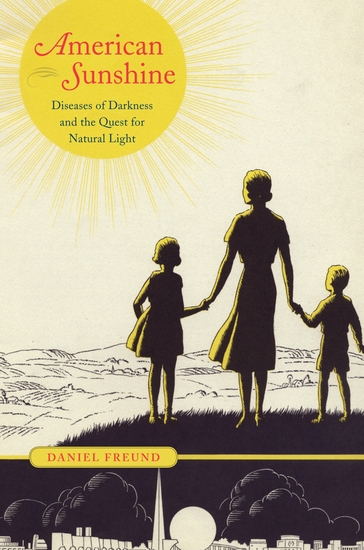
American Sunshine - Diseases of Darkness and the Quest for Natural Light - cover

American Sunshine - Diseases of Darkness and the Quest for Natural Light

Daniel Freund

Publisher: The University of Chicago Press

  • 0
  • 0
  • 0

Summary

In the second half of the nineteenth century, American cities began to go dark. Hulking new buildings overspread blocks, pollution obscured the skies, and glass and smog screened out the health-giving rays of the sun. Doctors fed anxities about these new conditions with claims about a rising tide of the "diseases of darkness," especially rickets and tuberculosis. In American Sunshine, Daniel Freund  tracks the obsession with sunlight from those bleak days into the twentieth century.  Before long, social reformers, medical professionals, scientists, and a growing nudist movement proffered remedies for America’s new dark age. Architects, city planners, and politicians made access to sunlight central to public housing and public health. and entrepreneurs, dairymen, and tourism boosters transformed the pursuit of sunlight and its effects into a commodity. Within this historical context, Freund sheds light on important questions about the commodification of health and nature and makes an original contribution to the histories of cities, consumerism, the environment, and medicine.
Available since: 04/16/2012.
Print length: 226 pages.

Other books that might interest you

  • Portuguese Made Easy - Beginner - Volume 2 of 3 - cover

    Portuguese Made Easy - Beginner...

    Lingo Wave

    • 0
    • 0
    • 0
    We broke our new series on learning Portuguese down into different learning stages. Start with the "Lower Beginner" books followed by the "Beginner" and "Upper Beginner" books. Next, progress to the "Intermediate" series, then test and reinforce your knowledge with the "Conversations" series. 
    This audiobook is divided into units.While it provides different learning patterns and accommodates various needs, this audiobook focuses on helping you improve your ability to understand, speak, and memorise Portuguese.  
    In Unit 1 you will hear Portuguese decoded with each syllable spoken very slowly and clearly with repetition. Immediately before each sentence is spoken, you will hear the translation, so you will always understand what is being said. 
    Unit 2 focuses solely on increasing your listening ability, which will improve your abilities to engage in dialogue with a native Portuguese speaker. This chapter requires you to listen very carefully to nuances in the language. 
    By Unit 3 you will already notice progress in your abilities to speak and understand Portuguese. The spoken translation is followed by two repetitions in Portuguese at a completely natural speed. While you are learning to process naturally spoken Portuguese, Units 3 and 4 will help you memorise new vocabulary and full sentences. 
    In Unit 5 you can test yourself on how much you have learned. If you are having difficulties, we suggest you revisit the listening, speaking, or memorisation section of Units 1, 2 3 or 4, according to what you need more help with. 
    Topics covered in this book: 
    1. Asking about family 
    2. Asking about relationship status 
    3. Expressing frequency 
    4. Talking about spare time activities and hobbies 
    5. Using quantifiers/determiners 
    6. Talking about preference 
    7. Talking about abilities 
    8. Talking about location of places 
    9. Describing appearance 
    10. Talking about personality 
    ...
    Show book
  • Wetiko: The Deceptive Mind–Virus of the Psyche - cover

    Wetiko: The Deceptive Mind–Virus...

    Paulo Levy

    • 0
    • 0
    • 0
    Wetiko is known by many names in many different traditions. It’s a collective psychosis found within the psyche. This psychological force within the unconscious mind feeds off separation and polarization and predisposes us toward unwholesome impulses such as the thirst for power and control, greed, and jealousy. The good news is that the cure is also found within us.
    Show book
  • The Fall of the Berlin Wall - End of the Cold War - cover

    The Fall of the Berlin Wall -...

    Nova Ashford

    • 0
    • 0
    • 0
    The fall of the Berlin Wall in 1989 marked the dramatic end of an era that had shaped global politics for nearly half a century. The Cold War, a period of intense ideological, political, and military tension between the United States and the Soviet Union, had divided the world into two distinct blocs. At the heart of this division stood Germany, and within it, the iconic Berlin Wall—a physical symbol of the separation between East and West. For much of the post-World War II period, this wall was not just a barrier dividing a city but a vivid representation of the ideological conflict between communism and capitalism, between Soviet control and Western freedom.  
    The Cold War began shortly after the end of World War II, as the victorious Allied powers, particularly the United States and the Soviet Union, emerged as the world's superpowers. The ideological rift between these two nations—one advocating for a free-market economy and democracy, the other for a centrally controlled, one-party state—became a defining feature of global politics. The division of Germany into East and West in 1949 symbolized the larger division between East and West, and Berlin, split into sectors controlled by the Allies, became the focal point of this division. 
    The Berlin Wall was erected in 1961 to prevent East Germans from fleeing to the West. It quickly became one of the most visible manifestations of the Cold War. The wall separated families, prevented personal freedoms, and symbolized the repressive nature of the East German regime. For decades, it seemed an unmovable part of the geopolitical landscape. However, by the late 1980s, the winds of change were beginning to stir. Gorbachev’s reforms in the Soviet Union, including policies of glasnost (openness) and perestroika (restructuring), sparked a wave of political change throughout Eastern Europe. As these reforms loosened Soviet control, the call for more political freedom and reform became louder in East Germany.
    Show book
  • Let's Talk - An Essential Guide to Skillful Communication - cover

    Let's Talk - An Essential Guide...

    Mudita Nisker, Dan Clurman

    • 0
    • 0
    • 0
    Communication is the bedrock of our interactions, yet few of us are taught to talk and listen in a way that fosters clarity and connection. Too often, our communication habits lead to misunderstandings, bruised feelings, damaged relationships, and avoidable conflict. 
    Let’s Talk aims to change that. This practical guide gives you a wealth of skills you can use right now to improve your everyday conversations with loved ones, colleagues, and friends—no matter what you’re talking about. 
    These skills will help you: 
    • Address challenging topics with less stress and anxiety. 
    • Feel more confident expressing yourself. 
    • Influence others in respectful ways. 
    • Reduce friction in personal and professional relationships. 
    • Handle conflicts more constructively and with less messy fallout. 
    • Understand others more easily. 
    • Offer helpful support during tough times. 
    Drawing from psychology, sociology, learning theory, and spiritual traditions, Mudita Nisker and Dan Clurman’s unique, comprehensive approach to one-on-one communication is designed to be highly effective, yet easy to understand and to use. 
    Let’s Talk invites you to transform the way you relate to others—one conversation at a time.
    Show book
  • Shimmer Don't Shake - How Publishing can embrace AI - cover

    Shimmer Don't Shake - How...

    Nadim Sadek

    • 0
    • 0
    • 0
    Discover the future of publishing in Shimmer, don't Shake: How Publishing can embrace AI by Nadim Sadek. This groundbreaking book explores the evolving landscape of the publishing industry and the integration of artificial intelligence (AI) to revolutionize the way books are promoted, matched with readers, and valued. 
    Shimmer, don't Shake is a must-read for authors, publishers, and anyone interested in the future of the publishing industry. It offers a compelling vision of how AI can transform publishing, allowing books to embrace new opportunities, connect with readers on a deeper level, and ultimately thrive in the digital age.
    Show book
  • Skewed: How Bias Distorts Our View of Other People and How to Make it Stop - How Bias Distorts Our View of Other People and How to Make it Stop - cover

    Skewed: How Bias Distorts Our...

    Caryn Franklin MBE, Professor...

    • 0
    • 0
    • 0
    An Original Audiobook Production by W. F. Howes, written and presented by Caryn Franklin and Professor Keon West, with special guests. 
     
    •	How do news outlets choose which crimes to report on – and does it matter? 
    •	What do Disney films teach us about who is good and who is dangerous? 
    •	Can adverts really change how we think and behave?  
     
    Underpinning these questions looms the spectre of bias; the hidden force that frames our thinking and skews the facts. This provocative audio original will have you rethinking everything from pornography and pop music to children’s books and fashion. 
    Tackling the complex subject of bias head on, Skewed investigates the hidden messages we absorb from birth. Looking closely at what the research can tell us, Caryn Franklin and Professor Keon West explain how our inner worlds are shaped by false information, media trends, and the brain’s preference for patterns and stereotypes. Exploring biases around gender, sexuality, race, age and appearance, Caryn and Keon explain how bias impacts all of our lives. 
    Through conversations with a diverse range of voices - from cognitive psychologists to activists and entertainers – Caryn and Keon offer a vision for an alternative future; a world in which we recognise and manage bias, and one in which diversity and difference can truly flourish. 
    Guest interviews include campaigner and life coach Michelle Elman, author academic and drag artist Cheddar Gorgeous, creative director and campaigner Trevor Robinson, forensic psychologist Dr Dominic Willmott and many more. 
     
    About the authors 
    Caryn Franklin and Professor Keon West are two friends, connecting across a number of divides to share their different perspectives and explore the topic of bias in an open and insightful way. 
    Caryn Franklin MBE, MSc (Psyche) MBPsS is a former fashion editor and prime-time BBC TV Clothes Show presenter. Former co-editor of i-D Magazine, Caryn is a multi-platform broadcaster, fashion and identity commentator and activist. Across four decades of practice Caryn has explored the politics of image and self-esteem through commercial, educational and activist positions.  
    Caryn sat on steering groups for two successive Government Ministers of Equality: Lynne Featherstone and Jo Swinson. Consulting with the Advertising Standards Authority, Caryn has helped overturn the objectification of women in advertising. 
    Professor Keon West is an Associate Professor of Social Psychology at Goldsmiths, University of London and an expert on identity, prejudice, and representation. He has published over 60 empirical papers which have been cited over 1700 times in the wider scientific literature.   
     
    Keon has received numerous international awards for his research, teaching, media engagement, and social activism. He has also appeared several times in print, on radio and on television (including BBC Radio 4, BBC World Service, Channel 4, and the Discovery Channel) discussing his research and area of expertise.  Keon grew up in Jamaica and came to the UK as a Rhodes Scholar in 2006 to do a doctorate in Social Psychology at Oxford University. 
     
    Guest Contributors include: 
     
    Natasha Devon: Author, radio presenter and mental health campaigner 
    Dr Dominic Willmott: Senior Lecturer in Forensic Psychology researching bias within the Criminal Justice System 
    Michelle Elman: Author, life coach, body image campaigner 
    Professor Carolyn Mair: Behavioural Psychologist specialising in the psychology of fashion 
    Trevor Robinson OBE: Creative director and founder of Quiet Storm 
    Professor Jennifer Bosson: Social Psychologist  
    Dr Michael Atkinson: Drag Historian and TV’s Cheddar Gorgeous (Ch 4’s Drag SOS) 
    Georgina Lee:  Host of the podcast Age on Trial and co-Founder of This Age Thing 
    Trevor Robinson OBE: Creative director and founder of Quiet Storm 
    Adam All: Drag King and entertainer 
    Cindy Gallop: Founder of ra
    Show book