Join us on a literary world trip!
Add this book to bookshelf
Grey
Write a new comment Default profile 50px
Grey
Subscribe to read the full book or read the first pages for free!
All characters reduced
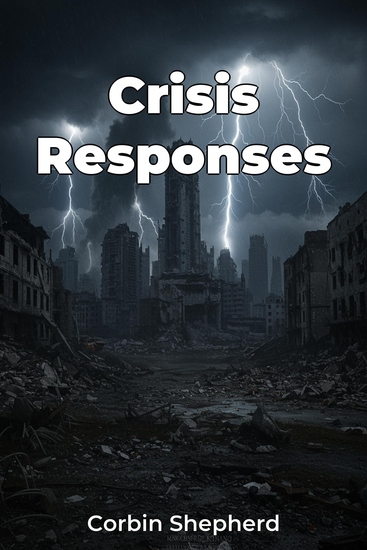
Crisis Responses - cover

Crisis Responses

Corbin Shepherd

Translator A AI

Publisher: Publifye

  • 0
  • 0
  • 0

Summary

Crisis Responses explores how societies react to major disruptions like natural disasters, economic collapses, and political upheavals. It examines historical events and contemporary challenges to understand the factors that determine a society's ability to withstand and recover from crises. The book argues that societal resilience, adaptive leadership, and strong social cohesion are key to effective crisis responses, providing a framework for analyzing past events and preparing for future challenges. One intriguing insight is how responses to events like the collapse of the Soviet Union or the 2008 financial crisis highlight the importance of adaptable leadership.

 
The book progresses by first defining "crisis" and establishing a framework for analysis. It then delves into case studies of natural, economic, and political crises, dissecting emergency responses and their consequences. By examining events through the lens of political science, economics, and history, Crisis Responses offers a multi-disciplinary approach, connecting fields like disaster management and behavioral economics.

 
The book aims to provide a balanced analysis of critical issues, making it a valuable resource for anyone seeking to understand global affairs and emergency responses.
Available since: 05/06/2025.
Print length: 74 pages.

Other books that might interest you

  • Accountability after Economic Crisis - Retribution Truth or Acknowledgment? - cover

    Accountability after Economic...

    Iosif Kovras

    • 0
    • 0
    • 0
    Accountability after Economic Crisis reconstructs the captivating story of how different nations responded to the 2008 economic crisis, one of the most challenging economic downturns in modern history. Why did some countries look for explanations of the economic failure and seek to hold those responsible to account, while others looked the other way? If so, were certain methods more effective than others? Is there, in fact, a best way? 


    Iosif Kovras introduces an innovative framework to explain the varied political responses to an economic crisis, pushing the boundaries of traditional analysis by drawing on political economy, comparative politics, public administration, economic history, criminal law, and criminology. He identifies three distinct accountability mechanisms used by leaders: retribution—prosecuting those at fault; truth recovery—establishing commissions of inquiry to reveal the facts; official acknowledgment—issuing formal apologies. Zeroing in on each country in turn, he shows how these mechanisms were employed and with what effect. 


    Featuring original observations from a survey in Iceland and experimental data from a conjoint experiment, Accountability after Economic Crisis provides a thorough and engaging examination of how countries manage accountability in the wake of an economic crisis.
    Show book
  • Farewell Address Oval Office - cover

    Farewell Address Oval Office

    Ronald Reagan

    • 0
    • 0
    • 0
    On January 11, 1989, Reagan gave the following farewell address to the nation from the Oval Office. The two things I’m proudest of are the economic recovery which created 19 million new jobs and that America is respected again in the world.  
    In 1980 pundits said our economic policies would cause inflation and collapse while our foreign policies would lead to war. Instead, tax cuts created “the longest peacetime expansion in our history” and “an explosion in research and new technology.” We knocked “down protectionist walls abroad instead of erecting them at home.” 
    We rebuilt our defenses and saw a new peacefulness around the globe. “Countries across the globe are turning to free markets and free speech and turning away from the ideologies of the past.” 
    I went into politics to protect something precious. “Our Constitution is a document in which ‘We the People’ tell the government what it is allowed to do. In the 1960s the government was taking our freedom with rules and regulations and confiscatory taxes.  
    People are “not free unless government is limited. There's a clear cause and effect here that is as neat and predictable as a law of physics: As government expands, liberty contracts.” 
    Are “we doing a good enough job teaching our children what America is and what she represents in the long history of the world?” “America is freedom -- freedom of speech, freedom of religion, freedom of enterprise. And freedom is special and rare.” Let’s start with more attention to American history. 
    I see America as a “shining city upon a hill” teeming with all kinds of people living in harmony, with ports humming with commerce, with doors open to anyone with the will to get here, a beacon and magnet for all who must have freedom. 
    Audio recording courtesy of the Ronald Reagan Presidential Library. 
    AspenLeafMedia.com
    Show book
  • The Village on the Edge of the World - Writing and Surviving in Ceausescu's Romania - cover

    The Village on the Edge of the...

    Herta Muller

    • 0
    • 0
    • 0
    A Nobel laureate presents a brilliant, discomfiting reflection on literary life defined by the brutality of Ceausescu’s Romania. 
    From her childhood in Romania, in a village “as small as a thimble on the edge of the world,” through to life in exile in Germany, Herta Müller's story unspools against the tumultuous history of Romania in the latter half of the twentieth century. Here, the Nobel Prize laureate reflects on cultural history, memory, and trauma, and on what it was to live and write under Ceausescu's regime. She revisits the friendships that buckled under the weight of fear and paranoia; the experience of being surveilled and interrogated; and on the unique blend of fear and tedium borne through life under totalitarianism. 
    The Village on the Edge of the World is a book that chronicles the minutiae of life under both fascism and the Soviet Union, while charting the existential questions posed by these regimes of the twentieth century—and how they remain with us in the twenty–first. This is a powerful and evocative reflection on life behind the Iron Curtain.
    Show book
  • The English Constitution - cover

    The English Constitution

    Walter Bagehot

    • 0
    • 0
    • 0
    Originally published in 1867, The English Constitution by Walter Bagehot remains one of the most influential analyses of the British political system ever written.
    
    Bagehot examines the functioning of the United Kingdom's constitutional monarchy, distinguishing between the "dignified" and "efficient" parts of government. With clarity and precision, he explains the roles of the Crown, Parliament, the Cabinet, and the House of Commons in shaping modern democracy.
    
    Essential reading for students of political science, constitutional law, and British history, this enduring classic offers profound insight into parliamentary government and the evolution of democratic institutions.
    
    A foundational work of constitutional theory and political analysis.
    Show book
  • The India Way - Strategies for an Uncertain World - cover

    The India Way - Strategies for...

    S. Jaishankar

    • 0
    • 0
    • 0
    The global order is always evolving, and in that sense, change could well be seen as a constant factor. But that ongoing evolution has now been given a sharper edge by the impact of the coronavirus pandemic, developments in Afghanistan, the Ukraine conflict and greater friction among key powers. 'One Trend and Four Shocks' are thus creating a new landscape. 
    The 'Four Shocks' have, each in their own way, led to heightened global anxiety and insecurity. This era of upheaval entails greater expectations from India, putting it on the path to becoming a leading power. 
    In The India Way, S. Jaishankar, India's Minister of External Affairs, analyses these challenges and spells out possible policy responses. In doing so, he is very conscious of balancing India's national interest with international responsibilities. He places this thinking in the context of history and tradition, appropriate for a civilizational power that seeks to reclaim its place on the world stage.
    Show book
  • Simple Sabotage Field Manual - cover

    Simple Sabotage Field Manual

    The Office of Strategic Services...

    • 0
    • 0
    • 0
    Originally written in 1944 by the Office of Strategic Services (O.S.S.), the wartime predecessor to the CIA, the Simple Sabotage Field Manual is a fascinating and often startling guide to subtle disruption during World War II. Designed to be used by ordinary citizens behind enemy lines, this manual offered clever, low-risk ways to undermine operations—from misfiling paperwork to tampering with machinery and stalling meetings. 
    Both a historical curiosity and a chillingly relevant study in passive resistance, the manual outlines how small acts of obstruction—carried out consistently and quietly—could grind an enemy’s war machine to a halt. With its dryly practical tone and surprising creativity, Simple Sabotage Field Manual reveals the hidden tactics of psychological warfare, bureaucratic interference, and grassroots defiance. 
    Narrated with gripping precision by Russ Jankovitz, this audiobook brings the shadowy ingenuity of World War II espionage to life, offering listeners a window into how everyday people were weaponized to fight tyranny from within.
    Show book