Join us on a literary world trip!
Add this book to bookshelf
Grey
Write a new comment Default profile 50px
Grey
Subscribe to read the full book or read the first pages for free!
All characters reduced
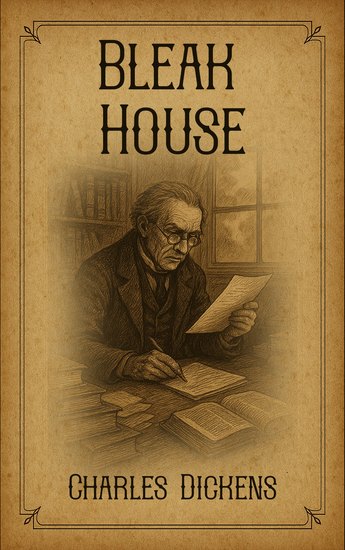
Bleak House - cover

Bleak House

Charles Dickens

Publisher: CLXBX

  • 0
  • 0
  • 0

Summary

A haunting mystery. A biting satire. A masterpiece of Victorian literature.

In one of his most ambitious and acclaimed novels, Charles Dickens weaves a complex web of mystery, injustice, and human drama in Bleak House—a powerful indictment of a broken legal system and a deeply moving portrait of the lives caught within it.

At the center of the novel is the long-running Jarndyce and Jarndyce case, a convoluted inheritance dispute that has dragged through the Court of Chancery for generations, consuming time, money, and lives. As the case grinds on, a cast of unforgettable characters emerges: the kind-hearted Esther Summerson, the brooding and generous John Jarndyce, the proud and tragic Lady Dedlock, and the mysterious figure who holds the key to secrets that could shatter reputations and lives.

Blending elements of legal drama, social critique, romance, and detective fiction, Bleak House is both a scathing commentary on institutional corruption and a deeply human story about identity, morality, and redemption.

Why readers still love Bleak House:

A vivid and sprawling narrative filled with memorable characters

One of the earliest novels to feature a detective figure in English fiction

A profound exploration of class, poverty, and the failures of bureaucracy

Dickens's razor-sharp wit and unforgettable prose

By turns darkly comic and emotionally devastating, Bleak House remains one of Dickens's greatest achievements—and one of the most important novels of the 19th century.
Available since: 02/04/2026.
Print length: 1214 pages.


Other books that might interest you

  • Wicked Captain Walshawe of Wauling - cover

    Wicked Captain Walshawe of Wauling

    Joseph Sheridan Le Fanu

    • 0
    • 0
    • 0
    "He was a man who feared neither God nor Devil, but he feared a life without gold even more."
    
    Captain Walshawe is a man of legendary cruelty and even greater debt. Living in the decaying Wauling Manor, he views his pious and suffering wife not as a companion, but as a financial obstacle. When she dies, the Captain's avarice leads him to commit a chilling act of spiritual sacrilege involving a "soul candle"—a ritual intended to secure her fortune for himself, regardless of the cost to her eternal rest. But as the shadows lengthen in the drafty halls of Wauling, the Captain discovers that some bargains cannot be undone, and the spirit he thought he had extinguished is far from gone.
    
    The Horror of Character: Unlike many Gothic tales that rely on external monsters, the primary horror here is Captain Walshawe himself. Le Fanu paints a portrait of a man so consumed by selfishness that he becomes more frightening than the specters that haunt him. His "wickedness" is a tangible force that stains the very walls of his home.
    
    The Symbolic "Soul-Candle": Le Fanu utilizes a unique and terrifying supernatural device in this story—the candle that represents the life or soul of the deceased. This element introduces a tactile, ticking-clock tension to the haunting, as the Captain's fate becomes literally tied to a flickering flame in the dark.
    
    A Masterclass in the Uncanny: The haunting of Wauling is subtle and psychological. It manifests in the sound of a silk dress brushing against a door, the smell of a guttering candle, and the oppressive feeling of a presence that refuses to leave. It is Le Fanu at his most focused, proving that the most terrifying ghosts are those created by our own transgressions.
    
    The Inevitability of Justice: As with much of Le Fanu's work, the story serves as a grim reminder that one cannot cheat the afterlife. The Captain's attempt to manipulate the spiritual world for material gain results in a haunting that is both a punishment and a mirror of his own moral vacuum.
    
    Face the darkness of Wauling. Purchase this classic of psychological horror today.
    Show book
  • The Three Musketeers - A soothing reading for sleep and relaxation - cover

    The Three Musketeers - A...

    Alexandre Dumas

    • 0
    • 0
    • 0
    Step into the swashbuckling world of The Three Musketeers, the beloved adventure by Alexandre Dumas, narrated by the calming voice of Andrew Bond and produced by Slumber Studios. 
    If sleepless nights or a restless mind are keeping you awake, this audiobook is designed to gently lull you into a peaceful and restorative sleep. 
    Close your eyes, relax, and let Andrew Bond’s soothing narration carry you to 17th-century France, where young d’Artagnan joins forces with the gallant trio—Athos, Porthos, and Aramis. Experience daring sword fights, secret plots, and unbreakable friendship, all while easing into deep relaxation. 
    At Slumber Studios, we specialize in creating tranquil content designed to help you unwind and fall asleep effortlessly. This audiobook features slow, gentle narration paired with soft background music, offering the perfect escape into dreamland. 
    If you're looking for a peaceful way to end your day, this is the perfect choice. Simply press play, get comfortable, and let Andrew’s serene voice guide you through the thrilling tale of The Three Musketeers. Wake up refreshed, with a spirit of courage and calm to greet the day ahead.
    Show book
  • Dracula - cover

    Dracula

    Bram Stoker

    • 0
    • 0
    • 0
    "I could feel the soft, shivering touch of the lips on the super-sensitive skin of my throat and the hard dents of two sharp teeth, just touching and pausing there. I closed my eyes in a languorous ecstasy and waited waited with beating heart." 
    In equal measures mesmerizing as it is diabolical, Dracula, told in epistolary format, is the story of Count Dracula and his attempt to move from Transylvania to England and the battle between him and a small team of people led by Professor Abraham Van Helsing.
    Show book
  • Fairy Tales of Hans Christian Andersen - cover

    Fairy Tales of Hans Christian...

    Hans Christian Andersen

    • 0
    • 0
    • 0
    Step Into a World Where the Heart Speaks in Every Shadow and Sunbeam.
    
    Unlike the collectors of folk legends who came before him, Hans Christian Andersen did not just record stories—he invented them. This comprehensive collection showcases the work of a visionary who gave souls to toys, voices to nature, and profound dignity to the outcast. His tales are the bridge between the ancient tradition of folklore and the modern world of the literary imagination.
    
    This collection captures the diverse brilliance of Andersen's imagination:
    
    The Master of Personification: Discover the magic in the mundane as household objects, flowers, and animals are brought to life with distinct personalities and relatable human desires.
    
    The Poetics of Melancholy: Experience the "bittersweet" quality that defines Andersen's work—stories that celebrate the beauty of the spirit even in the face of tragedy or unrequited love.
    
    Themes of Social Justice and Mercy: Explore narratives that often champion the poor and the misunderstood, offering a sharp critique of vanity and social hierarchy.
    
    Universal Transformations: Witness the physical and spiritual journeys of characters who must navigate a world of wonder and peril to find their true identity.
    
    Andersen's stories have been translated into more languages than almost any other book in history, barring the Bible. His ability to touch the hearts of both children and adults makes this volume an essential cornerstone for any library of classic literature, fantasy, and inspirational tales.
    
    Rediscover the magic of the human spirit. Buy "The Fairy Tales of Hans Christian Andersen" today and own the foundation of modern wonder.
    Show book
  • Epilogue of Sherlock Holmes An - cover

    Epilogue of Sherlock Holmes An

    Arthur Conan Doyle

    • 0
    • 0
    • 0
    His Last Bow An Epilogue Of Sherlock Holmes, is one of 56 short stories about Sherlock Holmes written by Sir Arthur Conan Doyle. It was first published in Strand Magazine. The narration is in the third person, instead of the first person narration usually provided by the character of Dr. Watson, and it is a spy story, rather than a detective mystery. Due to its portrayal of British and German spies, its publication during the First World War and its patriotic themes, the story has been interpreted as a propaganda tool intended to boost morale for British readers.Famous works of the author Arthur Conan Doyle: A Study in Scarlet, The Sign of the Four, The Adventures of Sherlock Holmes, The Memoirs of Sherlock Holmes, The Hound of the Baskervilles, The Return of Sherlock Holmes, The Valley of Fear, His Last Bow, The Case-Book of Sherlock Holmes, Stories of Sherlock Holmes, The Lost World.
    Show book
  • Before the Supreme Court - From their pens to your ears genius in every story - cover

    Before the Supreme Court - From...

    Lafcadio Hearn

    • 0
    • 0
    • 0
    Lafcadio Hearn was born on the 27th June 1850 on the Ionian isle of Levkás in Greece to a British Army officer and a Greek Mother. 
    His father, fearing for his career prospects at being married to a Greek Orthodox wife, sent them to Dublin whilst he continued to advance his career with further postings.  Life there was difficult for mother and son.  His father returned, wounded and traumatised, when Lafcadio was three.  He annulled the marriage and she remarried but had to give up care of Lafcadio to her sister-in law.   
    After brief periods for Catholic education in England and France he emigrated to Ohio in the United States when he was 19, taking on a series of casual jobs before embarking on a career as a journalist, publishing poems and essays in Cincinnati.  It was whilst here that he began a side-line in translating, starting with Gautier and Flaubert.  He married in 1874 to a 20 year old African-American woman in violation of Ohio's anti-miscegenation law.  The marriage soon failed. 
    In 1877 he relocated to New Orleans to write on a variety of themes before picking up a two year assignment from Harper’s to write in the West Indies, where he also wrote his first novel. 
    In 1890 Harper’s sent him to Japan.  Here he left journalism and took the remarkable decision to become a schoolteacher in the north of Japan.   Enraptured by the culture he was driven to explain it in various Western publications to those who had little, if any, knowledge of its culture.  Within the year he had fallen in love with, and married, a high-born Japanese lady, together they would have four children.   
    In 1895 he became a Japanese national and took the name Koizumi Yakumo, Koizumi being his wife’s family name. 
    The following few years, whilst a professor of Literature at the Imperial University of Japan, were his most creative and admired period.   
    Lafcadio Hearn died of heart failure on the 26th of September 1904, in Tokyo, Japan shortly before leaving to deliver a series of lectures at Cornell University in New York State.  He was 54.
    Show book