Join us on a literary world trip!
Add this book to bookshelf
Grey
Write a new comment Default profile 50px
Grey
Subscribe to read the full book or read the first pages for free!
All characters reduced
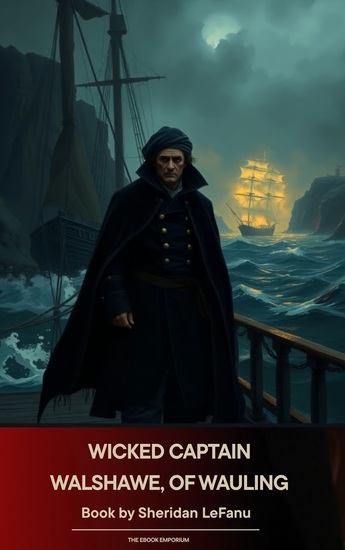
Wicked Captain Walshawe of Wauling - cover

Wicked Captain Walshawe of Wauling

Joseph Sheridan Le Fanu

Publisher: The Ebook Emporium

  • 0
  • 0
  • 0

Summary

"He was a man who feared neither God nor Devil, but he feared a life without gold even more."

Captain Walshawe is a man of legendary cruelty and even greater debt. Living in the decaying Wauling Manor, he views his pious and suffering wife not as a companion, but as a financial obstacle. When she dies, the Captain's avarice leads him to commit a chilling act of spiritual sacrilege involving a "soul candle"—a ritual intended to secure her fortune for himself, regardless of the cost to her eternal rest. But as the shadows lengthen in the drafty halls of Wauling, the Captain discovers that some bargains cannot be undone, and the spirit he thought he had extinguished is far from gone.

The Horror of Character: Unlike many Gothic tales that rely on external monsters, the primary horror here is Captain Walshawe himself. Le Fanu paints a portrait of a man so consumed by selfishness that he becomes more frightening than the specters that haunt him. His "wickedness" is a tangible force that stains the very walls of his home.

The Symbolic "Soul-Candle": Le Fanu utilizes a unique and terrifying supernatural device in this story—the candle that represents the life or soul of the deceased. This element introduces a tactile, ticking-clock tension to the haunting, as the Captain's fate becomes literally tied to a flickering flame in the dark.

A Masterclass in the Uncanny: The haunting of Wauling is subtle and psychological. It manifests in the sound of a silk dress brushing against a door, the smell of a guttering candle, and the oppressive feeling of a presence that refuses to leave. It is Le Fanu at his most focused, proving that the most terrifying ghosts are those created by our own transgressions.

The Inevitability of Justice: As with much of Le Fanu's work, the story serves as a grim reminder that one cannot cheat the afterlife. The Captain's attempt to manipulate the spiritual world for material gain results in a haunting that is both a punishment and a mirror of his own moral vacuum.

Face the darkness of Wauling. Purchase this classic of psychological horror today.
Available since: 01/13/2026.
Print length: 35 pages.

Other books that might interest you

  • The Minotaur - cover

    The Minotaur

    Nathaniel Hawthorne

    • 0
    • 0
    • 0
    Step into the mythic world of ancient Greece in this vivid retelling of The Minotaur by Nathaniel Hawthorne, brought to life by the captivating narration of Ram Ranjini. When brave young Theseus sets out to discover his true heritage, he finds himself face-to-face with destiny—and the monstrous half-man, half-bull that haunts the labyrinth of Crete. 
    With themes of heroism, sacrifice, and cunning, Hawthorne's version of this legendary tale blends classical mythology with rich moral insight and narrative charm. Ideal for fans of timeless legends, heroic quests, and Greek mythology, this dramatized tale will thrill listeners of all ages.
    Show book
  • Josephine the Songstress - cover

    Josephine the Songstress

    Franz Kafka

    • 0
    • 0
    • 0
    "Josephine the Songstress, or the Mouse Folk"  is the last short story written by Franz Kafka.The story was included in the collection A Hunger Artist published by Verlag Die Schmiede soon after Kafka's death.Franz Kafka's "Josephine the Songstress, or The Mouse Folk" follows the attempts of a member of a community to understand and explain the art of their only singer, Josephine, and the powerful effect that her singing has on the community that ordinarily has no use for song or diversion.
    Show book
  • White Nights - cover

    White Nights

    Fyodor Dostoevsky

    • 0
    • 0
    • 0
    White Nights, a tale of lonelyness by Fyodor Dostoevsky.  
    Like many of Dostoevsky's stories, "White Nights" is told in the first person by a nameless narrator, a young man living in Saint Petersburg who suffers from loneliness. He gets to know and falls in love with a young woman, but the love remains unrequited as the woman misses her lover. How will it end? 
     Narrated by Michael Ward.
    Show book
  • Uncomfortable Bed An - From their pens to your ears genius in every story - cover

    Uncomfortable Bed An - From...

    Guy de Maupassant

    • 0
    • 0
    • 0
    Henri René Albert Guy de Maupassant was born on August 5th, 1850 near Dieppe in France.  
    Maupassant’s early life was badly torn when at age 11 (his younger brother Hervé was then five) his mother, Laure, a headstrong and independent-minded woman, risked social disgrace in order to obtain a legal separation from her husband. 
    After the separation, Laure kept custody of her two boys. With the father now forcibly absent, Laure became the most influential and important figure in the young boy's life.   
    Maupassant’s education was such that he rebelled against religion and other societal norms but a developing friendship with Gustave Flaubert began to turn his mind towards creativity and writing. 
    After graduation he volunteered for the Franco-Prussian war. With its end he moved to Paris to work as a clerk in the Navy Department.  Gustave Flaubert now took him under his wing.  Acting as a literary guardian to him, he guided the eager Maupassant to debuts in journalism and literature.  For Maupassant these were exciting times and the awakening of his creative talents and ambitions. 
    In 1880 he published what is considered his first great work, ‘Boule de Suif’, (translated as ‘Dumpling’, ‘Butterball’, ‘Ball of Fat’, or ‘Ball of Lard’) which met with a success that was both instant and overwhelming.  Flaubert at once acknowledged that it was ‘a masterpiece that will endure.’ Maupassant had used his talents and experiences in the war to create something unique.  
    This decade from 1880 to 1891 was to be the most pivotal of his career.  With an audience now made available by the success of ‘Boule de Suif’ Maupassant organised himself to work methodically and relentlessly to produce between two and four volumes of work a year.  The melding of his talents and business sense and the continual hunger of sources for his works made him wealthy. 
    In his later years he developed a desire for solitude, an obsession for self-preservation, and a fear of death as well as a paranoia of persecution caused by the syphilis he had contracted in his youth.  
    On January 2nd, 1892, Maupassant tried to commit suicide by cutting his throat.  Unsuccessful he was committed to the private asylum of Esprit Blanche at Passy, in Paris.  It was here on July 6th, 1893 that Henri René Albert Guy de Maupassant died at the age of only 42.
    Show book
  • To the Lighthouse - cover

    To the Lighthouse

    Virginia Woolf

    • 0
    • 0
    • 0
    Set on an island off the Scottish coast, To the Lighthouse minutely examines the fleeting impressions of a large cast of family, friends, lovers, and hangers-on. Who can we be, Virginia Woolf invites us to ask, if no one can ever know our hearts - if they're unknowable even to ourselves? To the Lighthouse remains one of the most important Modernist novels, exquisitely composed by one of the most gifted writers of the Modernist movement.
    The opening section follows the passage of a day with a thwarted objective: to go to the nearby lighthouse. The concluding section revisits this expedition a decade later, when so much is irrevocably changed, as a chance to glimpse interpersonal understandings and connections. The novel provides a brilliant example of stream-of-consciousness writing, and raises questions that provoke us still: questions about whether children are the fullest realization of one's posterity, how women artists are regarded socially, and how money and status enable - or close off - networks, relationships, and the dreams we hold most dear.
    As masterful as its technique is, however, the lasting value of this novel for twenty-first-century readers may be its sharp representation of the emotional labor that people - particularly women - perform in order to manage the needs and expectations of others. Woolf wrote in an age when women's participation in society was tightly restricted by class norms and stultifying domesticity. Nearly a century later, scholars still have a great deal to say about Mrs. Ramsay, Lily Briscoe, and the tension between Mr. Ramsay and his son James.
    Woolf's fifth novel, and one of her most successful books both critically and commercially, To the Lighthouse was originally published in 1927, simultaneously in England and the United States. Due to a quirk in the management and correction of the proofs, according to scholar Hans Walter Gabler, the two editions were "not identical, since in a significant number of instances Virginia Woolf marked up the first proofs differently" for her two publishers.
    Show book
  • Oscar Wilde - Short Stories - cover

    Oscar Wilde - Short Stories

    Oscar Wilde

    • 0
    • 0
    • 0
    Welcome to the enchanting world of Oscar Wilde's timeless tales, now available in the captivating digital audiobook version of "Oscar Wilde - Short Stories"! Immerse yourself in the genius of Wilde's storytelling as you explore three beloved classics: "The Canterville Ghost," "The Fisherman and His Soul," and "The Devoted Friend." 
     
    Step into the realms of whimsy, wit, and wisdom with "The Canterville Ghost," a delightful blend of humor and the supernatural. Follow the misadventures of an American family as they encounter the stubbornly persistent ghost of Sir Simon, revealing unexpected twists and heartwarming moments along the way. 
     
    Venture into the mystical journey of "The Fisherman and His Soul," a poignant allegory exploring the conflict between the spiritual and the material. Join a young fisherman as he sacrifices everything for love, encountering mermaids, temptation, and the ultimate pursuit of true freedom. 
     
    Delve into the thought-provoking fable of "The Devoted Friend," a tale that explores the dynamics of friendship, kindness, and selflessness. Witness the evolving relationship between a selfless linnet and a materialistic water-rat, unraveling profound lessons about the true nature of generosity.
    Show book