Join us on a literary world trip!
Add this book to bookshelf
Grey
Write a new comment Default profile 50px
Grey
Subscribe to read the full book or read the first pages for free!
All characters reduced
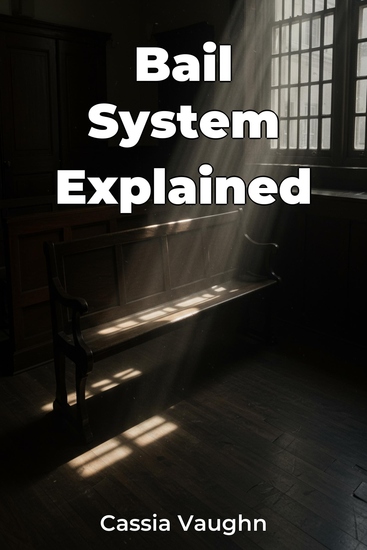
Bail System Explained - cover

Bail System Explained

Cassia Vaughn

Translator A AI

Publisher: Publifye

  • 0
  • 0
  • 0

Summary

Bail System Explained offers a comprehensive exploration of the U.S. bail system, a mechanism designed to ensure defendants appear in court while upholding the presumption of innocence. The book examines how bail practices impact individuals, communities, and the broader criminal justice system. It argues that the reliance on cash bail disproportionately affects low-income individuals and communities of color, leading to unnecessary pre-trial detention, which can result in job loss and family separation. For example, the book highlights the fact that pre-trial detention can increase the likelihood of pleading guilty, regardless of actual guilt.

 
The book traces the historical context of bail, from its origins in English common law to its modern-day application, examining the Eighth Amendment's prohibition against excessive bail. It delves into the criteria used to assess bail eligibility, exploring how socio-economic factors like income and race influence outcomes. Furthermore, it analyzes ongoing bail reform movements and alternative release mechanisms, such as risk assessment tools and supervised release programs, to improve pre-trial justice.

 
The book progresses by first introducing fundamental concepts, then delving into eligibility criteria, and finally analyzing ongoing reforms and their practical implications. By drawing upon legal precedents, statistical data, and case studies, Bail System Explained intersects with sociology, economics, and criminology to enrich its analysis. It provides a balanced and objective view, making it valuable for students, legal professionals, policymakers, and anyone interested in understanding the complexities and controversies surrounding bail reform and the legal system.
Available since: 04/05/2025.
Print length: 73 pages.
Other books that might interest you

  • Daughters of the Flower Fragrant Garden - Two Sisters Separated by China’s Civil War - cover

    Daughters of the Flower Fragrant...

    Zhuqing Li

    • 0
    • 0
    • 0
    Daughters of the Flower Fragrant Garden is a window into the lives of women in twentieth-century China, a time of traumatic change and unparalleled resilience. In this riveting and deeply personal account, linguist and East Asian scholar Zhuqing Li confronts the bitter political rivals of mainland China and Taiwan with elegance and unique insight, while celebrating her aunts’ remarkable legacies."Beautifully woven family memories coalesce into a vivid history of two very different Chinas."― Kirkus ReviewsSisters separated by war forge new identities as they are forced to choose between family, nation, and their own independence.Jun and Hong were scions of a once great southern Chinese family. Each other’s best friend, they grew up in the 1930s during the final days of Old China before the tumult of the twentieth century brought political revolution, violence, and a fractured national identity. By a quirk of timing, at the end of the Chinese Civil War, Jun ended up on an island under Nationalist control, and then settled in Taiwan, married a Nationalist general, and lived among fellow exiles at odds with everything the new Communist regime stood for on the mainland. Hong found herself an ocean away on the mainland, forced to publicly disavow both her own family background and her sister’s decision to abandon the party. A doctor by training, to overcome the suspicion created by her family circumstances, Hong endured two waves of “re-education” and internal exile, forced to work in some of the most desperately poor, remote areas of the country.Ambitious, determined, and resourceful, both women faced morally fraught decisions as they forged careers and families in the midst of political and social upheaval. Jun established one of U.S.-allied Taiwan’s most important trading companies. Hong became one of the most celebrated doctors in China, appearing on national media and honored for her dedication to medicine. Niece to both sisters,  Li tells her aunts’ story for the first time, honoring her family’s history with sympathy and grace.
    Show book
  • City Resilience - Building Stronger Urban Communities - cover

    City Resilience - Building...

    Lyric Vale

    • 0
    • 0
    • 0
    In an era of rapid urbanization, cities are facing an array of challenges that threaten the sustainability and stability of urban life. From climate change-induced natural disasters to social inequality and economic instability, the vulnerabilities of urban environments are increasingly evident. As the global population continues to concentrate in cities, the importance of urban resilience has never been more critical. Urban resilience refers to a city's capacity to withstand, adapt to, and recover from various shocks and stresses, ensuring the continued wellbeing of its residents and the functionality of its infrastructure. 
    The resilience of urban communities is not just about withstanding external shocks such as earthquakes, floods, or pandemics, but also about the ability to respond to longer-term stresses like climate change, economic fluctuations, and demographic shifts. Cities are complex systems, where the interplay of social, environmental, economic, and technological factors can either contribute to vulnerability or foster the development of adaptive capacities. Building resilience, therefore, requires a multi-dimensional approach that integrates these various aspects, creating a robust foundation upon which cities can thrive despite inevitable challenges. 
    One of the primary reasons urban resilience has gained such prominence is the growing recognition of the vulnerability of cities in the face of climate change. With rising sea levels, more frequent and severe storms, and heatwaves becoming the norm, cities are exposed to significant risks that threaten public safety, economic stability, and infrastructure. Moreover, rapid urban growth often leads to poor urban planning, inadequate infrastructure, and limited resources to address emerging problems.
    Show book
  • Creative Thinking in Schools - A Leadership Playbook - cover

    Creative Thinking in Schools - A...

    Bill Lucas, Nia Richards, Ellen...

    • 0
    • 0
    • 0
    This leadership playbook has been published to coincide with the global release of the first PISA test results on creative thinking, the Creativity Collaboratives under way in England and the growing importance of creative thinking in countries across the world.Creative Thinking in Schoolsfocuses on how leaders can create capacity among their staff to embed creative thinking, both in their own lives and in the lives of their pupils. Itoffers a framework for improving creative thinking based on the widely used five creative habits framework developed by the Centre for Real-World Learning. The framework focuses on developing learners who are inquisitive, persistent, collaborative, disciplined and imaginative.
    Underpinned by research and analysis of practice in hundreds of schools across the world, and more recently by an in-depth study of fifty schools in England,Creative Thinking in Schoolsprovides a range of accessible resources, planning tools and practical examples. These support leaders to reflect on their core purposes, understand the changes needed to embed creative thinking, develop leaders across their staff, facilitate the development of their teachers, plan, teach and assess creative thinking, and work with external partners, all the while developing a vibrant professional learning community.
    Complemented by a dedicated website which contains additional downloadable materials and case studies,the playbook will allow leaders and teachers around the world to connect with each other and share their own experiences in order to develop, spread, extend and evaluate creative thinking within and across schools.
    Creative Thinking in Schoolswill support a professional learning community of leaders and teachers who see creative thinking as a core purpose of education and are interested in making it a priority in their school. It will encourage pupils to develop their creativity in the classroom, allowing future generations to thrive in a world that is increasingly complex.
    Creative Thinking in Schools: A Leadership Playbookhas been supported by the Mercers Company, Creativity, Culture and Education and the Arts Council of Wales.
    Suitable for school and system leaders, teacher leaders and policy makers who see creative thinking as a core purpose in education.
    Show book
  • Early Cosmological Thinkers - The First Philosophical Inquiries into the Cosmos and Natural Laws (2 in 1) - cover

    Early Cosmological Thinkers -...

    Hector Davidson

    • 0
    • 0
    • 0
    This book consists of 2 titles, which are: 
    Heraclitus: Heraclitus of Ephesus, a pre-Socratic philosopher who lived in the 6th century BCE, remains one of the most enigmatic figures in the history of Western thought. Known for his cryptic sayings and profound insights into the nature of reality, Heraclitus' ideas have had a lasting influence on philosophy, science, and the arts. His philosophy, often centered around the concept of change, emphasized that everything in existence is in a constant state of flux. This view is encapsulated in one of his most famous quotes: "You cannot step into the same river twice." For Heraclitus, the essence of life and the universe lies in this unceasing transformation, where stability and change are not opposing forces but interconnected aspects of existence. 
    Pythagoras: As a philosopher and mathematician, Pythagoras is perhaps best known for the Pythagorean Theorem, a fundamental principle in geometry that has influenced the study of mathematics for over two millennia. However, his impact extends far beyond the confines of geometry. Pythagoras is often credited with transforming numbers from mere tools of calculation into a system that mirrors the structure and harmony of the universe. For him, numbers were not just abstract symbols but the very essence of reality, governing everything from the motions of the stars to the patterns in music. His belief in the mystical and metaphysical significance of numbers laid the groundwork for later developments in philosophy, particularly the idea that the world is not a chaotic, random place but a cosmos governed by rational and harmonious principles.
    Show book
  • Heavyweight - Black Boxers and the Fight for Representation - cover

    Heavyweight - Black Boxers and...

    Jordana Moore Saggese

    • 0
    • 0
    • 0
    In Heavyweight, Jordana Moore Saggese examines images of Black heavyweight boxers to map the visual terrain of racist ideology in the United States, paying particular attention to the intersecting discourses of Blackness, masculinity, and sport. Looking closely at the "shadow archive" of portrayals across fine art, vernacular imagery, and public media at the turn of the twentieth century, she demonstrates how the images of boxers reveal the racist stereotypes implicit in them, many of which continue to structure ideas of Black men today. With a focus on both anonymous fighters and notorious champions, including Jack Johnson, Saggese contends that popular images of these men provided white spectators a way to render themselves experts on Blackness and Black masculinity. These images became the blueprint for white conceptions of the Black male body—existing between fear and fantasy, simultaneously an object of desire and an instrument of violence. Reframing boxing as yet another way whiteness establishes the violent mythology of its supremacy, Saggese highlights the role of imagery in normalizing a culture of anti-Blackness.
    Show book
  • Mind the Inclusion Gap - How allies can bridge the divide between talking diversity and taking action - cover

    Mind the Inclusion Gap - How...

    Suzy Levy

    • 0
    • 0
    • 0
    We live in a wonderfully diverse and increasingly connected world. With that rise in connection comes a steep rise in expectations. 
    ... Expectations that we know how to talk about diversity, including with people who are different than ourselves. 
    ... Expectations that we lean into uncomfortable conversations, with sufficient fluency that we don't cause offence. 
    ... Expectations that we act, instead of simply walking by inequality. 
    Although most of us are curious about diversity, and some would go as far as to call ourselves allies, very few of us are skilled in inclusion. In the absence of knowing what to do, we double down on being nice and hope that will be enough. Unfortunately, this optimistic attitude may harm as much as help.  
    Mind the Inclusion Gap is for anyone who wants to move beyond talking to actively shaping an inclusive future. It looks beyond singular diversity categories, exploring the connections between race, ethnicity, sex, sexual orientation and gender identity. Filled with insight and everyday skills, it will help you navigate the polarised and divisive issues we face in the workplace and in the world.
    Show book