Join us on a literary world trip!
Add this book to bookshelf
Grey
Write a new comment Default profile 50px
Grey
Subscribe to read the full book or read the first pages for free!
All characters reduced
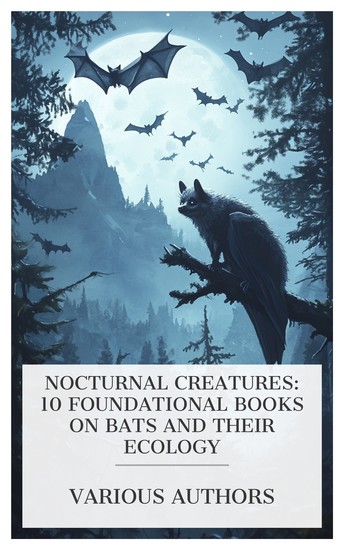
Nocturnal Creatures: 10 Foundational Books on Bats and Their Ecology - A New Subspecies of the Fruit-eating Bat Sturnira ludovici From Western Mexico An Annotated Checklist of Nebraskan Bats etc - cover

Nocturnal Creatures: 10 Foundational Books on Bats and Their Ecology - A New Subspecies of the Fruit-eating Bat Sturnira ludovici From Western Mexico An Annotated Checklist of Nebraskan Bats etc

Carleton J. Phillips, E. Raymond Hall, J. Knox Jones, Olin L. Webb, Ronald W. Turner, James Dale Smith, Sydney Anderson, Walter Woelber Dalquest, Gary L. Phillips, William B. Jackson

Publisher: e-artnow

  • 0
  • 0
  • 0

Summary

Nocturnal Creatures: 10 Foundational Books on Bats and Their Ecology offers a comprehensive exploration of the mysterious and often misunderstood world of bats. This collection brings together a seminal selection of scientific works that delve into the ecology, behavior, and conservation of these vital mammals. The anthology spans a range of literary styles, from technical analyses to descriptive natural histories, illuminating the significance of each contribution within its literary and scientific context. Standout pieces provide detailed studies on bat habitat interactions and the ecological role bats play, offering readers a profound insight into the complexities of bat biodiversity. The contributors to this anthology, including renowned experts such as Carleton J. Phillips and Sydney Anderson, present a mosaic of perspectives that deepen the collective understanding of chiropteran ecology. Each author brings a distinct voice and expertise, reflecting a convergence of historical, environmental, and evolutionary narratives that align with ongoing scientific discourse and conservation efforts. Whether examining the hidden histories of bat populations or their present-day ecological challenges, these works capture the dynamic relationship between bats and their environments. For any reader interested in expanding their knowledge on bats, this anthology provides an unparalleled opportunity to engage with a wealth of scholarly insights. Each work encourages not only an appreciation for the diversity within bat species but also inspires critical thought about ecological preservation. Covering a wide array of themes and methodologies, Nocturnal Creatures invites readers to explore the rich dialogue fostered by the collective expertise of its contributors, making it an indispensable addition to any library concerned with wildlife ecology and conservation.
Available since: 03/04/2025.
Print length: 2000 pages.

Other books that might interest you

  • Narendra Modi: From Dust to the Summit - cover

    Narendra Modi: From Dust to the...

    Sweet Audible

    • 0
    • 0
    • 0
    This audiobook is narrated by an AI Voice.   
    Prologue – The Son of the Soil 
    He was born in a small, dusty town called Vadnagar, in the western state of Gujarat. A town of narrow lanes, modest homes, and hardworking families. Among them lived a little boy who spent his early years helping his father sell tea at the local railway station. 
    Few noticed him then. He was one among many — barefoot, curious, and silent. But behind those watchful eyes burned a strange determination. He wanted to know why some lives spark with greatness while others fade unnoticed. 
    That boy was Narendra Damodardas Modi. 
    Content: 
    Prologue – The Son of the Soil 
    Chapter 1 – Childhood in Vadnagar 
    Chapter 2 – The RSS Path 
    Chapter 3 – The Political Step 
    Chapter 4 – The Trial by Fire 
    Chapter 5 – From Godhra to Global Attention 
    Chapter 6 – The Architect of Development 
    Chapter 7 – The Road to Delhi 
    Chapter 8 – The Prime Ministerial Journey Begins 
    Chapter 9 – Consecutive Mandates and National Leadership 
    Chapter 10 – The Global Stage and Legacy 
    Epilogue – The Silent March 
    Title: Narendra Modi: From Dust to the Summit 
    Genre: Audio Biography (Motivational) 
    Language: English 
    Format: Mp3 
    Duration: 1 Hour 43 Min 
    Audiobook Written, Narrated and Published by: Sweet Audible (2025) 
    Download our Audiobooks from: ⁠Sweet Audible
    Show book
  • The Age of Enlightened Despots - Reform and Reaction - cover

    The Age of Enlightened Despots -...

    Nova Ashford

    • 0
    • 0
    • 0
    The Age of Enlightened Despotism was a period in European history during the 18th century when absolute monarchs, inspired by the ideas of the Enlightenment, sought to combine their centralized power with reforms aimed at improving the welfare of their subjects. These rulers, often referred to as "enlightened despots," were influenced by the rationalist philosophy that emphasized reason, science, and progress. However, they did not embrace the democratic principles of the Enlightenment, opting instead to preserve their absolute authority while implementing select reforms to improve governance, society, and the economy. 
    At the heart of enlightened despotism was the belief that monarchs could act as benevolent rulers who used their absolute power to guide their countries towards prosperity and progress. These monarchs saw themselves as enlightened figures, tasked with leading their nations in line with the principles of the Enlightenment but without relinquishing control over the state. In contrast to traditional autocratic rulers, enlightened despots were often receptive to new ideas about governance, education, legal systems, and the treatment of their subjects. They embraced reforms that were designed to modernize their societies, often implementing policies that reflected Enlightenment thinkers such as Voltaire, Montesquieu, and Rousseau. 
    Frederick the Great of Prussia, Catherine the Great of Russia, and Joseph II of Austria were the most prominent examples of enlightened despots. Each of these rulers used their power to implement a range of reforms. Frederick, for instance, was known for his military prowess and his efforts to modernize the Prussian state, introducing reforms that improved the legal system, promoted education, and supported religious tolerance.
    Show book
  • Did Ye Hear Mammy Died? - A Memoir - cover

    Did Ye Hear Mammy Died? - A Memoir

    Séamas O'Reilly

    • 0
    • 0
    • 0
    A heart-warming and hilarious family memoir of growing up as one of eleven siblings raised by a single dad in Northern Ireland at the end of the Troubles. Séamas O’Reilly’s mother died when he was five, leaving him, his ten (!) brothers and sisters, and their beloved father in their sprawling bungalow in rural Derry. It was the 1990s; the Troubles were a background rumble, but Séamas was more preoccupied with dinosaurs, Star Wars, and the actual location of heaven than the political climate. ­  An instant bestseller in Ireland, Did Ye Hear Mammy Died? is a book about a family of loud, argumentative, musical, sarcastic, grief-stricken siblings, shepherded into adulthood by a man whose foibles and reticence were matched only by his love for his children and his determination that they would flourish.  “In this joyous, wildly unconventional memoir, Séamas O'Reilly tells the story of losing his mother as a child and growing up with ten siblings in Northern Ireland during the final years of the Troubles as a raucous comedy, a grand caper that is absolutely bursting with life.”―Patrick Radden Keefe, NYT bestselling author of Say Nothing and Empire of Pain One of NPR’s Best Books of the Year
    Show book
  • J Edgar Hoover and Allen Dulles: The History of 20th Century America’s Most Controversial FBI and CIA Directors - cover

    J Edgar Hoover and Allen Dulles:...

    Editors Charles River

    • 0
    • 0
    • 0
    No single figure in 20th century American history inspires such opposing opinions as J. Edgar Hoover, the iconic first director of the Federal Bureau of Investigation. In his time, he was arguably the most powerful non-elected figure in the U.S. government. Serving under 8 presidents (and outliving 2 of them), he remains the longest-serving head of a major government office. In essence, Hoover died as he began - a civil servant, having been appointed by the Attorney General and serving at the pleasure of the president.  
    By the 1960s and 1970s Hoover the hero had become Hoover the villain.  Various exposes and investigations revealed a darker side to the legend, one that included serious violations of the civil liberties of individuals. Hoover’s G-Men, it was discovered, engaged in illegal break-ins and wiretaps of suspected subversives; they wrote fake letters that undermined the reputations of public individuals; they paid informants for information and push the groups they belonged to into committing illegal acts. It was alleged that Hoover led a personal vendetta against Martin Luther King, Jr., and the entire civil rights movement. Hoover, it was said, had stayed in office so long by gathering secret files of damaging information about politicians (including presidents). 
    To this day, Allen Dulles’ eight-year tenure in that office is the longest, and as one of the country’s leading experts in international law, intelligence, and spycraft, he became renowned for his unwavering anti-communist ideology and readiness to take decisive measures to counter what he perceived as a menace to American safety. As such, it would be Dulles who sanctioned many of the CIA’s most notorious operations, including the ousting of Iran's democratically elected government in 1953, spying and experimentation on American citizens, and the disastrous Bay of Pigs.
    Show book
  • A Fight with a Cannon - From their pens to your ears genius in every story - cover

    A Fight with a Cannon - From...

    Victor Hugo

    • 0
    • 0
    • 0
    Victor Marie Hugo was born on 26th February 1802 in Besançon, France.   
    There can be no doubt that Hugo is ranked as the greatest of French authors and poets. In addition to this he fought against social injustice throughout his life and from his frequent elections to the French Assembly. 
    Hugo published his first novel, Han d’Islande (1823), the year after his marriage and so began an immense canon of fiction and poetry not only for France but to World literature.  
    He was elected to the Académie Française in 1841 and the same year came a peerage and entrance to the Higher Chamber as a pair de France, where he spoke against the death penalty, social injustice and in favour of press freedom.  
    In the years leading up to the Revolution of 1848 Hugo began to lean towards Republicanism and greater freedoms.  With the formation of the Second Republic, he was again elected to the Assembly. 
    When Napoleon III seized power in 1851, and established an anti-parliamentary constitution, Hugo openly declared him a traitor to France. This, of course, meant exile where he remained until 1870.  In exile he published his greatest work ‘Les Misérables’, and further widely honoured collections of poetry. 
    Returning home he was again elected to the National Assembly and the Senate.  It was the time of the Franco-Prussian war and with Paris under siege and food ever more scarce, he wrote in his diary that he was now "eating the unknown". 
    Later he was instrumental in strengthening the rights of artists and copyright, steps which led to the international protections of the Berne Convention.  
    Victor Hugo died on 22nd May 1885, aged 83.
    Show book
  • The Fly - An Appreciation - cover

    The Fly - An Appreciation

    Lucian of Samosata

    • 0
    • 0
    • 0
    Lucian of Samosata's beautiful description of a common fly. His satirical flourishes will leave the listener ever-the-more impressed with this most minute of creatures. A farcical journey, the Satirist takes us to the great halls of Heroes and Gods alike in this most apt comparison between the likes of Man and Fly.
    Show book