

Join us on a literary world trip!
Add this book to bookshelf
Grey
Write a new comment Default profile 50px
Grey
Subscribe to read the full book or read the first pages for free!
All characters reduced
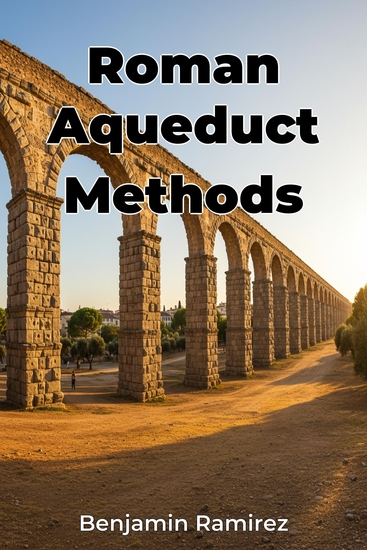
Roman Aqueduct Methods - cover

Roman Aqueduct Methods

Benjamin Ramirez

Translator A AI

Publisher: Publifye

  • 0
  • 0
  • 0

Summary

"Roman Aqueduct Methods" explores the remarkable engineering achievements of the Romans in providing fresh water to their cities. It examines how, without modern technology, they managed to supply water to over a million people in Rome, a feat unmatched for centuries. The book reveals that these aqueducts were more than just conduits; they were testaments to Roman ingenuity, shaping urban development and public health across their vast empire.

 
The book delves into the engineering principles, water flow management techniques, and urban planning strategies that underpinned their success, showing how meticulous planning and innovative construction methods led to remarkably efficient and durable systems. The book emphasizes the holistic approach the Romans took, integrating planning, surveying, construction, and water management. For example, the Romans demonstrated a sophisticated understanding of hydraulics.

 
Drawing on archaeological findings, historical accounts from figures like Vitruvius, and modern scientific analyses, the book offers a fresh perspective on Roman aqueduct technology. The book progresses systematically, introducing fundamental concepts of Roman engineering and water management, then detailing the construction process including surveying, tunneling, and material usage. It further examines water flow control through settling tanks, filtration systems, and distribution mechanisms. Finally, it analyzes the aqueducts' integration into the urban landscape and their impact on public health and sanitation, providing valuable insights into sustainable infrastructure development.
Available since: 05/03/2025.
Print length: 60 pages.

Other books that might interest you

  • Yassir Arafat: A short biography - 5 Minutes: Short on time – long on info! - cover

    Yassir Arafat: A short biography...

    5 Minutes, 5 Minute Biographies,...

    • 0
    • 0
    • 0
    Yassir Arafat, leader of the Palestinians and Nobel Peace Prize laureate: Life and work in a short biography! Everything you need to know, brief and concise. Infotainment, education and entertainment at its best!
    Show book
  • Who Gets Believed - When the Truth Isn't Enough - cover

    Who Gets Believed - When the...

    Dina Nayeri

    • 0
    • 0
    • 0
    Why are honest asylum seekers dismissed as liars? Former refugee and award-winning author Dina Nayeri begins with this question, turning to shocking and illuminating case studies in this book, which grows into a reckoning with our culture’s views on believability. From persuading a doctor that she’d prefer a C-section to learning to “bullshit gracefully” at McKinsey to struggling, in her personal life, to believe her troubled brother-in-law, Nayeri explores an aspect of our society that is rarely held up to the light. For fans of David Grann, Malcolm Gladwell, and Atul Gawande, Who Gets Believed? is a book as deeply personal as it is profound in its reflections on morals, language, human psychology, and the unspoken social codes that determine how we relate to one another.
    Show book
  • Stories on lord Shiva series - 22 - From various sources of Shiva Purana - cover

    Stories on lord Shiva series -...

    Anusha HS

    • 0
    • 0
    • 0
    Lord shiva is adi and he is only the anthya. He is the sole reason for the happenings in both the movable and immovable worlds. Therefore, it is said that not even a spring of grass will move without his permission. He is the one who has given life to all the creatures. He is also the one who takes away the lives of all the creatures. Sadhus sages and aghoraas practice severe penance without minding day and night on Lord Shiva.He blesses his devotees with boons
    Show book
  • Murder on the Inside - The True Story of the Deadly Riot at Kingston Penitentiary - cover

    Murder on the Inside - The True...

    Catherine Fogarty

    • 0
    • 0
    • 0
    Shortlisted for the Speaker's Book Award • Shortlisted for The Brass Knuckles Award for Best Nonfiction Crime Book
    		 
    “You have taken our civil rights—we want our human rights.”
    		 
    On April 14, 1971, a handful of prisoners attacked the guards at Kingston Penitentiary and seized control, making headlines around the world. For four intense days, the prisoners held the guards hostage while their leaders negotiated with a citizens’ committee of journalists and lawyers, drawing attention to the dehumanizing realities of their incarceration, including overcrowding, harsh punishment and extreme isolation. But when another group of convicts turned their pent-up rage towards some of the weakest prisoners, tensions inside the old stone walls erupted, with tragic consequences. As heavily armed soldiers prepared to regain control of the prison through a full military assault, the inmates were finally forced to surrender.
    		 
    Murder on the Inside tells the harrowing story of a prison in crisis against the backdrop of a pivotal moment in the history of human rights. Occurring just months before the uprising at Attica Prison, the Kingston riot has remained largely undocumented, and few have known the details—yet the tense drama chronicled here is more relevant today than ever. A gripping account of the standoff and the efforts for justice and reform it inspired, Murder on the Inside is essential reading for our times.
    Show book
  • If the South Had Won - The American Civil War's Alternate Ending - cover

    If the South Had Won - The...

    Marcus Draysun

    • 0
    • 0
    • 0
    The outcome of the Civil War changed dramatically in this alternate history, with the South emerging victorious. The Confederacy’s early victories redefined the course of the conflict and set the stage for a dramatically different future. One of the key factors in the South’s triumph was the strategic advantage gained in the opening years of the war. With superior military leadership, especially from General Robert E. Lee, the Confederacy was able to exploit the Union’s weaknesses and win crucial battles that would eventually shift the momentum in their favor. The Battle of Gettysburg, for instance, saw Confederate forces turning the tide of battle in their favor. With the Union forces retreating, the South captured key northern territories, including Washington D.C., which became a symbol of Confederate dominance. 
    The impact of foreign intervention was another pivotal factor in the war's new direction. European powers, particularly Great Britain and France, had long been sympathetic to the Southern cause due to economic interests, primarily the cotton trade. With the Union struggling, European nations were more inclined to recognize the Confederacy, and this recognition provided them with military and financial support. In this alternate timeline, the Confederacy was not only able to win vital battles but also secure crucial international recognition, which solidified its independence. 
    A key turning point in this reimagined history occurred when the South succeeded in capturing Washington, D.C. After several key victories, the Union’s capital fell into Confederate hands. This was a symbolic and strategic blow to the Union cause. Without the political and military heart of the nation, the North was thrown into disarray. President Abraham Lincoln, unable to maintain control, was forced to negotiate a peace settlement. The Confederate States of America, led by President Jefferson Davis, could now dictate the terms of the peace and its future.
    Show book
  • China's Foreign Policy Contradictions - Lessons from China's R2P Hong Kong and WTO Policy - cover

    China's Foreign Policy...

    Tim Nicholas Ruhlig

    • 0
    • 0
    • 0
    Throughout the post–Mao reform era, China has championed the principle of sovereign state control, which holds that states should not intervene in the affairs of other states. Yet as Tim Nicholas Rühlig argues in China's Foreign Policy Contradictions, in recent years they have not actually acted this way. Chinese foreign policy actions fail to match up with official rhetoric, and these inconsistencies—in combination with China's growing power—will have dramatic effects on the future shape of international order. 


    To explain these contradictions, Rühlig draws from in-depth interviews with party-state officials to explain the foreign policy dynamics and processes of the normally opaque Chinese party-state. He demonstrates how different sources of the Chinese Communist Party's domestic legitimacy compete within the complex and highly fragmented Chinese party-state, resulting in contradictory foreign policies. He focuses on three issue areas: international human rights law and "responsibility to protect" (R2P); China's role in World Trade Organization (WTO) policymaking; and China's evolving relationship with Hong Kong. 


    In this work, Rühlig shows not only why China's foreign policy is so inconsistent, but why it is likely to contribute to a more particularistic, plural, and fragmented international order in the years to come.
    Show book
