

Rejoignez-nous pour un voyage dans le monde des livres!
Ajouter ce livre à l'électronique
Grey
Ecrivez un nouveau commentaire Default profile 50px
Grey
Abonnez-vous pour lire le livre complet ou lisez les premières pages gratuitement!
All characters reduced
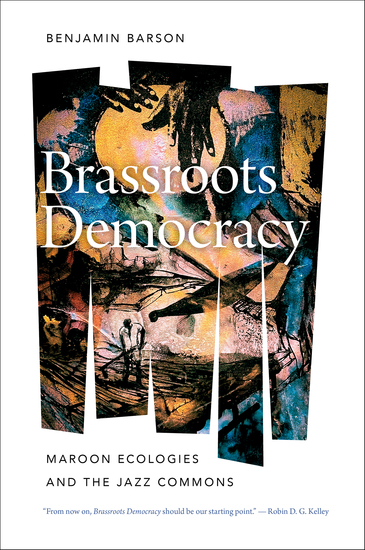
Brassroots Democracy - Maroon Ecologies and the Jazz Commons - cover

Brassroots Democracy - Maroon Ecologies and the Jazz Commons

Benjamin Barson

Maison d'édition: Wesleyan University Press

  • 0
  • 0
  • 0

Synopsis

Brassroots Democracy recasts the birth of jazz, unearthing vibrant narratives of New Orleans musicians to reveal how early jazz was inextricably tied to the mass mobilization of freedpeople during Reconstruction and the decades that followed. Benjamin Barson presents a "music history from below," following the musicians as they built communes, performed at Civil Rights rallies, and participated in general strikes. Perhaps most importantly, Barson locates the first emancipatory revolution in the Americas—Haiti—as a nexus for cultural and political change in nineteenth-century Louisiana. In dialogue with the work of recent historians who have inverted traditional histories of Latin American and Caribbean independence by centering the influence of Haitian activists abroad, this work traces the impact of Haitian culture in New Orleans and its legacy in movements for liberation.Brassroots Democracy demonstrates how Black musicians infused participatory music practice with innovative forms of grassroots democracy. Late nineteenth-century Black brass bands and activists rehearsed these participatory models through collective performance that embodied the democratic ethos of Black Reconstruction. Termed "Brassroots Democracy," this fusion of political and musical spheres revolutionized both. Brassroots Democracy illuminates the Black Atlantic struggles that informed music-as-world-making from the Haitian Revolution through Reconstruction to the jazz revolution. The work theorizes the roots of the New Orleans brass band tradition in the social relations grown in maroon ecologies across the Americas. Their fruits contributed to the socio-sonic commons of the music we call jazz today.
Disponible depuis: 24/09/2024.
Longueur d'impression: 425 pages.

D'autres livres qui pourraient vous intéresser

  • No Memory for Murder - The Incredible Story of a Sadistic Murder in Halifax's Point Pleasant Park - cover

    No Memory for Murder - The...

    Blain Henshaw

    • 0
    • 0
    • 0
    A spellbinding story of murder in a popular Halifax park, high courtroom drama, and hints of demonic possession and satanic worship. 
    In 1975, Jimmy Odo was charged with the murder of fourteen–year–old Tony Cluett, who was found strung up crucifixion–style in Halifax’s Point Pleasant Park. Six years later, he was charged with bludgeoning to death Darlene Davidson, his former girlfriend’s five–year–old daughter. 
    At trial in 1981, Odo testified that although he didn’t remember the killings, he had lied to avoid conviction for the Cluett murder. He also spoke of being part of a satanic cult while living in Montreal. 
    This is the true story of two brutal murders, a flawed parole system that granted early release to a convicted sex offender with known homicidal tendencies, the questionable conduct of two defence lawyers, and the sick mind of a killer.
    Voir livre
  • Malcolm X The CIA and Other Blacks - cover

    Malcolm X The CIA and Other Blacks

    Don Rojas, Herb Boyd

    • 0
    • 0
    • 0
    Like two intrepid leftist sleuths, Herb Boyd and Don Rojas take a deep dive into the files of the CIA, mainly inspired by Malcolm X's belief that he was under surveillance. They unearth and disclose enough evidence to confirm Malcolm's suspicion as well as to suggest, through circumstantial documentation, at least one agent stalking him. The book offers valuable insight into the history of government agencies spying on Black activists, and targeting Malcolm was just among the most notable of those in the CIA's crosshairs. Plummeting the depths of secrecy and intrigue of the CIA and Black radicals, Boyd and Rojas provide a promising blueprint and when, if ever, the agencies decide to declassify more documents on Malcolm, their work will be pivotal in the further pursuit of this ignominious truth.
    Voir livre
  • Campus Free Speech - A Pocket Guide - cover

    Campus Free Speech - A Pocket Guide

    Cass R. Sunstein

    • 0
    • 0
    • 0
    Free speech is indispensable on college campuses: allowing varied views and frank exchanges of opinion is a core component of the educational enterprise. But free speech does not mean a free-for-all. The First Amendment prohibits "abridging the freedom of speech," yet laws against perjury or bribery, for example, are still constitutional. In the same way, valuing freedom of speech does not stop a university from regulating speech when doing so is necessary for its educational mission. So where is the dividing line? How can we distinguish reasonable restrictions from impermissible infringement? 


    In this pragmatic, no-nonsense explainer, Cass Sunstein takes us through a wide range of scenarios involving students, professors, and administrators. He discusses why it's consistent with the First Amendment to punish students who shout down a speaker, but not those who chant offensive slogans; why a professor cannot be fired for writing a politically charged op-ed, yet a university might legitimately consider an applicant's political views when deciding whether to hire her. He explains why private universities are not legally bound by the First Amendment yet should, in most cases, look to follow it. And he addresses the thorny question of whether a university should officially take sides on public issues or deliberately keep the institution outside the fray.
    Voir livre
  • Union Intelligence in the Civil War: The History of the North’s Spy Networks and Covert Operations against the Confederates - cover

    Union Intelligence in the Civil...

    Charles River Editors

    • 0
    • 0
    • 0
    Americans have long been fascinated by the Civil War, marveling at the size of the battles, the leadership of the generals, and the courage of the soldiers. Since the war's start over 150 years ago, the battles have been subjected to endless debate among historians and the generals themselves. The Civil War was the deadliest conflict in American history, and had the two sides realized it would take four years and inflict over a million casualties, it might not have been fought. Since it did, however, historians and history buffs alike have been studying and analyzing the biggest battles ever since.  
    In September 1862, the Union had no intelligence service worthy of the name. It had detectives, scouts, scattered networks of informants, balloons, signal flags, and a great deal of luck, but the federal government did not have a coordinated system, to the extent that military commanders did not know enemy troop strength. In fact, General George McClellan spent most of his time in command of the Army of the Potomac dramatically overestimating the size of Robert E. Lee's Confederate army in front of him, and it would inform how he fought at Antietam on September 17, 1862. At that battle, McClellan believed Lee outnumbered him because his intelligence chief, Allan Pinkerton, had told him so. 
    	By the end of the war, the Union would be running the most sophisticated intelligence operations in American history to that point. The government eventually forged an integrated, all-source, professional service that fed the commanding generals daily reports on enemy strength, disposition, morale, and intent. The Union also successfully maintained a network of spies inside the Confederate capital that intercepted enemy signal traffic; read Southern newspapers for what the editors had let slip, and used escaped slaves as sources of intelligence and treated their testimony as it deserved to be treated.
    Voir livre
  • Argentina and Peronism: The History and Legacy of Argentina’s Transition from Juan Perón to Democracy - cover

    Argentina and Peronism: The...

    Charles River Editors

    • 0
    • 0
    • 0
    Until the 1930s, nationalism had always tended to be a phenomenon of the right-wing or the immigrant anarchists and Bolsheviks. Now, however, the emphasis shifted to the middle ground, and ironically, one of the issues driving Argentine nationalism was the outsized British presence in Argentine affairs, stoked recently by the preferential trade agreement. Perhaps most importantly, the seizure by the British in 1833 of the Islas Malvinas (or as the British termed them, the Falkland Islands) remained a sore point. 
    This wave of cultural nationalism was very different to the more visceral, political nationalism that came before it, and it gathered a considerable following in Buenos Aires among liberal intellectuals and the middle classes. The movement was given further impetus by the outbreak of World War II and the freezing of European markets, along with the British emphasis on the imperial preference as a means of saving foreign currency. Calls began to be heard for industries to be nationalized, for goods no longer imported to be manufactured at home, and for a greater degree of protectionism and self-sufficiency. At the same time, Argentina’s neutrality during the war was punished by the United States, which excluded Argentina from a program of arming several Latin American countries. This struck the Argentine armed forces with a bout of the jitters in case they fell behind in matters of military preparedness. 
    After the tensions had mounted for over a year, matters played out precisely as Perón’s opponents had feared. By the final months of 1945, his popularity had soared, and it seemed inevitable that he would seize control of the military government if permitted to remain in power.
    Voir livre
  • Albert Jack's Mysterious World - Part 1 - History's Greatest Mysteries - cover

    Albert Jack's Mysterious World -...

    Albert Jack

    • 0
    • 0
    • 0
    From the internationally best selling author of Red Herrings and White Elephants, Pop Goes the Weasel, New World Order and many more; 
    Albert Jack's Mysterious World is a collection of the world's most famous and puzzling mysteries. 
    What really happened to Agatha Christie? 
    Who is responsible for Crop Circles 
    Where is Bigfoot? 
    Could Aliens really exist? 
    From crop circles to the Scottish lighthouse keepers who vanished one stormy night and from religious visions to the spine tingling tale of a restless family tomb, bestselling author Albert Jack has now turned his detective skills to the mysteries that have baffled so many over the years. 
    And he has discovered all kinds of fascinating and surprising evidence. 
    Using 'Occam's Razor' Jack neatly peels away the myth, the legend, the improbable and unlikely and exams only the plausible. 
    'Sometimes the smarter stocking-filler may even help you to think better as well as to trounce the rival quiz crew. 
    From the Bermuda Triangle to the Loch Ness Monster Albert Jack offers a crash course in sceptical thinking. Brilliant' - The Independent, Books of the Year. 
    Part One Includes 
    The Famous Aurora Spaceship Mystery 
    The Mysterious Death of God’s Own Banker 
    Try to See It from My Angle: The Bermuda Triangle 
    Does Bigfoot Exist? 
    The Spine-chilling Tale of the Chase Vault 
    Committing the Perfect Crime: The Mysterious D. B. Cooper 
    The Real-life Agatha Christie Mystery 
    Who Really Makes Crop Circles? 
    John Dillinger: Whatever Happened to America’s Robin Hood? 
    The Missing Navy Diver 
    The Dover Demon
    Voir livre
