Join us on a literary world trip!
Add this book to bookshelf
Grey
Write a new comment Default profile 50px
Grey
Subscribe to read the full book or read the first pages for free!
All characters reduced
The Philosophy of the Practical: Economic and Ethic - cover

The Philosophy of the Practical: Economic and Ethic

Benedetto Croce

Translator Douglas Ainslie

Publisher: DigiCat

  • 0
  • 0
  • 0

Summary

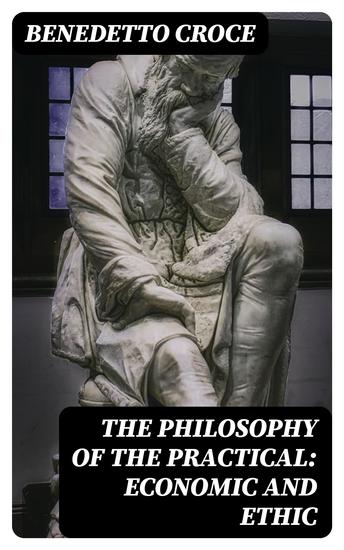
In "The Philosophy of the Practical: Economic and Ethic," Benedetto Croce elucidates the intricate relationship between economic principles and ethical considerations, positing that practical actions stem from a synthesis of economic realities and ethical decisions. Written in a style that harmonizes philosophical rigor with accessible reasoning, Croce deftly navigates through the rich Italian cultural milieu of the early 20th century, situating his arguments within a historical context marked by the upheaval of modernity. His dialogic method and careful analysis invite readers to reassess their understanding of both economics and ethics, emphasizing their interconnectedness rather than treating them as isolated domains of thought. Benedetto Croce (1866-1952), a prominent Italian philosopher, art historian, and politician, emerged as a key figure in Italian intellectual life. His extensive work in aesthetics and history laid a foundation for his exploration of practical philosophy, motivating him to address the broader implications of economic actions on societal ethics. Croce's experiences as a public figure during tumultuous political changes in Italy deeply influenced his philosophical outlook, driving his examination of the ethical dimensions inherent in practical undertakings. This book is highly recommended for those interested in the interplay between philosophy and economics, as well as for scholars exploring the ethical implications of economic actions. Croce's insights remain profoundly relevant today as we navigate a world where ethical considerations increasingly shape economic policies. Engage with this work to gain a nuanced perspective on the fundamental principles that govern human actions.
Available since: 09/04/2022.
Print length: 415 pages.

Other books that might interest you

  • Sun Tzŭ on The Art of War - cover

    Sun Tzŭ on The Art of War

    Sun Tzu

    • 0
    • 0
    • 0
    Brought to you by Altrusian Grace Media and Narrated by Matthew Schmitz. 
    Few works in human history have shaped the course of warfare, strategy, and leadership as profoundly as The Art of War by Sun Tzu. Written over 2,500 years ago during China’s Warring States period, this timeless treatise transcends its origins as a military manual, offering wisdom that applies not only to warfare but to politics, business, diplomacy, and personal growth. 
    At its core, The Art of War is a philosophy of strategy—one that emphasizes intelligence, adaptability, and the mastery of conflict through knowledge rather than brute force. Sun Tzu teaches that victory is not won by strength alone, but by the ability to anticipate, deceive, and maneuver with precision. His principles—such as knowing when to engage, when to retreat, and how to use terrain, morale, and deception to one’s advantage—have been studied by generals, statesmen, and leaders across cultures and eras. 
    Beyond the battlefield, Sun Tzu’s insights resonate in today’s world of business, competition, and negotiation. His maxims on leadership, preparation, and calculated decision-making remain as relevant in the boardroom as they were in the war camps of ancient China. The idea that “the supreme art of war is to subdue the enemy without fighting” reflects the wisdom of those who understand that true power lies in the mind rather than in force. 
    Yet, The Art of War is not merely a book of tactics; it is a study of human nature. Sun Tzu recognized that success comes from understanding people—their fears, ambitions, and motivations. His principles teach us that strategy is not just about defeating an opponent but about creating conditions where conflict can be avoided altogether. 
    May this work serve as a beacon of strategic wisdom, reminding us that the greatest victories are those won with knowledge, patience, and foresight.
    Show book
  • The Ukrainian Oligarchy After the Euromaidan - How Ukraine’s Political Economy Regime Survived the Crisis - cover

    The Ukrainian Oligarchy After...

    David Dalton

    • 0
    • 0
    • 0
    This book traces the conversion of wealth into political influence through vote-buying and of the transformation of political influence back into wealth.
    Show book
  • Fear and Trembling - cover

    Fear and Trembling

    Søren Kierkegaard

    • 0
    • 0
    • 0
    Soren Kierkegaard was a Danish philosopher, theologian, and religious author interested in human psychology. He is regarded as a leading pioneer of existentialism and one of the greatest philosophers of the 19th Century.
    Show book
  • Transform Your Future: Secrets to Choosing the Right College - "Elevate your college decision-making! Unlock insightful audio lessons for a successful future!" - cover

    Transform Your Future: Secrets...

    Ephraim Vexley

    • 0
    • 0
    • 0
    Transform Your Future: Secrets to Choosing the Right College 
    ⭐⭐ Simplified Guide & Explanations Included ⭐⭐ 
    Are you ready to advance your career and build a solid foundation for your future with informed college choices?  
    Searching for an all-encompassing guide that covers every essential element for making the right college decision? 
    Your search concludes here! 
    This audiobook is your ultimate companion for enhancing your understanding, applying your skills, and engaging in practical exercises. With this resource, you'll be set for success. 
    Updated for the 2024-2025 college admissions landscape. 
    Key features of this comprehensive guide include: 
    - Deep insights about the college admissions process 
    - In-depth explanations of the significance of choosing the right college 
    - Effective strategies for preparing and navigating the college selection 
    Our guide stands out by offering thorough coverage—crucial for your success. We don't just skim through concepts; we explore them intricately. 
    Please note that this guide is an independent resource and is not affiliated with any official college admissions entity. 
    Crafted with a clear structure and straightforward language, our guide ensures smooth transitions between topics. Say farewell to convoluted jargon and embrace clear, precise, and accurate content. 
    So, why delay? Click the BUY NOW button, secure your guide, and start your journey toward achieving informed college choices today! 
    Unlock your potential with informed college choices today!
    Show book
  • Identity in the Trenches - The Fatal Impact of Diversity Equity and Inclusion on US Military Readiness - cover

    Identity in the Trenches - The...

    Will Thibeau

    • 0
    • 0
    • 0
    The military is often perceived by well-meaning Americans as the last stronghold against the progressive march through America’s institutions. But this is no longer simply the case. Our Armed Forces were once the envy of the world, in large part because we selected based on merit, and instilled in our fighting men an unshakeable military ethos. Both the ethos and the selection, however, have been in steady decline as the Department of Defense succumbs to a dangerous ideology: selection and promotion based on racial and gender identity. This has already led to major problems and may well lead us down the path of disaster.
    Show book
  • The Aitareya Upanishad 101 - an original translation in modern language made plain and simple - cover

    The Aitareya Upanishad 101 - an...

    Matthew Barnes

    • 0
    • 0
    • 0
    Do you believe in evolution, but do not see this belief as necessarily negating the existence of an advanced Intelligence?  
    If so, you may find comfort, inspiration, and perhaps even proof for your beliefs within this ancient Hindu work.  
    The Aitareya Upanishad, which dates back to somewhere around 600-500 BCE, takes us through a journey … the journey of creation. It then leads us through the evolutionary changes that have brought us into this day and age and beyond, into the stage of existence that the ancient Hindus believed would come next. We were all created, the Hindus tell us, for a reason, and we are all evolving towards a particular state of beingness.  
    How can the Hindus be so sure that evolution is fact, and how can they be so sure that there is some sort of Intelligence behind it all? The Hindu religion is the oldest on earth. Their ancestors claim to have actually witnessed a small portion of evolution in action, and through their experiences, also claim to have discovered the underlying intent of life (both in the general and the individual sense). This work goes into these experiences and the insights the Hindus claim to have gained from them. 
    Also included in this narrative is an early Hindu concept of time and space that is extremely difficult to wrapt the human mind around. These concepts, however, coincide very closely with the findings of modern physics. 
    This work is my interpretation of the Aitareya Upanishad. I have endeavored to simplify its teachings, expand where needed, and include modern concepts, discoveries, and quotes to make the central concepts found within it more digestible to modern seekers, especially beginners.  
    Would you like to know more? 
    If so, scroll up and dive in now!
    Show book