Join us on a literary world trip!
Add this book to bookshelf
Grey
Write a new comment Default profile 50px
Grey
Subscribe to read the full book or read the first pages for free!
All characters reduced
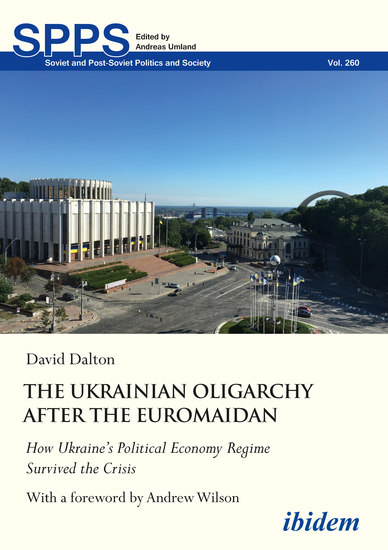
The Ukrainian Oligarchy After the Euromaidan - How Ukraine’s Political Economy Regime Survived the Crisis - cover

The Ukrainian Oligarchy After the Euromaidan - How Ukraine’s Political Economy Regime Survived the Crisis

David Dalton

Publisher: ibidem

  • 0
  • 0
  • 0

Summary

This book traces the conversion of wealth into political influence through vote-buying and of the transformation of political influence back into wealth.
Available since: 02/27/2023.
Print length: 326 pages.

Other books that might interest you

  • Summary of Confronting Evil - Assessing the Worst of the Worst - cover

    Summary of Confronting Evil -...

    Fortune Press

    • 0
    • 0
    • 0
    Book Summary: Confronting Evil by Bill O’Reilly and Josh Hammer 
     Assessing the Worst of the Worst 
    What drives human beings to commit acts of unspeakable cruelty—and what separates those who resist evil from those who enable it? In Confronting Evil, Bill O’Reilly and Josh Hammer examine history’s darkest figures to reveal the moral choices that define humanity’s ongoing battle between good and evil. 
    This summary explores the key ideas and insights behind O’Reilly and Hammer’s chilling yet thought-provoking analysis of tyrants, conquerors, and criminals—from Genghis Khan and Caligula to Hitler, Stalin, and modern-day despots. Through their stories, the book sheds light on the psychology of power, corruption, and the devastating cost of moral indifference. 
    With clarity and depth, this companion guide distills the authors’ central message: evil persists not only because of those who commit it, but because too many good people look away. 
    Disclaimer: This is an unofficial summary and analysis of Confronting Evil by Bill O’Reilly and Josh Hammer. It is intended to provide educational value and enhance understanding of the original work.
    Show book
  • The Shortest History of Greece - The Odyssey of a Nation from Myth to Modernity - cover

    The Shortest History of Greece -...

    James Heneage

    • 0
    • 0
    • 0
    Philosophy, art, democracy, language, even computers—the glories of Greek civilization have shaped our world even more profoundly than we realize. Pericles and the Parthenon may be familiar, but what of Epaminondas, the Theban general who saved the Greek world from Spartan tyranny? Alexander the Great's fame has rolled down the centuries, but the golden Hellenistic Age that followed is largely forgotten. "Byzantine" conjures decadence and deadly intrigue, yet the thousand-year empire that ruled from Constantinople and saved Europe twice from invasion was, in fact, Greek. 


    Greece's modern chapter, too, tells of triumph and calamity—from liberation and expansion to schism, homegrown dictatorship, Nazi occupation, and civil war. Today's nation is battered by austerity, encroaching climate change, and a refugee crisis—yet unwavering in its ancient values. 


    James Heneage captures the full Grecian drama in this riveting, short history, revealing Greece as the wellspring of Western civilization—and a model that may yet save modern democracy.
    Show book
  • The Pursuit of Dominance - 2000 Years of Superpower Grand Strategy - cover

    The Pursuit of Dominance - 2000...

    Christopher J. Fettweis

    • 0
    • 0
    • 0
    The United States is the most powerful actor in the international system, but it is facing a set of challenges that might lead to its decline as this century unfolds. 


    In The Pursuit of Dominance, Christopher J. Fettweis examines the grand strategy of previous superpowers to see how they maintained, or failed to maintain, their status. Over the course of six cases, from Ancient Rome to the British Empire, he seeks guidance from the past for present US policymakers. Like the United States, the examples Fettweis uses were the world's strongest powers at particularly moments in time, and they were hoping to stay that way. Rather than focusing on those powers' rise or how they ruled, however, Fettweis looks at how they sought to maintain their power. From these cases, one paramount lesson becomes clear: Dominant powers usually survive even the most incompetent leaders. Fettweis is most interested in how these superpowers defined their interests, the grand strategies these regimes followed to maintain superiority over their rivals, and how the practice of that strategy worked. 


    A sweeping history of grand strategy, The Pursuit of Dominance looks at the past 2,000 years to highlight what—if anything—current US strategists can learn from the experience of earlier superpowers.
    Show book
  • The EU and the South Caucasus: European Neighborhood Policies between Eclecticism and Pragmatism 1991-2021 - With a foreword by Nicholas Ross Smith - cover

    The EU and the South Caucasus:...

    Daviti Mtchedlishvili

    • 0
    • 0
    • 0
    This book delves into the complex and often contradictory relations between the South Caucasus and European Union (EU).
    Show book
  • Plenty Good Room - Co-creating an Economy of Enough for All - cover

    Plenty Good Room - Co-creating...

    Andrew Wilkes

    • 0
    • 0
    • 0
    Plenty Good Room lays out in clear terms the hope of democratic socialism for a world ravaged by intensifying racial capitalism and social injustice. Unleash your ingenuity for systems that offer plenty good room—not for just a few but for all. 
     
    Economic inequality yawns as wide as ever. Capitalism is working as it was designed: replicating an uneven balance of power, constraining life chances, and limiting imaginations. Those of us concerned about injustice often confine ourselves to issue-by-issue activism. The end result? Owners, investors, and a politics of inequality win. 
     
    But what if there's another way to organize our common life—and what if it's as homegrown as sweet potato pie? What if we could become moral engineers who co-create the world we all deserve? 
     
    Plenty Good Room helps readers understand Black Christian socialism, a stream of the Black radical tradition, from the perspective of a Brooklyn pastor and political scientist's civic awakening. As the former director of the Drum Major Institute, founded by America's most famous democratic socialist, Dr. Martin Luther King Jr., Rev. Andrew Wilkes mounts a challenge to the endless greed, inequality, and profiteering of racial capitalism. 
     
    Tugging on the threads of history and scripture and pointing to the work of Black radicals like W. E. B. Du Bois, Rev. Addie Wyatt, and Fannie Lou Hamer, Wilkes weaves a narrative of "plenty good room moments": times in which communities and individuals had sufficient resources, human rights, and beauty. He invites us to join a movement that a day-laboring Christ initiated as he organized the dispossessed, the disinherited, and those pushed to the edges of society. Wilkes also introduces contemporary efforts pushing for reparations, community ownership, participatory democracy, and solidarity economies. These stories show us that we can create a world of care and reciprocity by envisioning an economy of enough for all—one rooted in justice, equity, and the God whose spirit falls on all flesh.
    Show book

  • Ethics of Redistribution The: Book Summary & Analysis - cover

    Ethics of Redistribution The:...

    Briefly Summaries

    • 0
    • 0
    • 0
    This is a concise summary and analysis of The Ethics of Redistribution, by 
    Bertrand de Jouvenel.
     
    It is not the original book and is not affiliated with or endorsed by Bertrand de Jouvenel.
    Ideal those seeking a quick and insightful overview.
     
    In The Ethics of Redistribution, the author delves into the philosophical and economic implications of wealth redistribution, challenging commonly held assumptions about equality and social justice. The book explores the ethical boundaries of government intervention in economic systems, questioning whether redistributive policies truly benefit society or hinder individual freedoms and innovation. Through incisive arguments and historical examples, this work provides a thought-provoking critique of the role of the state in shaping economic fairness, making it an essential read for anyone interested in political philosophy, economics, or public policy.
    Show book