Join us on a literary world trip!
Add this book to bookshelf
Grey
Write a new comment Default profile 50px
Grey
Subscribe to read the full book or read the first pages for free!
All characters reduced
A General View of Positivism - cover

A General View of Positivism

Auguste Comte

Translator J. H. Bridges

Publisher: CrossReach Publications

  • 0
  • 0
  • 0

Summary

Although Positivism has been pretty widely discussed of late, not only by those interested in philosophy and religion, but by the general reader and the public press, perhaps but few of them, whether readers or critics, have exactly grasped the full meaning of it as a system at once of thought and of life. The vast range of the ground it covers and the technical, allusive, and close style of Comte’s writings in the original have made it difficult to master the subject as a whole. It has accordingly been thought that the time has come to add to the “New Universal Library” a translation of The General View of Positivism, i.e., the careful summary of the Positive Polity which Auguste Comte prefixed to the four volumes of his principal work. The translation which was published by Dr. J. H. Bridges in 1865 is at the same time a most accurate version by one of Comte’s earliest followers, and also it is turned in an easy and simpler style, with the references and allusions explained, marginal headings to the paragraphs, and a complete analysis of the contents.Positivism is not simply a system of Philosophy; nor is it simply a new form of Religion; nor is it simply a scheme of social regeneration. It partakes of all of these, and professes to harmonize them under one dominant conception that is equally philosophic and social. “Its primary object,” writes Comte, “is twofold: to generalize our scientific conceptions and to systematize the art of social life.” Accordingly Comte’s ideal embraces the three main elements of which human life consists—Thoughts, Feelings and Actions.Now it is clear that no such comprehensive system was ever before offered to the world. Neither the Gospel nor any known type of religion undertook to give a synthetic grouping of the Sciences. No synthetic scheme of philosophy ever attempted to correlate religion, politics, art, and industry. No system of Socialism, ancient or modern, started with mathematics and led up to an ideal of a human devotion to duty, with a ritual of worship, both public and private.Now Comte’s famous Positive Polity did attempt this gigantic task. And the novelty and extent of such a work explains and accounts for the extreme difficulty met with by readers of the original French, and also for the fascination which it has maintained more than fifty years after the author’s death. It has been talked about, criticized, and even ridiculed, with an ignorance of its true character which can only be excused by the abstract and severe form in which Comte thought right to condense his thoughts. Comte was primarily a mathematician, and neither Descartes nor Newton troubled themselves about “the general reader.” Kepler, they say, declared himself satisfied if he had one convert in a century; and philosophers have seldom had justice done them until some generations have passed. The difficulties presented by the scientific form of Comte’s works have been obviated for English readers by the versions of his English followers, which are at once literal translations, analyses, and elucidations. For the “general reader” nothing could be more serviceable than Bridges’ clear presentation of Comte’s own “general view,” or summary of his system.
Available since: 04/08/2022.
Print length: 553 pages.
Other books that might interest you

  • Speed Reading - How To Read Smarter Learn Faster and Remember More - cover

    Speed Reading - How To Read...

    Steve Collins

    • 0
    • 0
    • 0
    Do you ever wish you could read faster without forgetting what you just read? 
    In today’s information-overloaded world, mastering the art of speed reading isn’t just a skill—it’s a superpower. 
    Speed Reading: How to Read Faster, Understand Better, and Retain More Information is your complete guide to unlocking your mind’s full reading potential. Whether you’re a student, professional, or lifelong learner, this book teaches you how to absorb information quickly, boost comprehension, and remember what truly matters. 
    Inside, you’ll discover:The fascinating history and science of speed readingProven techniques to double or even triple your reading speedHow to improve focus and comprehension while reading fastThe most common bad reading habits—and how to fix themEasy exercises to train your eyes and brain for faster learningPractical tips to retain key ideas long after you finish reading 
    If you want to read smarter, learn faster, and retain more knowledge, this book will show you exactly how.
    Show book
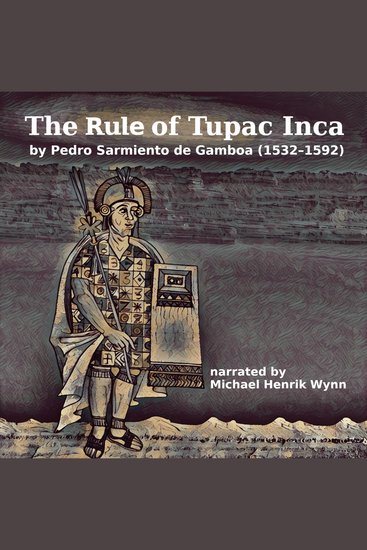
  • Rule of Tupac Inca by Pedro Sarmiento de Gamboa The (1532–1592) - narrated by Michael Henrik Wynn - cover

    Rule of Tupac Inca by Pedro...

    Pedro Sarmiento de Gamboa

    • 0
    • 0
    • 0
    Only 40 years after the Spanish arrival in Cusco, Peru, Pedro Sarmiento de Gamboa  (1532–1592) was commissioned in 1572 by Francisco de Toledo, the fifth Viceroy of Peru, to write a history of the Incas. Toledo intended this history to justify Spanish colonization by documenting the violent and tyrannical nature of the Inca rulers. Sarmiento gathered information through extensive interviews with indigenous informants, former Incan nobles, local leaders, and surviving Spanish conquistadors. To ensure accuracy, his manuscript was read and reviewed by 42 indigenous authorities before publication. 
    This audiobook presents a reading of Sarmiento de Gamboa’s chapter on one of the most influential and formidable Inca emperors: Túpac Inca Yupanqui, the tenth Sapa Inca. Like his father Pachacuti and his son Huayna Capac, Túpac Inca expanded the Inca Empire, bringing under Inca control the territories of much of present-day Peru, Chile, Bolivia, Ecuador, Argentina, and beyond. He also lived to an advanced age and fathered nearly one hundred children. 
    The narrator is Michael Henrik Wynn, editor of the educational net radio stream historyradio.org.
    Show book
  • Kaya Mijikenda - The Nine Tribes - cover

    Kaya Mijikenda - The Nine Tribes

    Ibrahim Mwafrika

    • 0
    • 0
    • 0
    Based on a true culture, way of life in the year 1500 AD. The Kaya Mijikenda Community of the Bantu Origin namely Kambe, Ribe, Jibana, Kauma, Rabai, Chonyi, Giriama, Duruma and Digo, lived a life worth remembering. Here is their Story.
    Show book
  • Summary: Never Enough - When Achievement Culture Becomes Toxic-and What We Can Do About It by Jennifer Breheny Wallace: Key Takeaways Summary & Analysis - cover

    Summary: Never Enough - When...

    Brooks Bryant

    • 0
    • 0
    • 0
    DISCLAIMER: THIS IS NOT THE OFFICIAL BOOK. 
    This is a summary & it does not accompany the official. 
    "Never Enough" by Jennifer Breheny Wallace delves into the high-pressure world of today's students, who strive relentlessly for success and often find themselves overwhelmed. This book explores the pervasive culture of toxic achievement, where students pack their schedules with activities and face intense competition, leading to rising rates of anxiety and depression. 
    Wallace investigates the origins of this culture and its deep-seated roots in society, driven by income inequality and limited opportunities. Through interviews and research, the book highlights how children are absorbing the message that their worth is solely tied to their accomplishments. 
    However, "Never Enough" offers a different perspective, emphasizing the importance of children feeling like they matter intrinsically, regardless of their external achievements. It advocates for parents and educators to adopt a mindset that values a child's sense of self-worth and contribution to a larger community. By doing so, the book argues, children can develop resilience, self-confidence, and psychological security. 
    With insightful stories and practical guidance, "Never Enough" provides an urgent and humane perspective on the challenges facing today's teenagers and offers a framework for positive change in how we nurture and support them.
    Show book
  • Right to Die? - Euthanasia Assisted Suicide and End-of-Life Care - cover

    Right to Die? - Euthanasia...

    John Wyatt

    • 0
    • 0
    • 0
    The case for assisted suicide can seem so compelling. Surely it can't be wrong to help desperate people to kill themselves? Don't we have a right to take our own lives in certain circumstances? 
    There are no trite or easy answers. John Wyatt helps us to navigate the arguments with hearts and heads engaged, and above all with our Bibles open. There are practical and compassionate alternatives to assisted suicide, and as many who have gone before us have found, the end of our lives on this earth may turn out to be a strange and wonderful opportunity for growth and internal healing.
    Show book
  • All in! - Energy and Prosperity for a Growing World - cover

    All in! - Energy and Prosperity...

    Bert Beyers, Franz Josef Prof....

    • 0
    • 0
    • 0
    Today, more than 80 percent of global energy comes from coal, gas and oil. A completely renewable and electric energy system (All-Electric) is a distant dream, perhaps not even that.
    
    Time is of the essence. That is why we need to use all climate-neutral and secure energy sources immediately: Renewable, fossil with CO2 capture and nuclear energy-ALL IN! instead of All-Electric. Because fossil emissions are the problem, not fossil fuels.
    
    Climate neutrality can only be achieved pragmatically, open to technology and together in a symbiosis of technology and nature. Whether we get climate change under control will not be decided in Germany or Europe, not even in the USA, but in China, India and Africa. At best, climate nationalism helps our own conscience.
    Show book