Join us on a literary world trip!
Add this book to bookshelf
Grey
Write a new comment Default profile 50px
Grey
Subscribe to read the full book or read the first pages for free!
All characters reduced
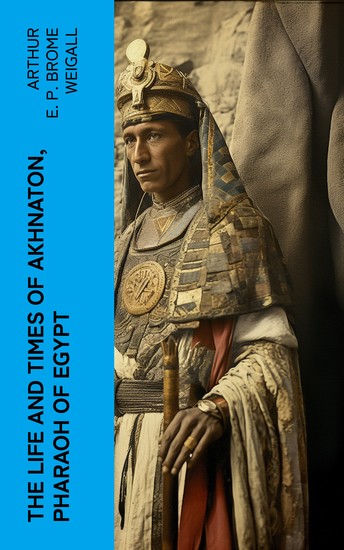
The Life and Times of Akhnaton Pharaoh of Egypt - cover

The Life and Times of Akhnaton Pharaoh of Egypt

Arthur E. P. Brome Weigall

Publisher: e-artnow

  • 0
  • 0
  • 0

Summary

"The Life and Times of Akhnaton, Pharaoh of Egypt" by English egyptologist Arthur Edward Pearse Brome Weigall is a seminal piece of historic non-fiction. Providing one of the most thoroughly researched biographies of the Pharoah Akhnaton. Basing his work on discoveries that, at the time of writing the book, were being unearthed daily, Weigall is able to create a picture of the rise and fall of this Pharaoh. Though it might be impossible to go back in time, Arthur Weigall has managed to create a picture that is so immersive, that readers have felt as if they were actually in Ancient Egypt since it was first published in 1910.
Available since: 12/09/2023.
Print length: 158 pages.

Other books that might interest you

  • Famous Artists - Art Movements Renaissance and Age of Enlightenment - cover

    Famous Artists - Art Movements...

    Kelly Mass

    • 0
    • 0
    • 0
    This book includes several books about the following topics: 
    Age of Enlightenment - Finally… finally, humanity began to wake up. Finally, they decided to take science, knowledge, politics, development, multiple angles and perspectives, and the details of our everyday lives a bit more seriously. For centuries, raw and primal urges and principles had taken hold of conquerors, officials, and governments. 
    Renaissance - When we think of the Renaissance, we often think of paintings. And indeed, many painters and sculptors were part of the artistic transformation the Renaissance caused. But there was more. The Renaissance basically formed a period of collective enlightenment and freedoms that put an end to certain tyrannies and false notions from the Middle Ages. 
    Claude Monet - Claude Monet has been the icon for the impressionist movement. Painting vague strokes of color and contrast, water, and flowers were typical. Other aspects of the art weren’t as clear but were just as important, nonetheless. 
    Pablo Picasso - Picasso’s work is famous. His art is intricate yet bizarre. Many people have stood still over the wonders and simplicity of cubism and surrealism and have either been disgusted or amazed by it. 
    Vincent van Gogh - Vincent van Gogh is undoubtedly one of the most influential painters of the end of the 19th century. His style was unique in that he used all types of colors in a painting that didn’t show those colors in reality and somehow, he still made it work and look like an actual shape.  
    Michelangelo Buonarotti - Michelangelo had a vision, a dream, and the talent to carry out those imaginations. His life, in our perspective, is a compilation of great works of art, architecture, sculptures, paintings, and intricate movements, contrast, colors, and anatomy of the human body.
    Show book
  • Rachel Saint - A Star in the Jungle - cover

    Rachel Saint - A Star in the Jungle

    Janet Benge, Geoff Benge

    • 0
    • 0
    • 0
    Aboard the Aquitania, Rachel became aware of something strange happening to her. It was as if she were not on the deck of the ship anymore but was instead in a jungle clearing, looking at a group of brown-skinned, half-naked people. The people beckoned for her to come. Suddenly the scene vanished, and Rachel fell to her knees and prayed. When young Rachel Saint surrendered her life to God, she began an unimaginable journey that would span decades and radically transform a dying culture steeped in revenge. Against all odds, God would lead her to Ecuador's Waorani Indians -- known as Aucas, or savages, and infamous for murder. Despite the martyrdom of five missionaries by Waorani spears, Rachel boldly persisted in following God. In one of the greatest testimonies to God's grace and power in our time, this pioneering Bible translator would live for two decades with her own brother's killers, for the joy of seeing them become brothers and sisters in Christ.
    Show book
  • My Secret Life Vol 3 Chapter 13 - cover

    My Secret Life Vol 3 Chapter 13

    Dominic Crawford Collins

    • 0
    • 0
    • 0
    My Secret Life, the anonymously written erotic memoirs of a Victorian English gentleman who refers to himself simply as 'Walter' is one of the most idiosyncratic and sexually obsessed books ever written. In this vast autobiographical confessional the author recounts, in meticulous detail, his sexual exploits throughout the course of a life devoted entirely to the pursuit of carnal pleasure. Through this compelling exploration of the author's sexual behaviour we are left with a uniquely entertaining insight into life behind the closed doors of Victorian society. My Secret Life is evocative, provocative, sorrowful, suspenseful, obscene, exciting and highly erotic...in it we are privy to the thoughts, emotions and memories of one of the most unusual, unsung and colourful English eccentrics of the Victorian era.
    
    Now, for the first time, the complete unabridged version of this unique text is being narrated and scored by film composer Dominic Crawford Collins as an 'audiofilm' (an audiobook in which the emotional landscape is explored through the music score). Each chapter of My Secret Life will be released at monthly intervals over the next ten or so years culminating in what is likely to become the longest audio book ever to be produced.
    Show book
  • Tough Rugged Bastards - A Memoir of a Life in Marine Special Operations - cover

    Tough Rugged Bastards - A Memoir...

    John A. Dailey

    • 0
    • 0
    • 0
    Following the 9/11 attacks, Secretary of Defense Donald Rumsfeld directed the Marine Corps to establish a unit that would answer to US Special Operations Command. The eighty-six-man "Detachment One" was formed with a two-year charter to train and deploy as a "proof-of-concept" to assess the viability of a larger Marine Special Operations contribution in support of the Global War on Terror. 


    For such a departure from the norm, a special leader was needed. The Commanding Officer—Colonel Robert J. Coates, a Marine Force Recon legend—was given his pick of personnel. One of the four team leaders he selected was Gunnery Sergeant John A. Dailey. 


    These men built a unit from nothing, trained for unknown missions in an unknown location, and deployed amid controversy and skepticism. Once in Iraq, they were dubbed "Task Unit Raider" and quickly won over the naysayers who doubted the Marine's ability to operate successfully. 


    This book tells Dailey's story of the creation, training, and volatile 2004 Iraq deployment of Task Unit Raider that led to the creation of the Marine Forces Special Operations Command. Det-1 served as the bridge between the Raiders of WWII and the Marine Raiders of today.
    Show book
  • Empedocles - The Four Elements and Cosmic Cycles - cover

    Empedocles - The Four Elements...

    Hector Davidson

    • 0
    • 0
    • 0
    Empedocles, a philosopher and poet from the ancient Greek city of Acragas (modern-day Agrigento, Sicily), lived during the 5th century BCE and is often regarded as one of the most original thinkers of his time. His life and works remain an intriguing fusion of science, mysticism, and poetry. Though much of what we know about Empedocles comes from fragments of his writings, his ideas have had a profound and lasting influence on philosophy, science, and even religion. 
      
    Empedocles is best known for his theory of the four elements—earth, air, fire, and water—which he posited as the fundamental building blocks of the universe. Unlike his predecessors, who sought to explain the world through a singular substance (such as water for Thales or air for Anaximenes), Empedocles argued that these four elements combined and separated through two cosmic forces: Love (Philia) and Strife (Neikos). Love brings the elements together, fostering harmony and unity, while Strife pulls them apart, creating division and chaos. This cyclical process of combination and separation underlies the ongoing changes in the cosmos. 
      
    In addition to his materialistic philosophy, Empedocles incorporated spiritual and mystical elements into his worldview. He believed in the transmigration of souls, suggesting that human beings and other living creatures are bound to an endless cycle of reincarnation. According to Empedocles, the soul is trapped in a cycle of birth, death, and rebirth, and it can achieve liberation through purification and virtuous living. His philosophical system thus integrated both natural and ethical concerns, urging individuals to live in harmony with the forces of the cosmos and pursue a life of virtue.
    Show book
  • Strangers to Ourselves - Unsettled Minds and the Stories That Make Us - cover

    Strangers to Ourselves -...

    Rachel Aviv

    • 0
    • 0
    • 0
    A New York Times Book Review Ten Best Books of 2022 A Wall Street Journal Ten Best Books of 2022 The acclaimed, award-winning New Yorker writer Rachel Aviv offers a groundbreaking exploration of mental illness and the mind, and illuminates the startling connections between diagnosis and identity. In Strangers to Ourselves, a powerful and gripping debut, Rachel Aviv raises fundamental questions about how we understand ourselves in periods of crisis and distress. Drawing on deep, original reporting as well as unpublished journals and memoirs, Aviv writes about people who have come up against the limits of psychiatric explanations for who they are. She follows an Indian woman, celebrated as a saint, who lives in healing temples in Kerala; an incarcerated mother vying for her children’s forgiveness after recovering from psychosis; a man who devotes his life to seeking revenge upon his psychoanalysts; and an affluent young woman who, after a decade of defining herself through her diagnosis, decides to go off her meds because she doesn’t know who she is without them. Animated by a profound sense of empathy, Aviv’s exploration is refracted through her own account of living in a hospital ward at the age of six and meeting a fellow patient with whom her life runs parallel—until it no longer does. Aviv asks how the stories we tell about mental disorders shape their course in our lives. Challenging the way we understand and talk about illness, her account is a testament to the porousness and resilience of the mind.
    Show book