Join us on a literary world trip!
Add this book to bookshelf
Grey
Write a new comment Default profile 50px
Grey
Subscribe to read the full book or read the first pages for free!
All characters reduced
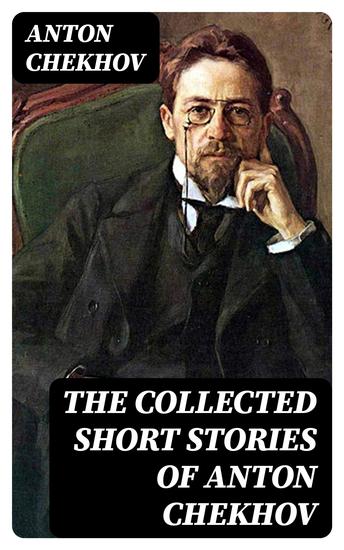
The Collected Short Stories of Anton Chekhov - Enriched edition - cover

The Collected Short Stories of Anton Chekhov - Enriched edition

Anton Chekhov

Translator Julian Hawthorne, Constance Garnett, Thomas Seltzer, Marian Fell, Herman Bernstein, Robert Edward Crozier Long, C.E. Bechhofer Roberts, S.S. Koteliansky, Gilbert Cannan, J. M. Murry, B. Roland Lewis, Julius West

Publisher: DigiCat

  • 0
  • 0
  • 0

Summary

In "The Collected Short Stories of Anton Chekhov," readers are invited into a rich tapestry of human emotion and social commentary that exemplifies Chekhov's mastery of the short story form. With a distinctive literary style characterized by subtle irony, intricate character development, and profound psychological insight, this collection highlights the existential dilemmas of everyday life. Chekhov deftly navigates themes of love, disillusionment, and the passage of time, often reflecting the shifting socio-political landscape of late 19th-century Russia, making his work timeless and universal in appeal. Anton Chekhov, a physician turned playwright and short story writer, provided a unique lens through which to view the human condition. Having experienced the complexities of life in a rapidly modernizing Russia, Chekhov's keen observations and personal experiences deeply informed his narratives. His belief in the power of story to encapsulate life's unsung moments propelled him to become one of the most significant figures in world literature, influencing generations of writers and reshaping the short story genre. For readers seeking both literary excellence and profound insight into the human experience, "The Collected Short Stories of Anton Chekhov" stands as an essential addition to any literary collection. Chekhov's ability to portray the nuances of personal and societal conflicts invites readers to reflect on their own lives, making this anthology not just a reading experience, but an exploration of what it means to be human.

In this enriched edition, we have carefully created added value for your reading experience:
- A comprehensive Introduction outlines these selected works' unifying features, themes, or stylistic evolutions.
- The Author Biography highlights personal milestones and literary influences that shape the entire body of writing.
- A Historical Context section situates the works in their broader era—social currents, cultural trends, and key events that underpin their creation.
- A concise Synopsis (Selection) offers an accessible overview of the included texts, helping readers navigate plotlines and main ideas without revealing critical twists.
- A unified Analysis examines recurring motifs and stylistic hallmarks across the collection, tying the stories together while spotlighting the different work's strengths.
- Reflection questions inspire deeper contemplation of the author's overarching message, inviting readers to draw connections among different texts and relate them to modern contexts.
- Lastly, our hand‐picked Memorable Quotes distill pivotal lines and turning points, serving as touchstones for the collection's central themes.
Available since: 11/13/2022.
Print length: 2500 pages.
Other books that might interest you

  • Our Mutual Friend - Book the First: The Cup and the Lip (Unabridged) - cover

    Our Mutual Friend - Book the...

    Charles Dickens

    • 0
    • 0
    • 0
    Charles Dickens was a writer and social critic who created some of the world's best-known fictional characters and is regarded as the greatest novelist of the Victorian era. His works enjoyed unprecedented popularity during his lifetime, and by the twentieth century critics and scholars had recognised him as a literary genius. His novels and short stories enjoy lasting popularity.
    BOOK THE FIRST: THE CUP AND THE LIP: In these times of ours, though concerning the exact year there is no need to be precise, a boat of dirty and disreputable appearance, with two figures in it, floated on the Thames, between Southwark bridge which is of iron, and London Bridge which is of stone, as an autumn evening was closing in.
    Show book
  • A Medical Crime - From their pens to your ears genius in every story - cover

    A Medical Crime - From their...

    J. Storer Clouston

    • 0
    • 0
    • 0
    The bookshelves of British literature are incredible collections that have gathered together centuries of very talented authors.  From these Isles their fame spread and whilst among their number many are now forgotten or neglected their talents endure.  Among them is J Storer Clouston.
    Show book
  • At Christmas Time - From their pens to your ears genius in every story - cover

    At Christmas Time - From their...

    Anton Chekhov

    • 0
    • 0
    • 0
    Anton Pavlovich Chekhov was born on 29th January 1860 in Taganrog, on the south coast of Russia.  
    His family life was difficult; his father was strict and over-bearing but his mother was a passionate story-teller, a subject Chekhov warmed to. As he later said; ‘our talents we got from our father, but our soul from our mother’.  
    At school Chekhov was distinctly average. At 16 his father mis-managed his finances and was declared bankrupt. His family fled to Moscow. Chekhov remained and eked out a living by various means, including writing and selling short sketches to newspapers, to finish his schooling. That completed and with a scholarship to Moscow University obtained he rejoined his family. 
    He was able to help support them by selling satirical sketches and vignettes of Russian lifestyles and gradually obtained further commissions. In 1884, he qualified as a physician and, although it earned him little, he often treated the poor for free, he was fond of saying ‘Medicine is my lawful wife, and literature is my mistress.’ 
    His own health was now an issue as he began to cough up blood, a symptom of tuberculosis.  Despite this his writing success enabled him to move the family into more comfortable accommodation.  
    Chekhov wrote over 500 short stories which included many, many classics including ‘The Kiss’ and ‘The Lady with a Dog’.  His collection ‘At Dusk’ won him the coveted Pushkin Prize when was only 26.  
    He was also a major playwright beginning with the huge success of ‘Ivanov’ in 1887.   
    In 1892 Chekhov bought a country estate north of Moscow. Here his medical skills and money helped the peasants tackle outbreaks of cholera and bouts of famine. He also built three schools, a fire station and a clinic.  It left him with less time for writing but the interactions with real people gained him detailed knowledge about the peasantry and their living conditions for his stories.  
    His most famous work, ‘The Seagull’ was received disastrously at its premiere in St Petersburg. It was later restaged in Moscow to highlight its psychological aspects and was a huge success. It led to ‘Uncle Vanya’, ‘The Three Sisters’ and ‘The Cherry Orchard’.  
    Chekhov suffered a major lung hemorrhage in 1897 while visiting Moscow. A formal diagnosis confirmed tuberculosis and the doctors ordered changes to his lifestyle.  
    Despite a dread of weddings the elusive literary bachelor quietly married the actress Olga Knipper, whom he had met at rehearsals for ‘The Seagull’, on 25th May 1901. 
    By May 1904 with his tuberculosis worsening and death imminent he set off for the German town of Badenweiler writing cheerful, witty letters to his family and assuring them his health was improving.  
    On 15th July 1904 Anton Chekhov died at Badenweiler.  He was 44.
    Show book
  • Middlemarch (Book 2: Old and Young) - cover

    Middlemarch (Book 2: Old and Young)

    George Eliot

    • 0
    • 0
    • 0
    Middlemarch (Book 2: Old and Young), A Study of Provincial Life is a novel by English author George Eliot, the pen name of Mary Ann Evans. It appeared in eight installments (volumes) in 1871 and 1872. Set in Middlemarch, a fictional English Midlands town, from 1829 to 1832, it follows distinct, intersecting stories with many characters. Issues include the status of women, the nature of marriage, idealism, self-interest, religion, hypocrisy, political reform, and education. Leavened with comic elements, Middlemarch approaches significant historical events in a realist mode: the Reform Act 1832, early railways, and the accession of King William IV. It looks at medicine of the time and reactionary views in a settled community facing unwelcome change. Eliot began writing the two pieces that formed the novel in 1869–1870 and completed it in 1871. Initial reviews were mixed, but it is now seen widely as her best work and one of the great English novels.
    Show book
  • Northanger Abbey - Audiobook - cover

    Northanger Abbey - Audiobook

    Jane Austen, Classic Audiobooks,...

    • 0
    • 0
    • 0
    Northanger Abbey is both a coming-of-age story and a playful parody of Gothic novels. It follows Catherine Morland, a naïve and imaginative young woman who enters the social world of Bath and later visits the mysterious Northanger Abbey. Influenced by the Gothic romances she devours, Catherine begins to see sinister plots and secrets where none exist.Through Catherine's misadventures and gradual maturity, Austen gently mocks the sensationalism of popular fiction while also exploring themes of imagination, reality, and the importance of self-awareness. The novel is lighter in tone but rich in irony, celebrating youthful curiosity while gently critiquing romantic excess.
    Show book
  • Kipps - cover

    Kipps

    H. G. Wells

    • 0
    • 0
    • 0
    First published in 1905 Kipps soon became H.G Wells’ most popular novel. It is a rags to riches story of a “simple soul” Arthur Kipps, a naïve young man who finds himself suddenly struggling to keep afloat in the deep waters of unlooked for wealth. He reaches out to those he considers his betters to anchor himself in this new world, so far removed from his relatively humble life of apprentice to a Draper. 
      
    Young Kipps is quick to abandon his first love Ann for the allure of Helen Walsingham, whom he feels is more the match for the inevitable rise in his status which must surely follow his new found wealth. 
      
    Wells lets the obviously humorous side of the situation naturally unfold, whilst subtly framing Kipps’ rise and fall in the context of the hypocrisies and futilities of Edwardian English society. 
    Narrated by Simon Hester. With original music.
    Show book