Join us on a literary world trip!
Add this book to bookshelf
Grey
Write a new comment Default profile 50px
Grey
Subscribe to read the full book or read the first pages for free!
All characters reduced
Kr̥ṣṇa in the Harivaṁśa (Vol II) - The Greatest of All Sovereigns and Masters - cover

Kr̥ṣṇa in the Harivaṁśa (Vol II) - The Greatest of All Sovereigns and Masters

André Couture

Publisher: D.K. Printworld

  • 0
  • 0
  • 0

Summary

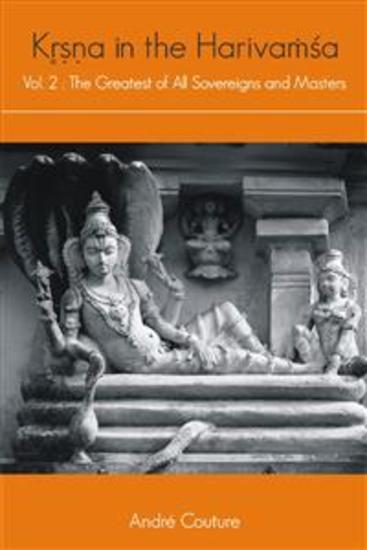
This second volume of Krishna in the Harivamsha brings together texts written between 2000 and 2015, more than half of which are of more recent vintage than those  included in Volume I. While Krishna’s biography is clearly divided into two large units, childhood and adulthood — the kshatriya (warrior) of the second period manifesting himself first as a gopa (cowherd) — it is important to note that both sections of the biography are similarly structured and carry an identical message. This book contends that the child and adult Krishnas are indeed one and the same.The initiation by guru Kashya Sandipani, the construction of the city of Dvaraka, and the fights involving Pradyumna and Aniruddha are among the best known episodes analysed in this volume. It is the oft-neglected Harivamsha version of these well-known stories that is studied here, version that has been passed over despite its early date of composition.An unstated assumption still influences a great deal of Harivamsha research. Many scholars assume that an addition of this sort to the Mahabharata can be little more than a collection of ancient records bearing witness to the primitive mentality of a people unable to think logically. On this view, the Harivamsha becomes reduced to a pile of documents of diverse origins. The articles contained in this volume take the opposite view. Krishna’s biography, which at first blush might appear to be an amalgam of various stories, proves in fact to be a skilful construction which conveys a clear message.
Available since: 03/09/2023.
Other books that might interest you

  • Four Russian Writers: Life Lessons and Storytelling Secrets - "Unlock the wisdom of Four Russian Writers! Experience captivating lessons that elevate your storytelling prowess" - cover

    Four Russian Writers: Life...

    Asherby Fosdick

    • 0
    • 0
    • 0
    Four Russian Writers: Life Lessons and Storytelling Secrets 
    ⭐⭐ A Simplified Guide with Insights Included ⭐⭐ 
    Are you eager to enhance your storytelling abilities and uncover valuable life lessons from some of the greatest Russian writers? 
    Searching for a comprehensive guide that encompasses all the essential elements to master the art of storytelling and learn from these literary giants? 
    Your quest ends here! 
    This guide acts as your ultimate resource for enriching your understanding, applying your newfound skills, and engaging in practical exercises. With our insights, you're poised for success. 
    Updated for the latest storytelling techniques and insights. 
    Key features of this insightful guide: 
    - In-depth explorations of storytelling techniques influenced by four iconic Russian authors. 
    - Clear explanations of life lessons drawn from their works. 
    - Effective strategies for applying storytelling techniques in your own writing. 
    What sets our guide apart is its thorough coverage, which is vital for your learning journey. Concepts are not just lightly touched upon; they are examined in depth. 
    Please note, this guide is an independent resource and not affiliated with any official literary institution. 
    Crafted with a logical structure and accessible language, our guide guarantees seamless transitions between topics. Say goodbye to complex jargon and embrace straightforward, precise, and engaging content. 
    So, why wait? Click the BUY NOW button, secure your guide, and embark on your journey to mastering storytelling through the insights of four remarkable Russian writers!
    Show book
  • The Mind of Primitive Man - cover

    The Mind of Primitive Man

    Franz Boas

    • 0
    • 0
    • 0
    In "The Mind of Primitive Man," Boas delves into the diversity of human cultures, examining their languages, customs, beliefs, and social organizations. He emphasizes the fundamental equality of human capacities across all cultures, debunking theories of racial hierarchy prevalent in the early 20th century. Boas argues that cultural differences arise from environmental factors and historical contingencies rather than innate racial characteristics. His work laid the foundation for modern cultural anthropology, emphasizing the importance of fieldwork, empirical observation, and cultural relativism.
    Show book
  • Beyond Neoliberalism and Neo-illiberalism - Economic Policies and Performance for Sustainable Democracy - cover

    Beyond Neoliberalism and...

    Markus Gabriel, Anna Katsman,...

    • 0
    • 0
    • 0
    In many countries, the political backlash against neoliberalism has mainly been a retreat from democracy, with a decline in independence of the judiciary and the monetary authorities, increased control of the media, and manipulation of elections for purposes of authoritarian control. The economic dynamics and the impact of neoliberalism, i.e. deregulation and liberalized markets, is just one cause of this authoritarian shift. The contributors to this volume examine the impact of neoliberal economic policies in relation to cultural and political factors and how these have promoted the recent authoritarian turn, as well as probing the economic policies and performance of the illiberal regimes.
    Show book
  • A Reading of the Inaugural Address of President Andrew Jackson - cover

    A Reading of the Inaugural...

    President Andrew Jackson

    • 0
    • 0
    • 0
    Andrew Jackson (March 15, 1767 - June 8, 1845) was an American politician and lawyer who served as the seventh president of the United States from 1829 to 1837. Before his presidency, he rose to fame as a general in the U.S. Army and served in both houses of the U.S. Congress. Jackson's legacy is controversial. He has been praised as an advocate for working Americans and preserving the union of states, and criticized for his racist policies, particularly towards Native Americans. His political philosophy became the basis for the Democratic Party. The following is a reading of President Polk's inaugural address on March 4, 1829.
    Show book
  • Ecce Homo - cover

    Ecce Homo

    Friedrich Nietzsche

    • 0
    • 0
    • 0
    "How does one become what one is?" 
     With Ecce Homo, Friedrich Nietzsche invites us on a fascinating journey into the heart of his tormented, lucid, and prophetic mind. Through dazzling prose, he reveals himself, explains himself, and celebrates himself in a final gesture of defiance and pride. 
    A thinker of nihilism and a fierce critic of traditional morality, Nietzsche, with his free and provocative style, forever changed the course of modern philosophy. Ecce Homo stands as both a philosophical self-portrait and an intellectual testament, where every word pulses with raw, timeless energy. 
    Delve into how Nietzsche revisits his major works in "Why I Write Such Good Books," experience his explosive vision of life in "Why I Am So Wise," and surrender to the dramatic intensity of "Why I Am a Destiny," a culminating chapter that resists all easy interpretations. 
    Today, Nietzsche’s influence continues to shape literature, psychology, and contemporary thought, resonating with those who seek meaning, authenticity, and transcendence beyond conventional norms. His singular voice remains as provocative and captivating as ever. 
    Enhanced by a crystal-clear AI narration, this audiobook offers a fully immersive experience into Nietzsche's fierce intellect. Each sentence is delivered with precision, preserving the raw power and poetic beauty of the original text. 
    Step into the incandescent spirit of Friedrich Nietzsche and let yourself be transformed by the words of a man who dared to confront the abyss.
    Show book
  • MIDLIFE - Humanity's Secret Weapon - cover

    MIDLIFE - Humanity's Secret Weapon

    Andrew Jamieson

    • 0
    • 0
    • 0
    Only two species of mammal have a post-reproductive life that lasts longer than their reproductive life: the killer whale, whose elders are able to sniff out food supplies over vast oceanic distances to keep their pods fed, and Homo sapiens. While the evolutionary purpose of the killer whale's extensive life seems clear, what is the point of ours?
    
    This was a question that intrigued psychoanalyst Carl Jung, who observed that if a culture is to maintain its deepest, profoundest roots while moving forward to embrace the challenges of historical and technological change, it needs to find an equilibrium between the energy, vigour and creativity of those in the ego-driven first half of life and the experience, dignity and wisdom of those in the second. But to make it to that second half of life, we need to traverse the dreaded 'middle years', when so many of us find ourselves discontent with our jobs, unhappy in our relationships and lamenting our fetishized youths.
    
    Drawing on history, psychology, science and literature, Jamieson shows just how ubiquitous, and crucial, the 'midlife crisis' is, and the devastating consequences for society at large if we continue to regard it as something we can, and should, avoid.
    Show book