Join us on a literary world trip!
Add this book to bookshelf
Grey
Write a new comment Default profile 50px
Grey
Subscribe to read the full book or read the first pages for free!
All characters reduced
MIDLIFE - Humanity's Secret Weapon - cover

MIDLIFE - Humanity's Secret Weapon

Andrew Jamieson

Publisher: Notting Hill Editions

  • 0
  • 0
  • 0

Summary

Only two species of mammal have a post-reproductive life that lasts longer than their reproductive life: the killer whale, whose elders are able to sniff out food supplies over vast oceanic distances to keep their pods fed, and Homo sapiens. While the evolutionary purpose of the killer whale's extensive life seems clear, what is the point of ours?

This was a question that intrigued psychoanalyst Carl Jung, who observed that if a culture is to maintain its deepest, profoundest roots while moving forward to embrace the challenges of historical and technological change, it needs to find an equilibrium between the energy, vigour and creativity of those in the ego-driven first half of life and the experience, dignity and wisdom of those in the second. But to make it to that second half of life, we need to traverse the dreaded 'middle years', when so many of us find ourselves discontent with our jobs, unhappy in our relationships and lamenting our fetishized youths.

Drawing on history, psychology, science and literature, Jamieson shows just how ubiquitous, and crucial, the 'midlife crisis' is, and the devastating consequences for society at large if we continue to regard it as something we can, and should, avoid.
Available since: 05/10/2022.
Print length: 156 pages.
Other books that might interest you

  • Peace on Our Terms - The Global Battle for Women’s Rights After the First World War - cover

    Peace on Our Terms - The Global...

    Mona L. Siegel

    • 0
    • 0
    • 0
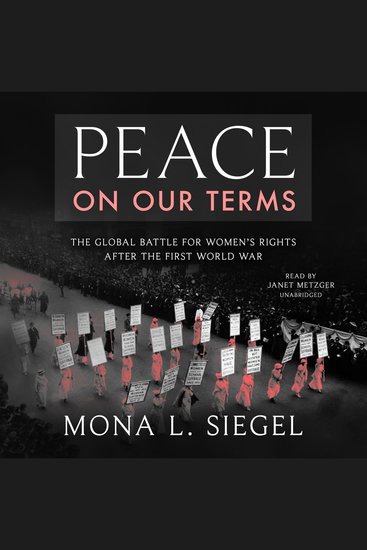
    In the watershed year of 1919, world leaders met in Paris, promising to build a new international order rooted in democracy and social justice. Female activists demanded that statesmen live up to their word. Excluded from the negotiating table, women met separately, crafted their own agendas, and captured global headlines with a message that was both straightforward and revolutionary: enduring peace depended as much on recognition of the fundamental humanity and equality of all people—regardless of sex, race, class, or creed—as on respect for the sovereignty of independent states. 
    Peace on Our Terms follows dozens of remarkable women from Europe, the Middle East, North America, and Asia as they crossed oceans and continents; commanded meeting halls in Paris, Zurich, and Washington; and marched in the streets of Cairo and Beijing. Mona L. Siegel’s sweeping global account of international organizing highlights how Egyptian and Chinese nationalists, Western and Japanese labor feminists, white Western suffragists, and African American civil rights advocates worked in tandem to advance women’s rights. Despite significant resistance, these pathbreaking women left their mark on emerging democratic constitutions and new institutions of global governance. Drawing on a wide range of sources, Peace on Our Terms is the first book to demonstrate the centrality of women’s activism to the Paris Peace Conference and the critical diplomatic events of 1919. Siegel tells the timely story of how female activists transformed women’s rights into a global rallying cry, laying a foundation for generations to come.
    Show book
  • The Alexandrian Wars - cover

    The Alexandrian Wars

    Julius Caesar

    • 0
    • 0
    • 0
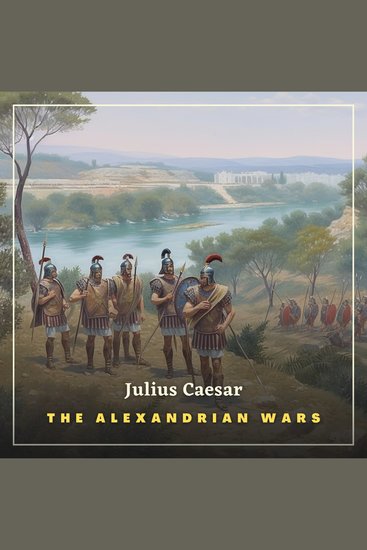
    The Alexandrian Wars, fought by Julius Caesar between 48 and 47 BCE, are of immense historical significance. They marked the culmination of Caesar's time in Egypt, as well as a shift in the Roman Empire's relations with the region. The Alexandrian Wars saw an impressive display of military prowess by Caesar and his legions, who were ultimately successful in their mission to annex Alexandria and its surrounding territories into the growing Roman Empire. Read in English, unabridged.
    Show book
  • The Indigenous Peoples' Message To The World - Words & Music - cover

    The Indigenous Peoples' Message...

    David Ison, Various Various

    • 0
    • 0
    • 0
    INDIGENOUS PEOPLES’ MESSAGE TO THE WORLD 
    This is our chance to listen to a message from people closely connected to the Earth. The industrial world has put their very existence at stake. Stop and listen to their world! -- Mickey Hart, drummer with the Grateful Dead and author of Drumming at the Edge of Magic Available for the first time in a digital format, the “Indigenous Peoples’ Message To The World” documents the First World Conference of Indigenous Peoples, a collaboration of numerous organizations, individuals and indigenous peoples from around the globe. The lectures and cultural music presentations that made up the conferences were recorded live in the Amazon 
    jungle in Brazil in 1992 and delivers a timeless and deeply relevant message to us all. The extraordinary partnership captured here was spearheaded by Marcos Terena, the founder of the United Indigenous Nations, and supported by the Tribal Link Foundation and Land is Life, organizations that actively promote and protect the rights of indigenous peoples. 
    Not only did this program receive a starred review in Publishers Weekly (PW), which called it a who of ritual tribal music and ceremony", but PW was inspired to create a new award – The pioneering Hybrid of the Month Award – specifically for this moving title. 
    Total Running Time: 75 minutes 
     
    ISBN: 978-1-61544-019-1
    Show book
  • The Greatest Evil is War - cover

    The Greatest Evil is War

    Chris Hedges

    • 0
    • 0
    • 0
    In fifteen short chapters, Chris Hedges astonishes us with his clear and cogent argument against war, not on philosophical grounds or through moral arguments, but in an irrefutable stream of personal encounters with the victims of war, from veterans and parents to gravely wounded American serviceman who served in the Iraq War, to survivors of the Holocaust, to soldiers in the Falklands War, among others. Hedges reported from Sarajevo, and was in the Balkans to witness the collapse of the Soviet Union. 


    In 2002 he published War Is a Force That Gives Us Meaning, which the Los Angeles Times described as "the best kind of war journalism . . . bitterly poetic and ruthlessly philosophical" and the New York Times called "a brilliant, thoughtful, timely, and unsettling book." In the twenty years since, Hedges has not wanted to write another book on the subject of war—until now, with the outbreak of war in Ukraine. It is important again to be reminded who are the victors of the spoils of war and of other unerring truths, not only in this war but in all modern wars, where civilians are always the main victims, and the tools and methods of war are capable of so much destruction it boggles the mind. This book is an unflinching indictment of the horror and obscenity of war by one of our finest war correspondents.
    Show book
  • Dusty Booze - In Search of Vintage Spirits - cover

    Dusty Booze - In Search of...

    Aron Goldfarb

    • 0
    • 0
    • 0
    In Dusty Booze: In Search of Vintage Spirits, journalist Aaron Goldfarb goes on an adventure in vintage spirits. This is an intoxicating story of obsessives on the hunt for old bottles of whiskey, tequila, rum, chartreuse—you name it—from estate sales, grandpa's liquor cabinet, and out-of-the-way and inner-city liquor stores that may just have a case or a few bottles lying around in the basement. 


    What Goldfarb and these "dusty hunters" discover are more than just bottles from bygone brands or old formulations no longer available—they find portals into history. Spirits, once bottled, don't age like wine. A bourbon from the 1935 lets you savor the end of Prohibition. A 1940s rum cocktail with actual 1940s rum tastes the way it would to a GI returning from WWII. An old Italian amaro captures la dolce vita in a glass, and vintage gin is a drinkable time capsule from Mad Men-era lunchtime martinis. 


    Dusty Booze mixes the history of our drinking culture and the Indiana Jones-meets-Simpsons Comic Book Guy adventures of the collectors, including the hunt for rumored stash from a reclusive Hollywood legend. This is a buoyant, thirst-triggering voyage into a unique subculture that has exploded in popularity in recent years.
    Show book
  • Stuart Restoration The: The History and Legacy of the English Monarchy’s Return to Power in the Late 17th Century - cover

    Stuart Restoration The: The...

    Editors Charles River

    • 0
    • 0
    • 0
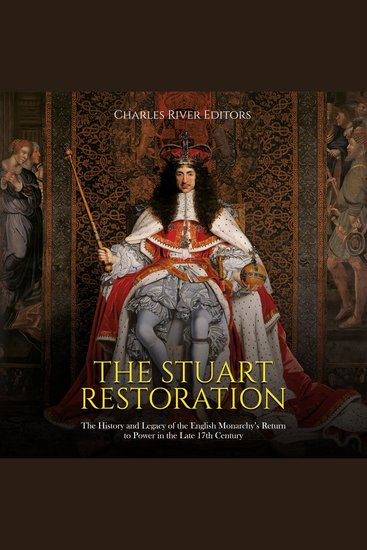
    Oliver Cromwell is one of the most important men in England’s history, but everything he struggled for collapsed within two decades of his death. The army, Parliament and the citizens of London grappled with each other for control of the country, and even the army no longer remained a united political force. Civil war almost broke out again as a force under Lambert failed to prevent General Monck, the military governor of Scotland, from marching south and dissolving the Rump Parliament. Excluded MPs were restored on condition that they themselves dissolve Parliament, and following fresh elections without military intervention, a new Parliament met on April 25, 1660. Dominated by Presbyterians and Royalists, it accepted a settlement offered by the man titling himself Charles II, the son and heir of Charles I. On May 25, 1660, Charles II returned to England, and less than two years after Cromwell’s death, his work was undone by the Restoration. King Charles II heaped ignominy upon defeat by having Cromwell’s body dug up and posthumously executed. Cromwell’s body was then decapitated, as was Ireton’s, and their heads were placed on a pike above Westminster Hall, where Charles I had been tried, for several years.  
    	Despite the Restoration, however, and despite the fact England’s republican experiment barely outlasted Cromwell, the Commonwealth and Restoration were hugely important in asserting the power of Parliament, and it permanently shifted England’s political balance firmly towards a constitutional monarchy limited by Parliament. The Stuart monarchy was restored on condition of compromise with Parliament and the army, and a precedent had been set for Parliament to replace the monarch, a precedent it would follow in the 1680s when James II was replaced by William and Mary in a settlement that set even more limits around the monarch.
    Show book