Join us on a literary world trip!
Add this book to bookshelf
Grey
Write a new comment Default profile 50px
Grey
Subscribe to read the full book or read the first pages for free!
All characters reduced
Smoke-Free Fire Cooking - cover

Smoke-Free Fire Cooking

Amelia Khatri

Translator A AI

Publisher: Publifye

  • 0
  • 0
  • 0

Summary

Smoke-Free Fire Cooking explores the history and science behind minimizing smoke and maximizing fuel efficiency in fire-based cooking, highlighting techniques like rocket stoves and underground ovens. The book argues that these ancient methods offer sustainable solutions to modern challenges, such as fuel scarcity and air pollution. These techniques show how to achieve nearly complete combustion, drastically reducing smoke.

 
The book progresses by first laying the historical groundwork, exploring the origins of rocket stoves and underground ovens across civilizations. Then it investigates the scientific principles, including combustion dynamics and heat transfer.

 
The book also details construction and application, providing step-by-step instructions. It emphasizes documented techniques, scientific rigor, and tangible results.
Available since: 02/13/2025.
Print length: 76 pages.

Other books that might interest you

  • Scimitar into Stanley - One Soldier's Falklands War - cover

    Scimitar into Stanley - One...

    Roger Field

    • 0
    • 0
    • 0
    In May 1982, Captain Roger Field, The Blues and Royals, attached to HQ 5th Infantry Brigade, sailed on the Queen Elizabeth 2 as part of the second wave to liberate the Falkland Islands. Surprised by what he saw at Brigade HQ, he started writing a diary. 
    His journey took him to Fitzroy as the Argentinean aircraft struck the landing ships Sir Galahad and Sir Tristram. A chance meeting led him to fighting alongside the Commanding Officer of 2 Para at the Battle of Wireless Ridge. When the commander of one of the four attached armoured cars of The Blues and Royals was knocked out part way through the battle, Roger took command of that Scimitar. Next day his Scimitar was at the very tip of the spear as 2 Para and The Blues and Royals led the victorious charge into Port Stanley. 
    ‘Revisionist’ in places and always refreshingly candid, this account is unique as it describes the War from the viewpoint of a staff officer, infanteer and armoured vehicle commander. A gripping listen.
    Show book
  • Spanish Short Stories for Beginners: Grow Your Vocabulary and Cultural Awareness While Having Fun - cover

    Spanish Short Stories for...

    Lingo Publishing

    • 0
    • 0
    • 0
    If you want to learn Spanish but are tired of the usual grammar books, keep listening… 
    Do you want to travel but don't speak Spanish properly? Do you have Spanish-speaking friends or colleagues, and you want to speak their language? Do you need to improve your Spanish for work? 
    Are you tired of seeing the same old grammatical structures without knowing how to use them? 
    With this audiobook, you will learn to speak Spanish through short stories in an effective and, above all, entertaining way!Learn the basic phrases for communicating in SpanishGet the tools you need to feel comfortable in a conversationDiscover the most common phrases in Spanish through numerous examplesRead fun stories and learn more about Spanish cultureAnswer questions to test your understandingStudy the basic ways to introduce yourself and meet other peopleLearn how to solve conflicts in SpanishAnd much more! 
    Thanks to this audiobook containing short Spanish stories, you will soon have the knowledge to keep a fluid conversation. In addition, you will learn while having fun with interesting and original stories! 
    Get Spanish Short Stories for Beginners. Grow Your Vocabulary and Cultural Awareness While Having Fun now, and start practicing!
    Show book
  • The Missing Peace - How to Be Held Together When You’re Falling Apart - cover

    The Missing Peace - How to Be...

    Tim Ross

    • 0
    • 0
    • 0
    In The Missing Peace, podcaster and thought leader Tim Ross introduces a stunning perspective on the peace Jesus left us to help us regulate our bodies and emotions as we break free of temporary happiness and walk toward freedom. 
    Are you okay? Have you tried everything you can think of to get to a place where you feel better, happier? Maybe you've reached for temporary fixes like retail therapy, or playing video games, or finding a spouse or a house in the right zip code, or even prayer and listening to worship music. But nothing seems to work, at least not long term. You don't know what's wrong, but you know you're not okay. You feel exhausted, overloaded, and frustrated. Is this just how life is? 
    Tim Ross, host of the popular podcast The Basement, offers hope and an eye-opening perspective on the peace Jesus left us and how it can help us regulate our bodies and our emotions, regardless of what is happening around us. Ross's stirring message reminds readers thatsilence isn't golden--giving voice to the soul opens the way to recovery,secrets keep us trapped--we can't heal what we don't reveal,romanticizing pain holds us back--facing it head-on moves us toward healing, andJesus saved us not to survive but to thrive--we don't need to settle for just getting by. 
      
    With a depth of pastoral experience and a winsomeness that resonates, Ross helps readers break free from silent suffering and the insatiable search for happiness by learning how to be truly okay in life's challenges and walk toward the peace and the freedom God created them to enjoy.
    Show book
  • Cola di Rienzo and Garibaldi: The History of the Italian Nationalists Who Failed and Succeeded in Unifying Italy - cover

    Cola di Rienzo and Garibaldi:...

    Editors Charles River

    • 0
    • 0
    • 0
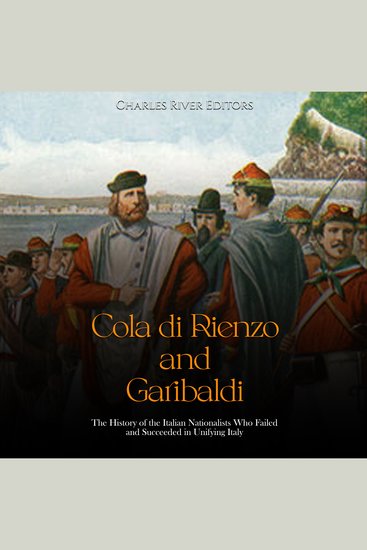
    Cola di Rienzo was a man whose life and actions have reverberated down the centuries, as his charismatic, yet unsuccessful dictatorship has spawned legends and comparisons with movements of later ages. His attempt to bring the greatness of Roman antiquity into the reality of the 14th century, the city’s lowest point, is inspiring on its face. In 1938, Iris Origo saw how Cola was being used by her present era and noted that "within the last century Emperor, Communist and Fascist in turn have paid tribute to Cola di Rienzo as a kindred spirit or precursor. But historical parallels are deceptive. To measure a man of one century against a man of another is to see neither of them in the light of his own time…" 
    The different Italian states on the peninsula experienced Napoleonic rule in the early 1800s, followed by a brief restoration that led to widespread political upheavals in the 1820s. As the 1840s came to a close, the Italian peninsula was in major disarray. In 1847, the Austrian Chancellor Klement von Metternich referred to Italy as merely a “geographical expression,” and to some extent, he was not far off the mark.   
    	The Italian state may have come together thanks to ideals, but the success of the Second Italian War of Independence owed a lot of its success to chance, foreign intervention, and the wheeling and dealing of a few powerful men. Its story is long and complex, and the ultimate unification of Italy as it’s recognized today would require no less than four wars. Nonetheless, despite its difficult birthing process and rocky start, the Italian state has survived over 150 years, and it even managed to remain united in the aftermath of World War II, escaping the fate of Nazi Germany.
    Show book
  • The American Operations in WW2: Normandy - 6 June–24 July 1944 - cover

    The American Operations in WW2:...

    History U.S. Army Center of...

    • 0
    • 0
    • 0
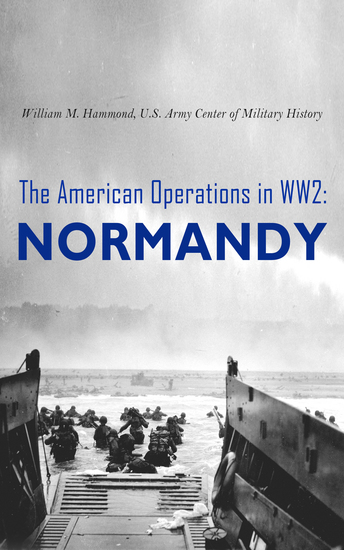
    World War II was the largest and most violent armed conflict in the history of mankind. Highly relevant today, World War II has much to teach us, not only about the profession of arms, but also about military preparedness, global strategy, and combined operations in the coalition war against fascism. This book follows military operations of the US Army in Normandy from 6 June to 24 July 1944. 
    A great invasion force stood off the Normandy coast of France as dawn broke on 6 June 1944: 9 battleships, 23 cruisers, 104 destroyers, and 71 large landing craft of various descriptions as well as troop transports, minesweepers, and merchantmen—in all, nearly 5,000 ships of every type. The naval bombardment that began at 0550 that morning detonated large minefields along the shoreline and destroyed a number of the enemy's defensive positions. To one correspondent, reporting from the deck of the cruiser HMS Hillary, it sounded like "the rhythmic beating of a gigantic drum" all along the coast. In the hours following the bombardment, more than 100,000 fighting men swept ashore to begin one of the epic assaults of history, a "mighty endeavor," as President Franklin D. Roosevelt described it to the American people, "to preserve . . . our civilization and to set free a suffering humanity."
    The attack had been long in coming. From the moment British forces had been forced to withdraw from France in 1940 in the face of an overwhelming German onslaught, planners had plotted a return to the Continent. Only in that way would the Allies be able to confront the enemy's power on the ground, liberate northwestern Europe, and put an end to the Nazi regime...
    Show book
  • The Evolution of Urban Planning - Historical and Contemporary Perspectives - cover

    The Evolution of Urban Planning...

    Lyric Vale

    • 0
    • 0
    • 0
    Urban planning is the process by which cities, towns, and other urban spaces are designed, organized, and managed. It is a field that encompasses various aspects of human life, from infrastructure to social dynamics, and aims to create environments that promote the well-being of residents and the sustainability of the urban ecosystem. The importance of urban planning lies in its ability to shape the physical, social, and economic structure of a community. It influences the way people interact with their environment and with each other, determining the accessibility of resources, the flow of traffic, and the availability of green spaces, among other factors. 
    The evolution of urban planning can be traced back to ancient civilizations, where early cities were often designed around central hubs of commerce, religion, or governance. In these early stages, urban planning was driven by necessity, focusing primarily on basic functions like defense, water management, and trade. Over time, as cities grew and became more complex, the need for more organized and systematic approaches to urban development emerged. This shift was marked by the introduction of formal planning principles that considered not only the practical aspects of urban life but also the aesthetic, cultural, and social needs of the inhabitants. 
    In the modern era, urban planning became an established profession, with experts tasked with the responsibility of designing and managing urban spaces to meet the growing demands of an increasingly urbanized population. The industrial revolution, for example, brought about massive shifts in population density and the structure of cities. It prompted the creation of zoning laws, housing regulations, and other planning policies that addressed new challenges such as pollution, overcrowding, and public health. These developments laid the groundwork for the more sophisticated planning techniques used in contemporary cities.
    Show book