Join us on a literary world trip!
Add this book to bookshelf
Grey
Write a new comment Default profile 50px
Grey
Subscribe to read the full book or read the first pages for free!
All characters reduced
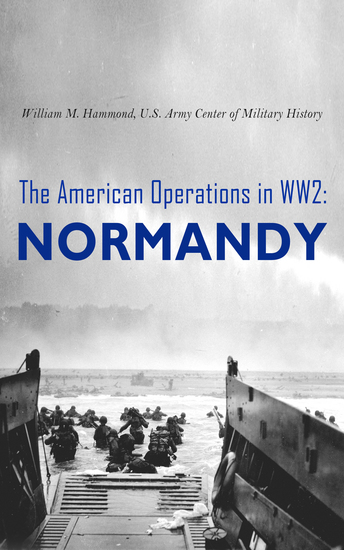
The American Operations in WW2: Normandy - 6 June–24 July 1944 - cover

The American Operations in WW2: Normandy - 6 June–24 July 1944

History U.S. Army Center of Military, William M. Hammond

Publisher: Madison & Adams Press

  • 0
  • 0
  • 0

Summary

World War II was the largest and most violent armed conflict in the history of mankind. Highly relevant today, World War II has much to teach us, not only about the profession of arms, but also about military preparedness, global strategy, and combined operations in the coalition war against fascism. This book follows military operations of the US Army in Normandy from 6 June to 24 July 1944. 
A great invasion force stood off the Normandy coast of France as dawn broke on 6 June 1944: 9 battleships, 23 cruisers, 104 destroyers, and 71 large landing craft of various descriptions as well as troop transports, minesweepers, and merchantmen—in all, nearly 5,000 ships of every type. The naval bombardment that began at 0550 that morning detonated large minefields along the shoreline and destroyed a number of the enemy's defensive positions. To one correspondent, reporting from the deck of the cruiser HMS Hillary, it sounded like "the rhythmic beating of a gigantic drum" all along the coast. In the hours following the bombardment, more than 100,000 fighting men swept ashore to begin one of the epic assaults of history, a "mighty endeavor," as President Franklin D. Roosevelt described it to the American people, "to preserve . . . our civilization and to set free a suffering humanity."
The attack had been long in coming. From the moment British forces had been forced to withdraw from France in 1940 in the face of an overwhelming German onslaught, planners had plotted a return to the Continent. Only in that way would the Allies be able to confront the enemy's power on the ground, liberate northwestern Europe, and put an end to the Nazi regime...
Available since: 09/05/2023.
Print length: 33 pages.

Other books that might interest you

  • Western Hostility to Russia - The Hidden Background to War in Ukraine - cover

    Western Hostility to Russia -...

    Terry Boardman

    • 0
    • 0
    • 0
    What are the origins of the war in Ukraine? Contrary to popular opinion, the conflict is ultimately not between Russia and Ukraine but between Russia and the West. Neither did it begin with Russia's invasion in 2022, nor the Maidan revolution in 2014.
    Providing a wealth of documented evidence, Terry Boardman shows that the roots of the hostility date back to the geopolitics of the nineteenth century, when Britain and Russia engaged in the so-called Great Game of controlling the 'heartland' of central Eurasia. With colonial supremacy at stake, the British ruling elite stoked hatred of the 'Russian bear'.
    In addition to conventional political motivations, the author identifies a little-known, esoteric dimension. Within the leadership of the Anglo-American West are initiated groups who understand that world guidance is destined eventually to move to the Slavic East. With the aim of maintaining control, the West has been seeking, pre-emptively, to suppress Russia's influence.
    Surveying the 'hot' and 'cold' wars of the twentieth century, the collapse of the USSR and the continual enlargement of NATO, Boardman reveals the hidden strategies employed in realizing the above goal, which has culminated in militarization, exploitation and mass death in Eastern Europe.
    Can we become aware of the subliminal, oppressive methods of our ruling elites? If we are to become free, we need at least to understand them. With political, historical and spiritual perspectives, this short book is a worthy primer.
    Show book
  • History Of Czechoslovakia & Yugoslavia 2 Books In 1 - Bohemia Czech Republic Slovakia & The Habsburg Monarchy - cover

    History Of Czechoslovakia &...

    HISTORY FOREVER

    • 0
    • 0
    • 0
    2 BOOKS IN 1 
    Book 1 - History of Czech Republic & Yugoslavia 
    Book 2 - History of Czechoslovakia 
    In book 1 you will discover; 
    ·       History of Bohemia 
    ·       Forming Czechoslovakia 
    ·       The Soviet Invasion Of Czechoslovakia 
    ·       The Breakup of Czechoslovakia 
    ·       The Velvet Revolution 
    ·       The Breakup of Yugoslavia 
    ·       Surprising Facts Of Czech Republic 
    In book 2 you will discover; 
    ·       History of the Bohemia, Slovakia & Czechia 
    ·       The Habsburg Rule 
    ·       The 30-year war 
    ·       Time of Darkness 
    ·       The Seven Years War 1756-1763 
    ·       The Second World War 
    ·       Czechoslovakia after WW2 
    ·       History of Prague 
    ·       Real Name of Czech Republic 
    ★ BUY THIS BOOK NOW ! ★
    Show book
  • Dead Sea and the Dead Sea Scrolls The: The History of the Unique Lake and Its Ancient Jewish Manuscripts - cover

    Dead Sea and the Dead Sea...

    Charles River Editors

    • 0
    • 0
    • 0
    If the world had a navel, it would be the Dead Sea, the lowest point on Earth where one can still stand on dry land. The photographs of this unique lake seem to be taken from a science fiction movie, or a land devastated after a nuclear holocaust. To others, the fluffy shores could remind them of Antarctica although it is in one of the warmest spots on the planet. Its white, creamy masses, scattered along golden beaches, are not ice floes or frozen water, but effervescent salt formations. The famous Jordan River, where the Hebrew people entered the Promised Land and Jesus was baptized, flows into the lake, but the basin is so deeply sunk into the face of the planet that the waters never leave, as if they had fallen into a small black hole where nothing can escape.  
    	The Dead Sea is also an archaeological site loaded with history. Known among the first civilizations in the region as "Sea of Asphalt" and “Salt Sea,” innumerable myths and legends lend it an air of mystery, as if it attracted sterility and misfortune while eradicating all life from its waters. It was perhaps the inhospitable feel of the place, the almost total desolation surrounding it, which led the writer of the Pentateuch to imagine that many years ago, a cataclysm sent to annihilate perverted people had taken place there.  
    	In the mid-20th century, one of the most important religious discoveries of all time was made in a series of caves near the Dead Sea, which had hidden remnants of nearly 1,000 texts, some of which were included in the Hebrew Bible and others which were extra-biblical. In addition to being the oldest surviving copies of such documents, the mixture of languages and different kinds of papers helped shed light on the people in the region at the time, making the Dead Sea Scrolls vitally important to the world’s major religions. 
    Show book
  • Scenes in the Life of Harriet Tubman - The Tract Of The Quiet Way - cover

    Scenes in the Life of Harriet...

    Sarah H. Bradford

    • 0
    • 0
    • 0
    Sarah H. Bradford's 'Scenes in the Life of Harriet Tubman' chronicles the extraordinary journey of a fearless woman escaping slavery and becoming a heroic conductor on the Underground Railroad. This biographical account unveils Tubman's indomitable spirit, recounting her daring rescues and tireless fight for freedom. Bradford's narrative, both poignant and empowering, honors Tubman's legacy as a symbol of courage and resilience in the face of oppression, offering a compelling testament to the human spirit's triumph over adversity. Read in English, unabridged.
    Show book
  • Freedom Teaching - Overcoming Racism in Education to Create Classrooms Where All Students Succeed - cover

    Freedom Teaching - Overcoming...

    Matthew Kincaid

    • 0
    • 0
    • 0
    In Freedom Teaching, educator and distinguished anti-racism practitioner Matthew Kincaid delivers a one-stop resource for educators and educational leaders seeking to improve equity and increase the cultural responsiveness of their school. In this book, you'll discover the meaning and fundamentals of anti-racist education and find a roadmap to reducing the impact of systemic racism in your classroom. 


    The author offers skills and tools he's developed over the course of his lengthy career teaching anti-racist ideas to educators, providing listeners with strategies that are effective at both the individual teacher and collective school community level. Listeners will also find: 


    ● A thorough introduction to the idea of Freedom Teaching and creating an education system that works for all students 


    ● Strategies for building and maintaining anti-racist schools and classrooms 


    ● Important social justice lessons from unsung activists 


    An indispensable resource for anyone who wants to actualize change in our education system, Freedom Teaching belongs in the libraries of the parents and families of students and teachers hoping for a better understanding on anti-racist concepts.
    Show book
  • Campus Free Speech - A Pocket Guide - cover

    Campus Free Speech - A Pocket Guide

    Cass R. Sunstein

    • 0
    • 0
    • 0
    Free speech is indispensable on college campuses: allowing varied views and frank exchanges of opinion is a core component of the educational enterprise. But free speech does not mean a free-for-all. The First Amendment prohibits "abridging the freedom of speech," yet laws against perjury or bribery, for example, are still constitutional. In the same way, valuing freedom of speech does not stop a university from regulating speech when doing so is necessary for its educational mission. So where is the dividing line? How can we distinguish reasonable restrictions from impermissible infringement? 


    In this pragmatic, no-nonsense explainer, Cass Sunstein takes us through a wide range of scenarios involving students, professors, and administrators. He discusses why it's consistent with the First Amendment to punish students who shout down a speaker, but not those who chant offensive slogans; why a professor cannot be fired for writing a politically charged op-ed, yet a university might legitimately consider an applicant's political views when deciding whether to hire her. He explains why private universities are not legally bound by the First Amendment yet should, in most cases, look to follow it. And he addresses the thorny question of whether a university should officially take sides on public issues or deliberately keep the institution outside the fray.
    Show book