Join us on a literary world trip!
Add this book to bookshelf
Grey
Write a new comment Default profile 50px
Grey
Subscribe to read the full book or read the first pages for free!
All characters reduced
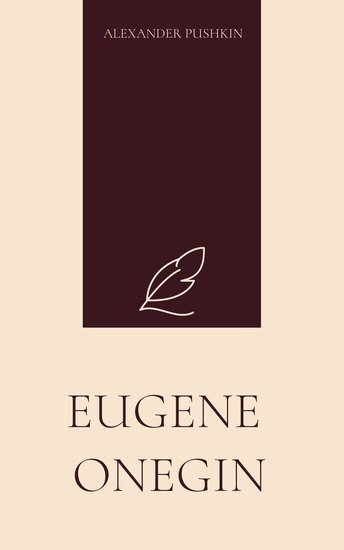
Eugene Onegin - cover

Eugene Onegin

Alexander Puskin

Publisher: CLXBX

  • 0
  • 0
  • 0

Summary

Eugene Onegin by Alexander Pushkin is a dazzling masterpiece of Russian literature—a novel in verse that blends romance, wit, irony, and profound psychological insight. Often regarded as the cornerstone of modern Russian fiction, this elegant and emotionally resonant work captures the spirit of an era while exploring timeless themes of love, regret, pride, and fate.

The story follows Eugene Onegin, a sophisticated yet disillusioned young aristocrat who inherits a country estate and retreats from the glittering social life of the city. Intelligent but emotionally detached, Onegin moves through life with cool indifference, guided more by boredom than passion. His quiet provincial surroundings introduce him to a circle of contrasting personalities, including the dreamy and sincere Tatyana Larina, whose heartfelt confession of love becomes one of the most famous moments in literary history.

Through Pushkin's lyrical and playful verse, readers witness the consequences of missed opportunities and careless choices. Onegin's rejection of genuine affection, his strained friendship with the idealistic poet Vladimir Lensky, and the tragic duel that follows set into motion a chain of events that reshape his life. Years later, when circumstances change and emotions mature, the past returns with bittersweet intensity.

Pushkin's narrative voice is as captivating as his characters—charming, reflective, and often ironic. He skillfully blends social commentary with intimate emotion, painting a vivid portrait of early 19th-century Russian society while revealing the universal struggles of youth and self-discovery. Beneath its graceful poetry lies a deep meditation on human nature, the passage of time, and the weight of regret.

Both romantic and tragic, playful and philosophical, Eugene Onegin remains one of literature's most enduring works. Its unforgettable characters and musical language have inspired generations of writers, composers, and readers. At once a love story and a study of character, this novel in verse stands as Pushkin's crowning achievement and a timeless exploration of the choices that define a life.
Available since: 02/27/2026.
Print length: 140 pages.
Other books that might interest you

  • Jack and Jill - cover

    Jack and Jill

    Louisa May Alcott

    • 0
    • 0
    • 0
    Jack Minot and Janey Pecq are best friends who live next door to each other. They are always seen together, so Janey gets the nickname of Jill, to mimic the old rhyme. The two do go up a hill one winter day— and then suffer a terrible accident. Seriously injured in a sledding accident, they recover from their physical injuries, while learning life lessons along with their many friends. They are helped along their journey to recovery by various activities created by their mothers.
    Show book
  • Frankenstein - cover

    Frankenstein

    Mary Shelley

    • 0
    • 0
    • 0
    "Frankenstein" by Mary Shelley, published in 1818, is a landmark Gothic novel that explores themes of ambition, creation, responsibility, and the consequences of playing God. Victor Frankenstein, a young man from Geneva, grows up in a loving and supportive family. He is deeply interested in science and becomes obsessed with understanding the secrets of life. After studying at the University of Ingolstadt, Victor discovers the method for creating life and becomes consumed with the idea of building a living being. However, when he finally brings the creature to life, he is horrified by its monstrous appearance. Overwhelmed by fear and disgust, Victor abandons the creature and flees, leaving it to fend for itself. Victor's ambition leads to his downfall, and the novel explores the consequences of overreaching human limits. The novel raises questions about the inherent nature of beings and whether the creature was born evil or became that way due to its treatment by society. The quest for forbidden knowledge and the consequences of scientific hubris are central to the narrative. In our times of Artificial Intelligence, the theme is of striking actuality.
    Show book
  • The Time Machine - Original 1895 Heinemann Publication - cover

    The Time Machine - Original 1895...

    H. G. Wells

    • 0
    • 0
    • 0
    This abridged version is the complete "Heinemann text" - the version that was published in Britain in 1895, and upon which most modern reprints and movies are based. 
    Immerse yourself in the classic journey of "The Time Machine" by H.G. Wells, presented in an unabridged audiobook format. This pioneering science fiction masterpiece explores the depths of time and speculative future of humanity. 
    As you follow the protagonist's extraordinary voyage to a distant epoch, you'll uncover a world where humanity has evolved into distinct factions. Reflect on themes of progress, class struggle, and the essence of humanity that resonate as much today as they did over a century ago. 
    Why "The Time Machine" Captivates Listeners Today:The original Time Travel machine: Wells coined the term "time machine" with this book and popularised the concept of time travel using a machine, a theme that has since become a cornerstone of science fiction.Classic themes of society: The narrative explores the social and class disparities of the late Victorian era, a theme that still resonates in today's context of ever-widening inequality and social debate.Timeless Influence: This original 1895 publication has inspired countless adaptations across films, television, and comics, attesting to its timeless relevance and appeal. 
    Embark on a journey not just through time, but through the very fabric of human society and our possible futures. Listen to "The Time Machine" to explore the possibilities that lie within and beyond our understanding of time and space.
    Show book
  • The Trimmed Lamp - cover

    The Trimmed Lamp

    O. Henry

    • 0
    • 0
    • 0
    "The Trimmed Lamp" by O. Henry is a collection of short stories delving into the complexities of urban life, human nature, and the pursuit of happiness. With wit and irony, O. Henry crafts tales that illuminate the hopes, dreams, and struggles of everyday people, offering glimpses into the human condition through vivid characters and unexpected plot twists.
    Show book
  • At Christmas Time - From their pens to your ears genius in every story - cover

    At Christmas Time - From their...

    Anton Chekhov

    • 0
    • 0
    • 0
    Anton Pavlovich Chekhov was born on 29th January 1860 in Taganrog, on the south coast of Russia.  
    His family life was difficult; his father was strict and over-bearing but his mother was a passionate story-teller, a subject Chekhov warmed to. As he later said; ‘our talents we got from our father, but our soul from our mother’.  
    At school Chekhov was distinctly average. At 16 his father mis-managed his finances and was declared bankrupt. His family fled to Moscow. Chekhov remained and eked out a living by various means, including writing and selling short sketches to newspapers, to finish his schooling. That completed and with a scholarship to Moscow University obtained he rejoined his family. 
    He was able to help support them by selling satirical sketches and vignettes of Russian lifestyles and gradually obtained further commissions. In 1884, he qualified as a physician and, although it earned him little, he often treated the poor for free, he was fond of saying ‘Medicine is my lawful wife, and literature is my mistress.’ 
    His own health was now an issue as he began to cough up blood, a symptom of tuberculosis.  Despite this his writing success enabled him to move the family into more comfortable accommodation.  
    Chekhov wrote over 500 short stories which included many, many classics including ‘The Kiss’ and ‘The Lady with a Dog’.  His collection ‘At Dusk’ won him the coveted Pushkin Prize when was only 26.  
    He was also a major playwright beginning with the huge success of ‘Ivanov’ in 1887.   
    In 1892 Chekhov bought a country estate north of Moscow. Here his medical skills and money helped the peasants tackle outbreaks of cholera and bouts of famine. He also built three schools, a fire station and a clinic.  It left him with less time for writing but the interactions with real people gained him detailed knowledge about the peasantry and their living conditions for his stories.  
    His most famous work, ‘The Seagull’ was received disastrously at its premiere in St Petersburg. It was later restaged in Moscow to highlight its psychological aspects and was a huge success. It led to ‘Uncle Vanya’, ‘The Three Sisters’ and ‘The Cherry Orchard’.  
    Chekhov suffered a major lung hemorrhage in 1897 while visiting Moscow. A formal diagnosis confirmed tuberculosis and the doctors ordered changes to his lifestyle.  
    Despite a dread of weddings the elusive literary bachelor quietly married the actress Olga Knipper, whom he had met at rehearsals for ‘The Seagull’, on 25th May 1901. 
    By May 1904 with his tuberculosis worsening and death imminent he set off for the German town of Badenweiler writing cheerful, witty letters to his family and assuring them his health was improving.  
    On 15th July 1904 Anton Chekhov died at Badenweiler.  He was 44.
    Show book
  • The Bet - Classic Tales Edition - cover

    The Bet - Classic Tales Edition

    Anton Chekhov

    • 0
    • 0
    • 0
    Many say that capital punishment is inhumane. But is it, in fact, more humane to take away life in one swift stroke, rather than condemn an individual to a lifetime in captivity? Two men place wagers, each backing a different side of the argument. After 15 years, this clumsy bet irrevocably changes their lives forever.
    Show book