Join us on a literary world trip!
Add this book to bookshelf
Grey
Write a new comment Default profile 50px
Grey
Subscribe to read the full book or read the first pages for free!
All characters reduced
Eugene Onegin - Enriched edition Must Read Classics - cover

Eugene Onegin - Enriched edition Must Read Classics

Alexander Puskin

Translator Henry Spalding

Publisher: DigiCat

  • 0
  • 0
  • 0

Summary

In "Eugene Onegin," Alexander Pushkin masterfully weaves a narrative that marries the elegance of verse with the complexity of human emotion. This novel in verse, first published in the 1820s, is celebrated for its rich character development and intricate exploration of societal norms in 19th-century Russia. Through the life of the disillusioned aristocrat Eugene Onegin and his interactions with the passionate Tatyana, Pushkin delves into themes of unrequited love, friendship, and the ennui of the Russian gentry. The structure of the work, employing the unique Odessan stanza, showcases Pushkin's innovative approach to poetry and storytelling, marking a pivotal contribution to the Russian literary canon and the development of the modern novel. Alexander Pushkin, often regarded as the father of Russian literature, was profoundly influenced by his life experiences, including his mixed heritage and the political turbulence of his time. These factors informed his perspectives on love, society, and the individual's place within it. His encounters with different social strata and his personal conflicts greatly influenced his creation of Eugene Onegin, encapsulating the contradictions of a society in transition. Readers are invited to immerse themselves in this quintessential work, which not only reflects the depth of human connection but also serves as a profound commentary on the complexities of Russian society. Pushkin's nuanced portrayal of his characters makes "Eugene Onegin" a timeless exploration of unfulfilled desires and the intricacies of social interaction, rendering it essential reading for anyone interested in the interplay of romance and existential reflection.

In this enriched edition, we have carefully created added value for your reading experience:
- A succinct Introduction situates the work's timeless appeal and themes.
- The Synopsis outlines the central plot, highlighting key developments without spoiling critical twists.
- A detailed Historical Context immerses you in the era's events and influences that shaped the writing.
- An Author Biography reveals milestones in the author's life, illuminating the personal insights behind the text.
- A thorough Analysis dissects symbols, motifs, and character arcs to unearth underlying meanings.
- Reflection questions prompt you to engage personally with the work's messages, connecting them to modern life.
- Hand‐picked Memorable Quotes shine a spotlight on moments of literary brilliance.
- Interactive footnotes clarify unusual references, historical allusions, and archaic phrases for an effortless, more informed read.
Available since: 05/17/2022.
Print length: 419 pages.
Other books that might interest you

  • The Pit and The Pendulum - cover

    The Pit and The Pendulum

    Sampi Books, Edgar Allan Poe

    • 0
    • 0
    • 0
    In Edgar Allan Poe's "The Pit and the Pendulum", a prisoner of the Spanish Inquisition faces psychological and physical torture in a dark cell. He struggles to survive deadly traps, including a sharp pendulum and a deep well, using his ingenuity to escape.
    Show book
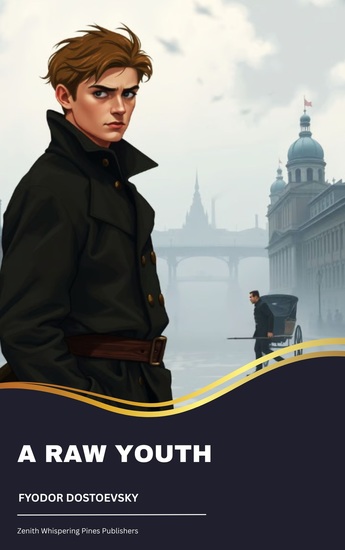
  • A Raw Youth - cover

    A Raw Youth

    Fyodor Dostoevsky

    • 0
    • 0
    • 0
    A young man hungry for greatness. A family torn by secrets. A world he is not ready to face.
    Arkady Dolgoruky, the illegitimate son of a nobleman, dreams of rising above his chaotic upbringing. But ambition collides with confusion as he navigates a storm of pride, jealousy, guilt, and longing. Pulled between the father he resents, the ideals he barely understands, and the passions that overwhelm him, Arkady's journey becomes a raw, unforgettable exploration of youth on the edge.
    
    Praised as "one of Dostoevsky's most psychological and revealing works," this novel captures the turmoil of adolescence with depth, humanity, and the author's unmatched insight into the restless human soul.
    
    If you love intense character studies, emotional conflict, and Dostoevsky's exploration of moral struggle and self-discovery, this masterpiece will grip you from the first page.
    
    Open the book—and follow a young man fighting to understand who he is, and who he dares to become.
    Show book
  • The Making of a Marchioness - cover

    The Making of a Marchioness

    Frances Hodgson Burnett

    • 0
    • 0
    • 0
    The Making of a Marchioness is Frances Hodgson Burnett’s delightful take on the Cinderella story. Born into an aristocratic family, Emily Fox-Seton is left penniless and must fend for herself after the death of her parents. Then one summer, everything changes.  This audio edition is read by Lucy Scott. Emily rents a room in a boarding house in London where she makes a modest  living as an assistant to aristocratic ladies. One summer, Lady Maria Bayne asks Emily to her country estate and it’s there that Emily receives a very surprising offer of marriage from a wealthy widower in need of a wife. But Emily’s new life is not without its own obstacles and challenges.The Making of a Marchioness is part of the Persephone Audiobook Collection, a series of forgotten classics including neglected fiction and non-fiction by women writers. First published in 1901, this edition includes a preface by Isabel Raphael and an afterword by Gretchen Gerzina.
    Show book
  • The Scarlet Pimpernel - cover

    The Scarlet Pimpernel

    Emmuska ORCZY

    • 0
    • 0
    • 0
    "The Scarlet Pimpernel" by Baroness Orczy is a captivating historical novel crafted in the early 20th century. Set against the swirling chaos of the French Revolution, the narrative follows the elusive Englishman known only as the Scarlet Pimpernel, who undertakes audacious rescues of aristocrats ensnared in the deadly clutches of the guillotine. This protagonist, cloaked in secrecy, juggles his dual identity, creating an electrifying tension as he maneuvers through the perilous political landscape. The novel poignantly explores themes of bravery, loyalty, and the profound cost of sacrifice. 
    As the story unfolds, the grim atmosphere of the Reign of Terror in Paris is palpably felt. The air is thick with the stench of fear and bloodshed as the relentless guillotine claims countless souls, its blade gleaming ominously in the sunlight. The bloodthirsty crowd, swelling with fervor, eagerly anticipates the next execution, their excitement palpable like a hungry predator awaiting its prey. At the heart of this mayhem stands Sergeant Bibot, a proud sentinel at the barricades, relishing his role in thwarting the desperate escape attempts of fleeing aristocrats. 
    Amidst the growing turmoil, whispers of a clandestine group of Englishmen begin to circulate, their leader—the enigmatic Scarlet Pimpernel—launching daring rescues that confound the authorities and thwart death's grasp. The narrative vividly paints the harrowing fear and desperation of those on the run, contrasting it with the zealous exhilaration of citizens intoxicated by their newfound power and thirst for vengeance. This sets the stage for a gripping tale of unwavering heroism amidst a world spiraling into chaos.
    Show book
  • The Murder of Roger Ackroyd - cover

    The Murder of Roger Ackroyd

    Agatha Christie

    • 0
    • 0
    • 0
    Despite his best efforts to retire, the fourth book in Agatha Christie's famous detective series sees Detective Hercule Poirot returning for his next intriguing case.Detective Poirot is enjoying a quiet, peaceful retirement in a small village where he can focus on gardening and daily life. His plans are rudely disrupted when Roger Ackroyd, a wealthy widower, is murdered in his study shortly after the suspicious death of his fiancée. Ackroyd's niece and Poirot's new neighbor, Flora, begs for the detective's help on the investigation, and he can't bring himself to refuse. Poirot quickly finds himself pulled into another intriguing case filled with impossible alibis and dark secrets that he will have to unravel if he wants to discover who killed Roger Ackroyd.
    Show book
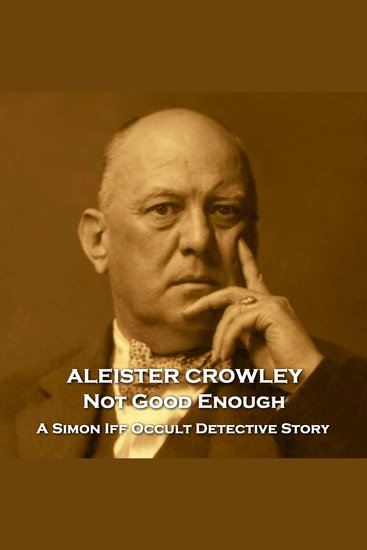
  • Not Good Enough - A Simon Iff Occult Detective Story - cover

    Not Good Enough - A Simon Iff...

    Aleister Crowley

    • 0
    • 0
    • 0
    Edward Alexander Crowley was born on 12th October 1875 to wealthy parents in Royal Leamington Spa in Warwickshire. 
     
    He was educated at Malvern College, Tonbridge School, Eastbourne College and finally Trinity College, Cambridge where he focused on his passions of mountaineering and poetry and published several volumes. 
     
    Life for Crowley was to abandon his parents’ Christian faith and instead to inject himself into Western esotericism.  In 1898, he joined the esoteric Hermetic Order of the Golden Dawn and was trained in ceremonial magic before studying both Hindu and Buddhist practices in India. 
     
    On his Egyptian honeymoon in 1904 he claimed contact with an entity―Aiwass―who gave him the sacred Book of the Law which served as the basis for the Thelema religion where he identified as its prophet.  During the Great War, which he spent in the United States, he claimed to be working for British Intelligence but by the 1920s he had decamped to pursue a libertine lifestyle in Sicily, and in the ensuing scandals was evicted by the Italian Government. 
     
    He divided the following two decades between France, Germany, and England, and the continuing promotion of Thelema. 
     
    During his life he gained widespread notoriety for his drug use, his bisexuality, and his alarming views on society.  In short, polite society frowned on his ways, his thoughts and his influence but to many others his stance had much of value.  Even after death he was a darling for the 60’s counterculture but his influence has since waned.   
     
    His literary works were both prolific and covered many topics.  In the early part of his career he published many poetry books, even plays, before his darker and more forceful works came to dominate his output. 
     
    Aleister Crowley died on 1st December 1947 at Hastings in England. He was 72.
    Show book