Join us on a literary world trip!
Add this book to bookshelf
Grey
Write a new comment Default profile 50px
Grey
Subscribe to read the full book or read the first pages for free!
All characters reduced
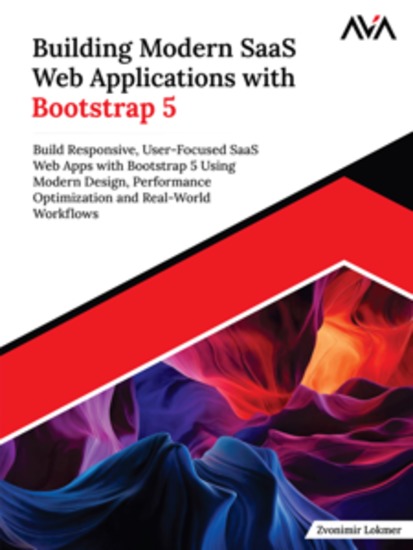
Building Modern SaaS Web Applications with Bootstrap 5: Build Responsive User-Focused SaaS Web Apps with Bootstrap 5 Using Modern Design Performance Optimization and Real-World Workflows - cover

Building Modern SaaS Web Applications with Bootstrap 5: Build Responsive User-Focused SaaS Web Apps with Bootstrap 5 Using Modern Design Performance Optimization and Real-World Workflows

Zvonimir Lokmer

Publisher: Orange Education Pvt Ltd

  • 0
  • 0
  • 0

Summary

Master Bootstrap 5 and Build Web Applications that Users will Love.Key Features● Master responsive design and layouts with Bootstrap 5 components.● Learn advanced customization for scalable, high-performance web apps.● Improve UX by applying the best practices, and real-world examples.Book DescriptionBootstrap 5 plays a crucial role in modern web development by offering a powerful, mobile-first grid system, reusable UI components, and a flexible architecture that accelerates development, without sacrificing design quality. Building Modern SaaS Web Applications with Bootstrap 5 is your practical guide to designing sleek, responsive, and scalable web interfaces, using one of the most widely adopted front-end frameworks, today.This book walks you through a complete journey—from Bootstrap fundamentals to building a fully responsive SaaS-style application. You will start by mastering layout structures, typography, and interactive components. Then, you will apply these skills to develop real-world sections, such as landing pages, pricing tables, feature showcases, testimonials, support sections, and blog layouts. Along the way, you will also learn how to apply UX/UI best practices, optimize performance, and ensure design consistency across devices.In the final section, you will unlock advanced customization techniques, using SASS and learn how to extend Bootstrap for brand-specific design systems. Thus, whether you are building internal tools, client-facing dashboards, or launching your next SaaS product, this book equips you to create professional-grade applications with confidence!So, begin your journey today, and build web applications, your users will love.What you will learn● Design fully responsive web pages with Bootstrap 5 components.● Customize UI with Bootstrap SASS and utility classes.● Build practical SaaS app sections like pricing, testimonials, and blogs.● Integrate UX best practices for user-friendly, conversion-focused design.● Improve performance and scalability, using advanced layout techniques.● Align frontend development with backend systems and project goals.
Available since: 08/28/2025.
Print length: 342 pages.

Other books that might interest you

  • Designed to the Core - cover

    Designed to the Core

    Hugh Ross

    • 0
    • 0
    • 0
    Are you up for a trip through the ultimate neighborhood? Join astrophysicist Hugh Ross for an insider’s look at our cosmic neighborhood, where you’ll see everything from the largest-scale structure of the universe to Earth’s innermost layers. In Designed to the Core, Ross explains how the most sophisticated scientific instruments reveal exquisite “interior designs” throughout the universe that are ideally suited for human habitation here on Earth right now. This scientific excursion takes us to the interior structures of super-superclusters of galaxies, clusters of galaxies, local galaxies, our Milky Way Galaxy, the Sun, our planetary system, the Moon, and Earth’s interior—all of which reveal fine-tuning that manifests a Designer’s planning and preparation.Please note that you may download accompanying PDFs that provide enhanced materials for this audiobook at https://reasons.org/audiobooks.
    Show book
  • Geospatial Data Engineering - Mapping the World of Geospatial Data Science - cover

    Geospatial Data Engineering -...

    Simon Winston

    • 0
    • 0
    • 0
    In an age where every corner of our world is digitized and interconnected, geospatial data engineering has risen as a cornerstone of the modern data landscape. "Geospatial Data Engineering: Navigating the Digital Earth" is your essential guide to mastering the art and science of working with geographic data. Whether you're a GIS professional, a data scientist, or simply curious about the transformative power of location-based information, this book provides an in-depth exploration of the field, offering a comprehensive roadmap to understanding, managing, and unleashing the potential of geospatial data. 
    Explore the fundamental concepts that underpin geographic information systems (GIS) and gain insights into spatial data models, sources, and the software tools that drive this technology. Learn the intricacies of geospatial data management, including data quality, integration, and the role of metadata. Dive into the world of spatial analysis, from traditional spatial statistics to advanced geostatistics and network analysis. 
    Unlock the vast potential of geospatial data in our increasingly interconnected and data-driven world. "Geospatial Data Engineering: Navigating the Digital Earth" is your indispensable companion on this exciting journey. Whether you're an expert in the field or just embarking on your geospatial data adventure, this book is your comprehensive map to understanding, managing, and leveraging the dynamic world of geospatial data. 
     
    Show book
  • The Great Survival Book of Foraging Wild Edible Plants - cover

    The Great Survival Book of...

    Small Footprint Press

    • 0
    • 0
    • 0
    In The Great Survival Book of Foraging Wild Edible Plants, you will discover:30+ of the most common wild edible foods that you can safely forage The basic tools you need to start foraging (hint: you probably already have all of them at home!)A detailed description of every poisonous and non-poisonous look-alikeThe health benefits of wild edible foods and how to successfully boost your health while enjoying delicious mealsWhy wild edible food is so much healthier than cultivated food60+ flavor-packed recipes for freshly foraged food – discover heaps of healthy meals your whole family will enjoyAll the knowledge and skills you need for sustainable, long-term foragingWhere, when, and how to forage to bring home a beautiful harvest every time you go out into the woodsThe most common mistakes that people make when foraging and how to avoid themA couple of the most straightforward and most budget-friendly conservation methods to have nourishing foods at home all year round 
    And much more. 
    Foraging is, in fact, as beneficial as experienced foragers claim it to be! 
    By keeping this in-depth guide by your side, you no longer need to worry about your foraging journey – you’re about to discover the best plant-identification methods you’ll ever need to pick your wild edible food safely. 
    Yes, free breakfast, lunch, and dinner are a real thing! 
    It’s time to take your first step in a new direction!
    Show book
  • Understanding the Artificial Intelligence Revolution - Between Catastrophe and Utopia - cover

    Understanding the Artificial...

    Shalom Lappin

    • 0
    • 0
    • 0
    After many years during which it languished in relative obscurity, in remote classrooms of computer science departments and in small prototype projects for tech companies, artificial intelligence (AI) is now a searingly hot topic across the media. Yet much of the public discussion is so feverish that an understanding of the basic scientific and engineering elements of the field is easily lost, often resulting in exaggerated claims, as well as dangerously neglected threats. 
     
    This concise and sober book presents a brief history of AI, explaining in clear language the central engineering innovations that have produced the current revolution. It distinguishes between imagined dangers and the very real problems that AI is creating. Spread across seven short and accessible chapters, this book explains the developments behind deep learning and the applications of deep neural networks (DNNs). It addresses both the imagined and actual risks posed by the AI revolution, before outlining the elements of a rational public policy on AI, covering topics like tech monopolies, disinformation, bias, hate speech, intellectual property rights, and inequality. 
     
    Understanding the Artificial Intelligence Revolution: Between Catastrophe and Utopia is the ideal book for anyone seeking a clear and informed introduction to AI.
    Show book
  • Private Pilot Blueprint - cover

    Private Pilot Blueprint

    Jason Schappert

    • 0
    • 0
    • 0
    Jason's objective for this book is to impart to others all that he wishes somebody would have let him know when he began his confidential pilot flight preparing so others can try not to misstep the same way he made that cost him time and cash. You'll have the option to apply the down to earth devices in this book to finish your Confidential Pilot Testament significantly quicker while turning into a protected, capable pilot. Take notes and follow intently as Jason assists you with capitalizing on your flight preparing. 
    Would you like to turn into a pilot and you don't know where to begin? The Confidential Pilot Diagram is your conclusive guide to starting your flight process. We'll respond to every one of your inquiries concerning everything from the preparation prerequisites to choosing a flight school and how to continue to grow your points of view once you become a pilot. With MzeroA, you'll gain all that you want to be aware from optimal design to Zulu time. Figuring out how to apply your aeronautical information is the way to turning into a protected pilot and partaking in each flight. We'll share tips that have helped huge number of understudies very much like you accomplish their flight dreams.
    Show book
  • The Inventions of Ancient Egypt - Pioneering Technologies and Ideas - cover

    The Inventions of Ancient Egypt...

    Omar Khalil

    • 0
    • 0
    • 0
    Ancient Egypt's writing systems stand as a testament to human ingenuity and cultural expression. The development of writing marked a pivotal point in Egyptian civilization, allowing for the documentation of history, religion, and daily life. Among the most significant inventions were hieroglyphs, which evolved into more simplified forms such as hieratic and demotic scripts. These writing systems not only served practical purposes but also played a crucial role in shaping Egypt’s legacy. 
    The invention of hieroglyphs can be traced back to around 3100 BCE. These symbols, composed of pictorial and phonetic elements, were carved into stone monuments and written on papyrus scrolls. Hieroglyphs were primarily used for religious texts, inscriptions on temples, and royal decrees. The complexity and beauty of this script were not just artistic but symbolic, as each symbol held both sound and meaning. Hieroglyphic writing required skilled scribes, who underwent rigorous training to master the hundreds of characters used in various contexts. 
    Over time, the need for quicker, more practical writing gave rise to hieratic script, a simplified and cursive form of hieroglyphs. Hieratic was used mainly for administrative and literary texts, allowing scribes to write more efficiently on papyrus. This new form retained the symbolic power of hieroglyphs but adapted to the demands of record-keeping and correspondence. As hieratic became more widespread, it bridged the gap between the formal, ceremonial writing of hieroglyphs and the everyday needs of administration and commerce.
    Show book