Join us on a literary world trip!
Add this book to bookshelf
Grey
Write a new comment Default profile 50px
Grey
Subscribe to read the full book or read the first pages for free!
All characters reduced
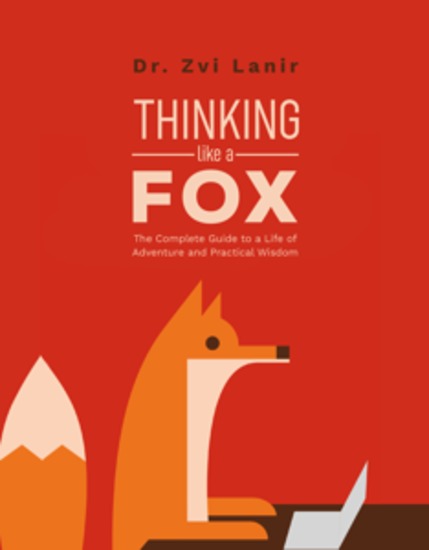
Thinking Like a Fox - cover

Thinking Like a Fox

Zvi Lanir

Publisher: Spines

  • 0
  • 0
  • 0

Summary

In "Thinking like a Fox," Dr. Zvi Lanir invites you on an intellectually engaging and experiential journey through the ancient metaphor of the hedgehog and the fox.Through allegories, stories, and anecdotes, Dr. Lanir presents deep philosophical, psychological, and practical insights. He guides you on how to transform from a 'hedgehog' who operates based on habitual perceptions to a 'fox' who acts flexibly to adapt to a world full of disruptive changes.This book will help you discover and examine your own 'hedgehogness' and develop new personal 'foxiness' abilities to cope with our 21st-century world, characterized by a dizzying pace of fundamental changes that disrupt everything we were accustomed to thinking and doing.Dr. Zvi Lanir, the founding president of the Praxis Institute, has specialized since 1993 in various aspects of coping with disruptive changes in personal, social, economic, and strategic domains. He uncovers these changes and guides how to navigate our thoughts and actions to adapt to the rapid changes occurring in our reality.
Available since: 02/27/2025.

Other books that might interest you

  • Exploring Shakespeare - A Director's Notes from the Rehearsal Room - cover

    Exploring Shakespeare - A...

    Bill Alexander

    • 0
    • 0
    • 0
    'Theatre is the greatest of collaborative art forms, and Shakespeare its greatest exponent: he used the form better than anyone else ever has to speak truth about the world.'
    In Exploring Shakespeare, acclaimed theatre director Bill Alexander takes us inside the rehearsal room to reveal – in unprecedented and captivating detail – exactly what happens there. He examines the key relationship between the actors and the director, how they work together to bring Shakespeare's vision to life, and how choices are made that will shape every aspect of the play in production.
    Full of acute observations and perceptions drawn from a long and brilliant career, the book covers the essential aspects of any Shakespeare production, from understanding the world of the play, to preparing and cutting the text, deciding on costumes and set design, handling soliloquies, and considering character and backstory.
    There are detailed studies of eight plays spanning the full length and breadth of the Shakespearean canon, from Titus Andronicus and The Shrew to The Tempest, via Othello, Hamlet, Lear, The Merchant of Venice and Twelfth Night. Alexander also provides first-hand case studies of three of his own productions, including his famous Richard III starring Antony Sher.
    Personal, forthright, and full of pragmatic advice, Exploring Shakespeare is a masterclass for directors and actors, and a fascinating insight for anyone interested in Shakespeare.
    Bill Alexander was an Associate Director of the Royal Shakespeare Company, and then Artistic Director of Birmingham Rep. His landmark productions include Richard III and The Merry Wives of Windsor (both Olivier Award-winners), The Merchant of Venice, The Taming of the Shrew, Titus Andronicus and King Lear with Corin Redgrave.
    'Bill Alexander is a brilliant director, whose work has powerfully shaped my understanding of Shakespeare's plays, Richard III most of all' James Shapiro, author of 1599: A Year in the Life of William Shakespeare
    Show book
  • The History of France - From Roman Gaul to the 1100s - cover

    The History of France - From...

    Will Forrest

    • 0
    • 0
    • 0
    Discover the Hidden Treasures of French History and Embark on a Fascinating Journey Through Time. 
    Have you ever found yourself captivated by the rich and enthralling history of France? 
    Are you eager to dive deep into a world of political intrigue, military conquests, and the legendary figures that forged the nation we know today? 
    Seize this unique opportunity to embark on an unforgettable journey through the ages with our meticulously researched and expertly crafted book. This comprehensive and engaging guide will take you on a voyage through time, revealing the secrets, stories, and events that have defined France. 
    Why You Need This Book in Your Life 
    With this remarkable guide, you'll:Unveil the mysteries of ancient Gaul, the Roman conquest, and the birth of France.Explore the rise and fall of the Merovingian and Carolingian dynasties, and the dawn of feudalism.Discover key figures like Clovis, Charlemagne, and William the Conqueror, who shaped France's destiny.Appreciate the cultural, religious, and social developments of the early Middle Ages. 
    What Sets This Book Apart? 
    Our book offers:A captivating and comprehensive account of France's past.A deep exploration of the myriad forces that have shaped the nation's historyPolitical intrigue and military conquests to cultural and social revolutions. 
    Ignite your passion for French history! 
    Secure Your Copy Today & Embark on an Unforgettable Journey Through Time! 
    So, what are you waiting for? 
    Take the plunge and immerse yourself in the mesmerizing world of medieval France. Buy your copy now and embark on a journey that will leave you captivated, enlightened, and forever changed.
    Show book
  • The Cultural Revolution - A Captivating Guide to a Decade-Long Upheaval in China Unleashed by Mao Zedong to Preserve Chinese Communism - cover

    The Cultural Revolution - A...

    Captivating History

    • 0
    • 0
    • 0
    If you want to discover the captivating history of the Cultural Revolution, then keep reading...
    
    The Cultural Revolution, known in full as the "Great Proletarian Cultural Revolution," was launched by Mao Zedong, the chairman of the Communist Party of China, as a means of quashing capitalism in China. He wanted to ensure that the desire for a communist government would remain strong in the country long after his death. Like other previous leaders who attempted to continue to rule after their death, his attempt did not work out quite the way he had planned. Over the course of a decade, from the summer of 1966 to 1976, Mao Zedong implemented a number of changes that have led him to be known as one of the most brutal tyrants of the modern age. It is estimated that between 500,000 to two million Chinese people, although numbers can go as high as twenty million, died as a direct result of Zedong's Cultural Revolution. It also resulted in millions of people being imprisoned, displaced, and tortured in an attempt to cement Mao Zedong's reputation as the leader of the communist world.
    In The Cultural Revolution:  A Captivating Guide to a Decade-Long Upheaval in China Unleashed by Mao Zedong to Preserve Chinese Communism, you will discover topics such as:
    
    -  Mao Zedong's Early Life, Rise to Power, and the Government Upheaval That Changed China during the First Half of the 20th Century 
    -  The Suspicion Behind the United Face 
    -  The Five-Year Plan, the Great Leap Forward, and the Events Leading to the Cultural Revolution 
    -  fighting the Capitalism of the West 
    -  The Introduction of Revolution 
    -  The Red Guards 
    -  July 20th Incident 
    -  Border Clashes with the Communist Soviets 
    -  Lin Biao – The Successor and Opponent 
    -  Health Issues and Slipping Grip on the Revolution 
    -  The 10th Congress and the Shifting of Power 
    -  Mass Killings in China and Devastation in Northern China 
    -  End of the Cultural Revolution 
    -  Lasting Effects 
    -  And much, much more! 
     So if you want to learn more about the Cultural Revolution, scroll up and click the "add to cart" button! 
    Show book
  • The Wounds Are the Witness - Black Faith Weaving Memory into Justice and Healing - cover

    The Wounds Are the Witness -...

    Yolanda Pierce

    • 0
    • 0
    • 0
    From celebrated scholar Dr. Yolanda Pierce comes this indelible meditation on Black faith, suffering, hope, and the healing possibilities of justice, written in the venerable tradition of James Cone and Kelly Brown Douglas. 
      
    What do we do with wounds—our own, others', and a nation's? We can turn away, avert our gaze. We can make a spectacle of suffering. Or like the doubting disciple who longed to touch Jesus's side, we can acquaint ourselves with the wounds: both the story they tell and the healing they prefigure. 
      
    In The Wounds Are the Witness, Yolanda Pierce, dean of Vanderbilt University Divinity School and author of In My Grandmother's House, weaves together her own memories, vignettes from Black life, and scenes from scripture, especially the passion of Christ. To work for liberation in a broken world, we cannot look away from crucified flesh. Bones from the Middle Passage, GI Bill benefits denied to Black veterans, women inmates shackled while giving birth: we must take all such wounds seriously. They testify to both the pain and the faith of a people. 
      
    With the lyrical eye of a poet and the moral precision of a preacher, Pierce casts readers into the astounding story of God's healing. From the curative powers of a spiderweb to the work of justice in history, politics, medicine, higher education, and the Black church, Pierce asks: Where are the remedies for the battered and broken? What does accountability look like? Is there any cure? 
      
    Healing takes time, Pierce writes, and even the wounds of the risen Christ do not immediately close. When the wounds become the witness, we find a faith reimagined and a hope transfigured. They tell the truth: about the extent of the injury and the extraordinary work of healing.
    Show book
  • Urbanization and Its Impact - Understanding City Growth - cover

    Urbanization and Its Impact -...

    Lyric Vale

    • 0
    • 0
    • 0
    Urbanization refers to the process by which an increasing proportion of a population comes to reside in urban areas, often transforming rural landscapes into bustling cities. It is a complex and multidimensional phenomenon that encompasses social, economic, cultural, and environmental changes. The rapid expansion of urban areas is one of the most defining features of modern society, reflecting humanity's growing tendency to cluster in cities for opportunities, convenience, and better access to resources. 
    Historically, urbanization began with the establishment of early agricultural settlements, which served as hubs for trade and governance. Over time, these settlements grew into cities as advancements in technology, transportation, and infrastructure facilitated their expansion. The Industrial Revolution, in particular, marked a pivotal moment in the history of urbanization, drawing large numbers of people into urban centers in search of work and prosperity. Today, urbanization continues at an unprecedented pace, driven by industrial growth, globalization, and population migration from rural to urban regions. 
    The scope of urbanization extends far beyond the mere growth of cities. It profoundly influences nearly every aspect of human life, from economic development to social interactions and environmental sustainability. Economically, cities serve as engines of growth, innovation, and creativity, offering concentrated markets, skilled labor, and access to advanced infrastructure. Socially, urban areas often promote cultural exchange and diversity, creating spaces where people from different backgrounds can interact and collaborate. However, this growth also comes with challenges, such as overcrowding, inequality, and the strain on public services and infrastructure.
    Show book
  • Putin's Russia - Life in a Failing Democracy - cover

    Putin's Russia - Life in a...

    Anna Politkovskaya

    • 0
    • 1
    • 0
    A searing portrait of a country in disarray and of the man at its helm, from "the bravest of Russian journalists" (The New York Times)Hailed as "a lone voice crying out in a moral wilderness" (New Statesman), Anna Politkovskaya made her name with her fearless reporting on the war in Chechnya. Here, she turned her steely gaze on the multiple threats to Russian stability, among them Vladimir Putin himself.Rich with characters and poignant accounts, Putin's Russia depicts a far-reaching state of decay. Politkovskaya describes an army in which soldiers die from malnutrition, parents must pay bribes to recover their dead sons' bodies, and conscripts are even hired out as slaves. She exposes rampant corruption in business, government, and the judiciary, where everything from store permits to bus routes to court appointments is for sale. And she offers a scathing condemnation of the war in Chechnya, where kidnappings, extra-judicial killings, rape, and torture beget terrorism rather than fighting it. Finally, Politkovskaya denounces both Putin, for stifling civil liberties as he pushes the country back to a Soviet-style dictatorship, and the West, for its unqualified embrace of the Russian leader.Sounding an urgent alarm, Putin's Russia is a gripping portrayal of a country in crisis and the testament of a great and intrepid reporter, who received death threats and survived assassination attempts for her scathing criticism of the Kremlin. Tragically, on October 7, 2006, Politkovskaya was shot and found dead in an elevator in her Moscow apartment building. After several years of investigations, five men were imprisoned for her murder.
    Show book