Join us on a literary world trip!
Add this book to bookshelf
Grey
Write a new comment Default profile 50px
Grey
Subscribe to read the full book or read the first pages for free!
All characters reduced
Doctrine of the Mean - cover

Doctrine of the Mean

Zi Zisi

Publisher: The Ebook Emporium

  • 0
  • 0
  • 0

Summary

"What Heaven has conferred is called The Nature; an accordance with this nature is called The Path."

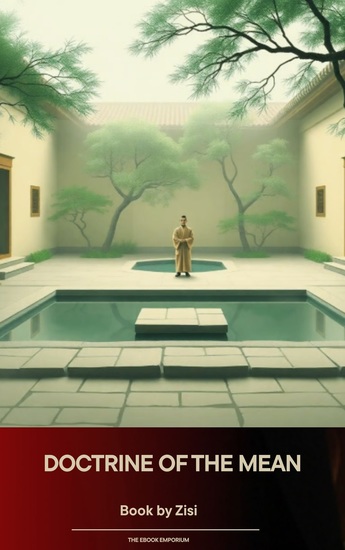
One of the "Four Books" of Confucianism, the Doctrine of the Mean is a profound philosophical treatise that provides the metaphysical framework for a balanced life. It teaches that the path to virtue—the "Mean"—is not merely a compromise, but a state of perfect equilibrium and harmony with the cosmic order. To find the Mean is to align one's personal conduct with the very pulse of the universe.

The Power of Sincerity (Cheng): At the heart of Zisi's work is the transformative power of "Sincerity." The text argues that by being true to oneself and one's nature, an individual can reach a state of enlightenment that allows them to "assist the transforming and nourishing powers of Heaven and Earth." It is a philosophy of active self-cultivation, where the internal moral state of the individual has the power to bring peace to the entire world.

A Blueprint for the "Superior Man": The Doctrine of the Mean outlines the characteristics of the Junzi (the Superior Man), who remains cautious even when unseen and walks the path of virtue even in solitude. It bridges the gap between everyday ethics and transcendental philosophy, making it an essential read for anyone seeking a life of purpose, stability, and profound ethical clarity.

Discover the wisdom of balance in a world of extremes. Purchase the "Doctrine of the Mean" today and align your life with the Way.
Available since: 01/05/2026.
Print length: 27 pages.
Other books that might interest you

  • Genghis Khan – The Man Who Built the Largest Empire in History - The Untold Story of Genghis Khan’s Rise Military Genius and the Mongol Empire That Shaped the World - cover

    Genghis Khan – The Man Who Built...

    Jules Strosin

    • 0
    • 0
    • 0
    Genghis Khan was more than just a conqueror—he was a visionary leader who built the largest contiguous empire in human history. From his brutal early struggles as a tribal outcast to his rise as the supreme ruler of the Mongol Empire, his story is one of strategy, resilience, and ambition. 
    This audiobook takes you inside the mind of the man who revolutionized warfare, unified warring tribes, and reshaped civilizations across Asia, the Middle East, and Europe. Discover the real Genghis Khan—beyond the myths and legends—in an epic tale of conquest, leadership, and destiny. 
    Genghis Khan – The Man Who Built the Largest Empire in History is an immersive journey into one of history’s most feared and respected rulers. A must-listen for anyone fascinated by power, strategy, and global history.
    Show book
  • Napoleon’s Escape from the Middle East: The History of the French General’s Flight from the Levant and Egypt - cover

    Napoleon’s Escape from the...

    Editors Charles River

    • 0
    • 0
    • 0
    In addition to being unable to be reinforced or supplied by sea, Napoleon's ambitions to establish a permanent presence in Egypt were further frustrated by a number of uprisings. Early in 1799, Napoleon advanced against France’s erstwhile enemy, the Ottoman Empire, invading modern Syria (then the province of Damascus) and conquering the cities of Gaza, Jaffa, Arish and Haifa. However, with the plague running rampant through his army and his lines of supply from Egypt stretched dangerously thin, Napoleon was unable to destroy the fortified city of Acre and was forced to retreat. The retreat cost him almost all of his wounded as, harassed by enemy forces, he was forced to abandon most of his casualties to the Ottomans’ mercy, or lack thereof. Most of the wounded were tortured and beheaded. 
    	Napoleon harbored all kinds of delusions about his time in Egypt that were not based in reality, but he definitely left a lasting legacy in the region, one he would never live to see or appreciate. By shifting the theater of operations to Africa and the Middle East, Napoleon inadvertently ensured the Europeans would fight there in the future, and the French occupation impressed upon the locals the necessity of catching up to the modern world in terms of technology. Ancient tactics could not prevail against a modern army, no matter the numbers, but while that was a lesson Napoleon consistently taught his enemies in Egypt and the Levant to their detriment, the French also sped up the occupied populations’ technological advances as well. Perhaps more importantly, the Egyptian Scientific Institute introduced numerous modern innovations, perhaps most importantly the printing press, which in turn encouraged literacy. This brought about the emergence of nationalism and liberalism, leading eventually to the establishment of Egyptian independence and modernization under the rule of Muhammad Ali Pasha in the first half of the 19th century.
    Show book
  • Learn Chinese Idioms with Stories: Volume 2 - An Easy Guide with Meaning & Story - cover

    Learn Chinese Idioms with...

    Letitia Wu

    • 0
    • 0
    • 0
    More wisdom. More stories. More Chinese you’ll never forget. 
    Discover the meaning behind 10 powerful Chinese idioms through story and sound. 
    Even if you don’t speak Chinese yet, you can enjoy the journey. 
    Each idiom includes: 
    • A vivid, short story 
    • A clear explanation in simple English 
    • A cultural insight or life lesson 
    • Easy memory tips 
    • And a few example sentences — perfect if you’re ready to try using the idioms yourself! 
    Whether you’re a beginner, advanced learner, or simply curious about Chinese culture, this audiobook helps you: 
    ✔︎ Understand how Chinese people think 
    ✔︎ Learn real expressions, naturally 
    ✔︎ Enjoy meaningful stories, anytime 
    No textbook needed. Just press play.
    Show book
  • Summary of Counter Gaslighting - A small manual of Counter-manipulation - cover

    Summary of Counter Gaslighting -...

    Dan Crown

    • 0
    • 0
    • 0
    In a world where psychological well-being is paramount, understanding the nuances of manipulative behaviors is crucial. One of the most insidious forms of manipulation is gaslighting. This chapter delves deep into the definition of gaslighting, aiming to equip you with the knowledge to identify and protect yourself from this covert form of emotional abuse. 
    What is Gaslighting? 
    Gaslighting is a form of psychological manipulation in which a person or a group covertly sows seeds of doubt in a targeted individual or group, making them question their own memory, perception, or judgment. It often leads to significant emotional distress, confusion, and a diminished sense of self-worth in the victim. 
    The Core Elements of Gaslighting 
    -Doubt: The manipulator's primary tool is doubt. By questioning the validity of the victim's memories or perceptions, the manipulator creates uncertainty. 
    -Denial: Despite evidence to the contrary, the gaslighter will deny behaviors or events, further confusing the victim. 
    -Discredit: The gaslighter may also discredit the victim to others, isolating the victim and undermining their support system. 
    -Dependency: Over time, the victim may become dependent on the gaslighter for their version of reality, eroding the victim's ability to trust their own judgment.
    Show book
  • Anarchism and Other Essays - cover

    Anarchism and Other Essays

    Emma Goldman

    • 0
    • 0
    • 0
    "Goldman was an admirer of Nietzsche and in many ways represents a model of a superior individual who is capable of rising above the herd instincts of the masses and embracing confrontation with danger. She never hesitated to countenance both the ire of public authorities and the scorn of public opinion. As contemporary anarchists have fallen into the mundane habit of politically correct conformity, a full examination of Goldman's thought suggests the need for a new anarchism that reflects the martial spirit of which Goldman was an exemplary.  Emma Goldman is often depicted in current academic discourse, and the "Left" in particular, as a role model for feminists and a champion of the proletariat. Keith Preston however in reviewing each chapter of Goldman's most famous work "Anarchism and Other Essays" reveals that Emma Goldman often expressed ideas which many of her present day admirers will find surprising and unsettling. He highlights the fact that Emma Goldman distrusted the proletariat, wrote disdainfully of the early feminists who were her contemporaries, and expressed scepticism of women's suffrage."
    Show book
  • The Poverty of Philosophy - cover

    The Poverty of Philosophy

    Karl Marx

    • 0
    • 0
    • 0
    Marx started work on this book in January 1847, as can be judged from Engel's letter to Marx on January 15, 1847. By the beginning of April 1847, Marx's work was completed in the main and had gone to the press. On June 15, 1847, he wrote a short foreword. 
     
    Published in Paris and Brussels in 1847, the book was not republished in full during Marx's lifetime. Excerpts from section five of Chapter Two appeared in different years, mostly between 1872 - 1875 in papers such as La Emancipacion, Der Volksstaat, Social-Demokrat, and others. In 1880 Marx attempted to publish the Poverty of Philosophy in the French socialist newspaper L'Égalité, the organ of the French Workers' Party, but only the foreword and section one of Chapter One were published. 
     
    This translation is from the original 1847 French edition. It has been updated to also include the changes/corrections Marx made in the copy of the book he presented to N. Utina in 1876, as well as the corrections made by Frederick Engels in the second French edition and the German editions of 1885 and 1892. The first English edition of this work was published in 1900 by Twentieth Century Press. 
    Show book