

Join us on a literary world trip!
Add this book to bookshelf
Grey
Write a new comment Default profile 50px
Grey
Subscribe to read the full book or read the first pages for free!
All characters reduced
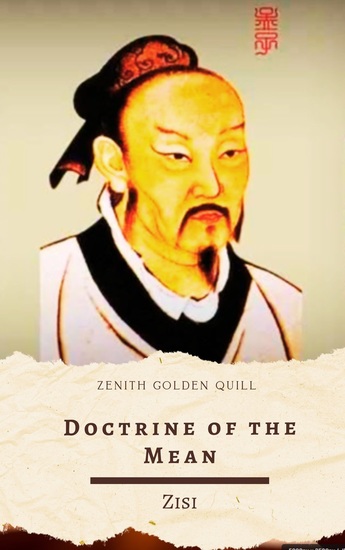
Doctrine of the Mean - The Confucian Classic of Harmony Virtue and Self-Cultivation by Zisi - cover

Doctrine of the Mean - The Confucian Classic of Harmony Virtue and Self-Cultivation by Zisi

Zi Zisi, Zenith Golden Quill

Publisher: Zenith Golden Quill

  • 0
  • 0
  • 0

Summary

Balance. Moderation. Inner harmony. The path to wisdom lies not in extremes, but in the middle way.

Doctrine of the Mean (Zhongyong) is one of the Four Books of Confucian philosophy and a cornerstone of Eastern thought. Authored by Zisi, the grandson of Confucius, this profound text explores how individuals can align themselves with cosmic order, cultivate moral character, and achieve harmony within society and self.

Bridging ethics, politics, and spirituality, this work remains timeless in its call for moderation, sincerity, and righteous living—a message increasingly relevant in today's polarized world.

📘 This Edition Features:
✔ Complete English translation
✔ Kindle-optimized formatting with interactive table of contents
✔ Essential reading for students of philosophy, spirituality, or Chinese classics

💬 What Readers Say:
"A brilliant guide to inner peace and societal integrity."
"One of the most spiritually profound books I've ever read."
"As relevant today as it was 2,000 years ago."

📥 Download Doctrine of the Mean today and discover the timeless Confucian path to virtue, clarity, and peace.
Available since: 05/08/2025.
Print length: 37 pages.

Other books that might interest you

  • Not A Real Enemy - The True Story of a Hungarian Jewish Man's Fight for Freedom - cover

    Not A Real Enemy - The True...

    Robert Wolf, Janice Harper

    • 0
    • 0
    • 0
    Hungary, 1944. Almost half a million Jewish Hungarians are deported to Auschwitz. Among the few surviving Hungarian Jews from this era were young men who, like Ervin Wolf, were forced into the brutal Labor Service where they were cut off from the outside world and forced to endure inhumane brutalities and servitude. Once freed, a new oppression took hold as communist rule under Stalin turned friends to foes, enveloped the nation in fear and suspicion, and tested everyone’s character and strength. 
    This is the true story of Ervin Wolf and his family as the fascist tide of Eastern Europe takes hold of Hungary. From the Wolfs’ comfortable upper-class life to imprisonment, daring escapes, tragic deaths, cloak-and-dagger adventures, and Ervin’s final escape to freedom in the dead of night, Not a Real Enemy is a page-turning tale of suspense, tragedy, comedy, and ultimately, triumph.
    Show book
  • Women at War - The Pivotal Role of Women in the Allied Effort - cover

    Women at War - The Pivotal Role...

    Sage Winters

    • 0
    • 0
    • 0
    Before the outbreak of World War II, women’s roles in society were primarily defined by traditional expectations of domesticity and support. The early 20th century saw most women confined to the home, tasked with caring for children, managing households, and supporting their husbands. While some women worked outside the home, their opportunities were limited to roles deemed suitable for their gender, such as teaching, nursing, and clerical work. A societal emphasis on strict gender roles reinforced the idea that women’s contributions were secondary to those of men.  
      
    Despite these restrictions, change was already stirring in many parts of the world. The suffrage movement had gained momentum in the late 19th and early 20th centuries, granting women the right to vote in some countries. This political shift signaled the beginning of a broader movement toward gender equality. Women’s participation in the workforce during World War I also laid important groundwork, as millions stepped into roles vacated by men who had gone to fight. Although many women were forced to relinquish these jobs after the war, the experience proved their capability and fueled the belief that women could contribute beyond the domestic sphere.  
      
    However, the interwar period brought mixed progress. The economic hardships of the Great Depression in the 1930s reinforced traditional values in some regions, with governments and employers often prioritizing men for scarce jobs. At the same time, women’s organizations continued to advocate for expanded rights, education, and opportunities. The period also saw significant cultural shifts, with women entering public life in new ways. The flapper era of the 1920s, for instance, challenged societal norms by embracing independence, freedom of expression, and modernity. 
    Show book
  • Imperial Japan - Expansion World War and the Rise of a Global Power - cover

    Imperial Japan - Expansion World...

    Rolf Hedger

    • 0
    • 0
    • 0
    The rise of Imperial Japan is a remarkable story of transformation and ambition. It was a journey from isolation to global power, marked by rapid modernization, industrialization, and an expanding empire. At the start of the 19th century, Japan was still a feudal society, deeply rooted in its traditional ways, with the Tokugawa shogunate governing the country in relative peace for over two centuries. However, Japan’s world would change forever when the United States, under Commodore Matthew Perry, forced the country to open its ports in 1854 after a period of strict isolation. 
    This marked the beginning of the Meiji Restoration in 1868, a pivotal event that reshaped Japan’s destiny. The Meiji Restoration was a time of intense reform, where Japan sought to modernize in order to survive and compete with the Western powers. The young Emperor Meiji played a crucial role in transforming Japan from a feudal society into a centralized, modern state. The Japanese government adopted Western methods of governance, education, and technology, while also developing a new sense of national pride and unity. The feudal system was dismantled, and Japan was rapidly industrialized, building a powerful military and a burgeoning economy. 
    The Meiji government’s aggressive modernization policies allowed Japan to catch up with the West in terms of technological and military advancements. Railroads, factories, and telegraphs quickly spread throughout the country. The education system was restructured, producing a new generation of skilled workers and intellectuals who were eager to contribute to Japan’s growing power. By the late 19th century, Japan had established a modern, strong economy capable of competing on the world stage.
    Show book
  • Conduct of Life volume 1 - cover

    Conduct of Life volume 1

    R. Moses Almosnino, Walter...

    • 0
    • 0
    • 0
    The major work of Rabbi Moses Almosnino (1515-1580), “Conduct of Life,” remains to this day an essential reference in classical Judeo-Spanish literature, now finally available in English in its first translation. First published in Ladino in 1564 as, Sefer Hanhagat ha-hayimIn 1729 as “Reghimiento de la vyida”, this three-volume edition is part of the prestigious collection Veritas è terra orietur. The introduction by Jean-Pierre Rothschild, Director of Research at CNRS and Director of Studies at EPHE, specializing in medieval philosophy, enlightens the reader on the foundations and stakes of the work. The first volume aims to provide practical advice for leading a good life from an early age. It emphasizes the distinction between spiritual, physical, and external goods (Volume 1, chapters 1-3), including suggestions on dietary habits, sleep and waking, going to bed and getting up, walking and sitting, speaking and silence (chapters 4-10), the four types of discourse, and why the righteous die young (chapter 11). Finally, it addresses questions on eschatology, classical philosophy, and theodicy (chapters 12-14). “Conduct of Life” draws heavily from the Nicomachean Ethics but transcends this source by situating itself at the universal intersection of several traditions: Greco-Arabic philosophy, Judeo-Christian scholasticism, classical Sephardic Judaism, and medieval Jewish thought. Thus, this work contributes to peace and intercultural understanding among peoples.
    Show book
  • The Harvey Girls - Women Who Opened the West - cover

    The Harvey Girls - Women Who...

    Lesley Poling-Kempes

    • 0
    • 0
    • 0
    The award-winning history of the women who went West to work in Fred Harvey's restaurants along the Santa Fe railway—and went on to shape the American Southwest 


    From the 1880s to the 1950s, the Harvey Girls went west to work in Fred Harvey's restaurants along the Santa Fe railway. At a time when there were "no ladies west of Dodge City and no women west of Albuquerque," they came as waitresses, but many stayed and settled, founding the struggling cattle and mining towns that dotted the region. Interviews and historical research help recreate the Harvey Girl experience. The accounts are personal, but laced with the history the women lived: the dust bowl, the depression, and anecdotes about some of the many famous people who ate at the restaurants—Teddy Roosevelt, Shirley Temple, Bob Hope, to name a few. 


    The Harvey Girls was awarded the winner of the 1991 New Mexico Press Women's ZIA award.
    Show book
  • Grilling Dahmer - The Interrogation Of "The Milwaukee Cannibal" - cover

    Grilling Dahmer - The...

    Patrick Kennedy, Robyn Maharaj

    • 0
    • 10
    • 0
    The Milwaukee detective who interrogated the notorious serial killer shares a vivid chronicle of what was revealed during the weeks-long encounter. In the late hours of July 22, 1991, Detective Patrick “Pat” Kennedy of the Milwaukee Police Department was asked to respond to a possible homicide. Little did he know that he would soon be delving into the dark mind of one of America's most notorious serial killers, the “Milwaukee Cannibal” Jeffrey Dahmer. As the media clamored for details, Kennedy spent the next six weeks, sixteen hours a day, locked in an interrogation room with Dahmer. There the thirty-one-year-old killer described in lurid detail how he lured several young men to his apartment where he strangled, sexually assaulted, dismembered, and in some cases, cannibalized his victims. In Grilling Dahmer,Kennedy takes readers inside the mind of evil as he patiently, meticulously, listens to unspeakable horrors.
    Show book
