Join us on a literary world trip!
Add this book to bookshelf
Grey
Write a new comment Default profile 50px
Grey
Subscribe to read the full book or read the first pages for free!
All characters reduced
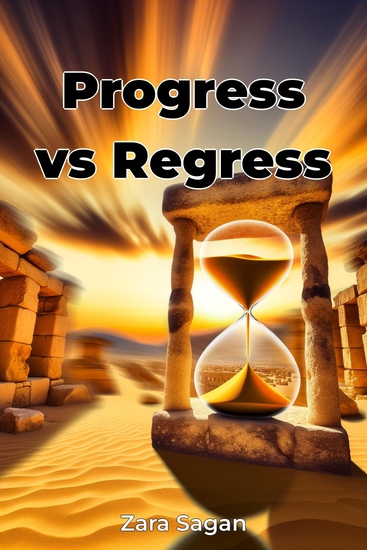
Progress vs Regress - cover

Progress vs Regress

Zara Sagan

Translator A AI

Publisher: Publifye

  • 0
  • 0
  • 0

Summary

"Progress vs Regress" offers a thought-provoking examination of how societies advance and decline, challenging the common belief that human development follows a straightforward upward path. Through a comprehensive analysis spanning archaeology, economics, and social psychology, the book reveals how progress and regression are intricately interconnected, often occurring simultaneously across different aspects of society.

 
This nuanced approach demonstrates how technological advancements might coincide with deteriorating social bonds or environmental conditions, painting a more complex picture of societal development. The book's three-part structure first establishes a theoretical framework for understanding the cyclical nature of progress, then explores specific cases across technological, social, and cultural domains, and finally presents practical models for evaluating change processes.

 
Drawing from diverse historical examples, from ancient empires to contemporary societies, the author illustrates how advancements in one area frequently correlate with decline in others. The analysis is particularly relevant in our current era of rapid technological transformation, offering valuable insights for policy makers, academics, and informed citizens.

 
What sets this work apart is its interdisciplinary approach and balanced perspective, combining quantitative social indicators with qualitative historical analysis to create a comprehensive understanding of societal change. Rather than advocating for either a purely optimistic or pessimistic view, the book provides practical frameworks for analyzing and managing change processes, helping readers navigate the complex interplay between progress and regress in their own contexts. The author's careful examination of historical patterns and contemporary data offers readers tools to better understand and respond to ongoing social transformations.
Available since: 01/05/2025.
Print length: 116 pages.

Other books that might interest you

  • Anger Management for Explosive Parents - Practical Strategies for Moms and Dads to Stay Calm Break the Guilt Cycle and Reconnect with Your Kids - cover

    Anger Management for Explosive...

    Anonymous

    • 0
    • 0
    • 0
    Are you tired of losing your temper—and the connection you
    have with your kids?
    You’re not a bad parent. You’re an overwhelmed one.
     
    Anger Management for Explosive Parents: Practical
    Strategies for Moms and Dads to Stay Calm, Break the Guilt Cycle, and Reconnect
    with Your Kids is your practical roadmap to peace, designed for real
    families living real chaos.
     
    In this powerful, science-backed guide, you’ll discover how
    to: 
    
     
    Each chapter blends psychology, neuroscience, and
    heart—showing you not just why you lose control, but how to
    regain it.
    You’ll learn to see anger not as your enemy, but as a signal that something
    inside you needs care and attention.
     
    Whether you’re a mom, dad, or co-parent trying to stop the
    yelling spiral, this audiobook will help you pause, breathe, and build a
    calmer, more connected home—one moment at a time.
     
    Because peace isn’t a trait you’re born with.
    It’s a skill you can build.
    Show book
  • Byzantium and Constantinople: The History of the Ancient Greek City that Became the Byzantine Empire’s Capital - cover

    Byzantium and Constantinople:...

    Editors Charles River

    • 0
    • 0
    • 0
    Due to the importance of the Roman Empire and the offshoot Byzantine Empire, it’s often forgotten that Constantinople wasn’t chosen at random; in fact, the city already existed, and it lent its name to the empire that was subsequently centered there. Byzantium, known originally as Byzantion, was an ancient Greek city centuries before it became known as Constantinople, and the etymology of Byzantion/Byzantium is still unknown. It has been suggested that Byzantion is of Thracian origin and may be derived from the Thracian personal name Byzas, which means “he-goat.” Ancient Greek legend refers to King Byzas as the leader of the Megaran colonists and the founder of the city, but the earliest name for a city on the site is “Lygos,” which likely corresponds to an earlier Thracian settlement described by Pliny the Elder in his seminal work, Natural History: “On leaving the Dardanelles we come to the Bay of Casthenes, ...and the promontory of the Golden Horn, on which is the town of Byzantium, a free state, formerly called Lygos; it is 711 miles from Durazzo.” 
    Pliny went on to explain that Lygos was a Thracian settlement founded between the 13th and 11th centuries BCE. The site, however, was probably abandoned well before Megara founded Byzantion around 657 BCE across from Chalcedon on the Asiatic side of the Bosphorus. The city was briefly renamed Augusta Antonina in the early 3rd century CE by the Emperor Septimius Severus, who razed the city to the ground in 196 CE for supporting a rival contender in the civil war and had it rebuilt in honor of his son and successor, Marcus Aurelius Antoninus, known as Caracalla. This new name appears to have been quickly forgotten and abandoned, with the city reverting to Byzantium after the assassination of Caracalla in 217 CE, and that’s how it would be known when Constantine fatefully moved the seat of power there over a century later.
    Show book
  • It's What You Do Next - The Fall and Rise of Nashville's First Female Mayor - cover

    It's What You Do Next - The Fall...

    Megan Barry

    • 0
    • 0
    • 0
    In 2015, after a historic run-off election, Megan Barry became the first female mayor of Nashville, Tennessee. Quickly becoming one of the most popular progressive politicians in the Bible Belt, Barry was a beloved leader with a sky-high approval rating and an unshakable hope for a new, forward-thinking, modern South. For her first few years in office, she was one of the most important voices at the table—until she became the most notorious. 


    Barry loved three things the most in the world—her son, Max, her husband, Bruce, and her job as the mayor of Nashville . . . until she lost two of them. Her monumental lapse in judgment led to a painful public reckoning and the fall of her rising political career. A battle with substance-use disorder robbed her of her only child. Grief, pride, shame, longing, and resentment nearly destroyed her marriage. Barry has to start again, the right way, with humility, hope, and a wicked sense of humor. 


    It's What You Do Next is a deeply honest book about womanhood at home, in politics, and in the spaces between.  Warm, funny, and uncompromisingly honest, Barry speaks to women as their close friend, not their fearless leader, her true self, not always her best self. She gives listeners permission to come as they are and leave knowing that what matters most, is what happens next.
    Show book
  • Lifehouse - Taking Care of Ourselves in a World on Fire - cover

    Lifehouse - Taking Care of...

    Adam Greenfield

    • 0
    • 0
    • 0
    How to reclaim power in a time of perpetual crisis 


    We are living through a Long Emergency: a near-continuous train of pandemics, heatwaves, droughts, resource wars, and other climate-driven disasters. In Lifehouse, Adam Greenfield asks what might happen if the tactics and networks of care that spring up in response to these times might be brought together in a single, coherent way of life? 


    Using examples from the Black Panthers' "survival programs," the astonishingly effective Occupy Sandy disaster-relief effort, and the neighborhood-based mutual aid groups that sustained many during COVID lockdowns to the large-scale, self-organized polities of municipalist Spain and Kurdish Rojava, Greenfield argues for rethinking local power as a bulwark against despair—a way to discover and develop the individual and collective capacities that have gone underutilized during all the long years of late capitalism, and a means for thriving in the face of impending catastrophe.
    Show book
  • Constant Reader - The New Yorker Columns 1927-28 - cover

    Constant Reader - The New Yorker...

    Dorothy Parker, Sloane Crosley

    • 0
    • 0
    • 0
    Dorothy Parker's complete weekly New Yorker column about books and people and the rigors of reviewing. 


    When, in 1927, Dorothy Parker became a book critic for the New Yorker, she was already a legendary wit, a much-quoted member of the Algonquin Round Table, and an arbiter of literary taste. In the year that she spent as a weekly reviewer, under the rupic "Constant Reader," she created what is still the most entertaining book column ever written. Parker's hot takes have lost none of their heat, whether she's taking aim at the evangelist Aimee Semple MacPherson ("She can go on like that for hours. Can, hell—does"), praising Hemingway's latest collection ("He discards detail with magnificent lavishness"), or dissenting from the Tao of Pooh ("And it is that word 'hummy,' my darlings, that marks the first place in The House at Pooh Corner at which Tonstant Weader Fwowed up"). 


    Introduced with characteristic wit and sympathy by Sloane Crosley, Constant Reader gathers the complete weekly New Yorker reviews that Parker published from October 1927 through November 1928, with gimlet-eyed appreciations of the high and low, from Isadora Duncan to Al Smith, Charles Lindbergh to Little Orphan Annie, Mussolini to Emily Post.
    Show book
  • Singlehandedly - Learning to Unhide and Embrace Connection - cover

    Singlehandedly - Learning to...

    Ruth Rathblott

    • 0
    • 0
    • 0
    What are you hiding? 
    Chances are there is something about you that makes you different, that makes you feel you don’t belong. Many of us hide—our ethnicity, sexuality, mental health, disability, religion…the list goes on. The diversity and inclusion movement has emboldened some to come out of the shadows. But too often, disability is not included in that conversation. 
    Ruth Rathblott was born with a limb difference. In her compelling and intimate memoir, she recounts the exhausting and often lonely years she spent overachieving and trying to hide her disability before she learned to unhide. She takes us on a journey of self-discovery: discovering her difference, being taught to hide it, and ultimately finding self-acceptance and connection with others. 
    This book will show you how to build a world of true acceptance, inclusion, and belonging. By the end, you will understand the need to:Own your difference—it’s your greatest gift!Find connection and community by allowing others in to support youCreate inclusive conversations that allow for curiosity and empathyRecognize why representation is essential to creating an inclusive environmentRealize the power of sharing your story 
    Singlehandedly is a book for all of us who have been hiding our differences and want to find freedom, for leaders who want to build more inclusive teams, and for diversity and inclusion directors committed to expanding the diversity conversation to include everyone.
    Show book