Join us on a literary world trip!
Add this book to bookshelf
Grey
Write a new comment Default profile 50px
Grey
Subscribe to read the full book or read the first pages for free!
All characters reduced
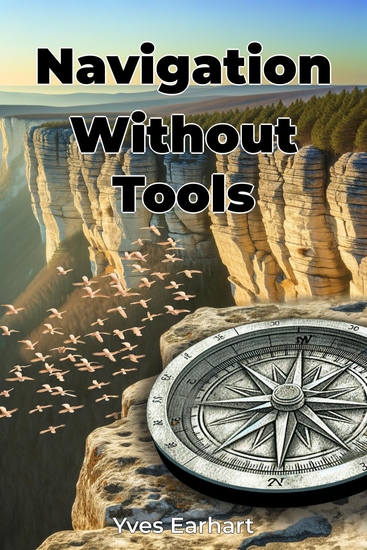
Navigation Without Tools - cover

Navigation Without Tools

Yves Earhart

Translator A AI

Publisher: Publifye

  • 0
  • 0
  • 0

Summary

"Navigation Without Tools" offers a fascinating exploration of ancient wayfinding methods that have guided humans across land and sea for thousands of years. This comprehensive guide uniquely bridges traditional wisdom with modern scientific understanding, demonstrating how natural navigation serves both as a practical survival skill and a means of deepening our connection with the environment.

 
Through a systematic approach, the book examines three fundamental aspects of natural navigation: celestial indicators like sun patterns and star movements, terrestrial features including wind patterns and geological formations, and biological markers found in plant growth and animal behavior. The book progresses logically from basic concepts to advanced techniques, incorporating practical exercises and field activities that allow readers to develop their skills progressively.

 
What sets this work apart is its integration of multiple navigation methods, backed by scientific validation and real-world case studies. Readers learn how to determine cardinal directions using shadow-stick methods, interpret moss growth patterns, and recognize how certain plants orient themselves – skills that remain relevant even in our technology-dependent world.

 
Throughout its chapters, the book maintains an accessible balance between theoretical knowledge and practical application, making complex concepts understandable through clear examples and scenarios. While acknowledging the value of modern navigation tools, it emphasizes the importance of maintaining traditional wayfinding skills as both backup systems and means of developing greater environmental awareness.

 
The content serves diverse audiences, from outdoor enthusiasts and wilderness professionals to anyone interested in developing self-reliance skills, all while connecting these ancient practices to contemporary environmental stewardship.
Available since: 01/13/2025.
Print length: 117 pages.

Other books that might interest you

  • The Hitchhike - cover

    The Hitchhike

    Mark Paul Smith

    • 0
    • 0
    • 0
    Mark Paul Smith graduated college on an Air Force scholarship with dreams of becoming a pilot. He had some downtime after graduation and before reporting for duty so he decided to hitchhike the world. A decision that would change his life forever.As he traveled, his approach to life and his future decisions changed. He hitchhiked through the Iron Curtain and worked on a collective farm in Hungary only to find that communism wasn't our real enemy. He met people from North Vietnam who showed him the real enemy was the U.S. war machine. Being an American was not popular in those days, but the people of the world showed Smith kindness and kept him alive when he ran out of money. The long road to decision showed him that people everywhere want peace, not war.Mark Paul Smith's hitchhike from Indiana to India in 1972 changed him from being an Air Force Officer into a conscientious objector. His faith in the United States of America was restored when he sued the government and won his case in federal court.His journey is one of faith, contemplation, and awakening, mixed with the freedom and abandonment of the 70s.
    Show book
  • Italian Short Stories for Beginners - Over 100 Conversational Dialogues & Daily Used Phrases to Learn Italian Have Fun & Grow Your Vocabulary with Italian Language Learning Lessons! - cover

    Italian Short Stories for...

    Language Mastery

    • 0
    • 0
    • 0
    SPEAK ITALIAN IN 30 DAYS - EVEN IF YOU KNOW ZERO WORDS TODAY 
    Dreaming of ordering authentic pasta in Rome without pointing at the menu? 
    Planning your Italian adventure but worried the language barrier will keep you trapped in tourist traps? 
    Want to truly experience Italy - not just photograph it? 
    HERE'S THE PROBLEM: Only 13% of Italians speak English well. The real Italy - hidden trattorias, local markets, conversations with passionate locals - stays locked away from tourists who can't speak Italian. 
    There's a better way to unlock la dolce vita. 
    "Italian Short Stories for Beginners" by Language Mastery uses the scientifically-proven immersion method that makes learning Italian feel natural and enjoyable. 
    WHAT MAKES THIS PERFECT FOR BEGINNERS: 
    ✓ 100+ authentic dialogues by native Italian speakers - real conversations from Roman cafes, Tuscan markets, and Venetian piazzas 
    ✓ Captivating stories so entertaining you'll forget you're learning - vocabulary sticks naturally through context, not boring flashcards 
    ✓ Two-speed audio: Start ultra-slow to master beautiful Italian pronunciation, then accelerate to natural speaking pace 
    ✓ Effortless grammar absorption - learn through storytelling, just like you learned English as a child 
    ✓ Progress tracking with comprehension checks so you always know you're advancing 
    ✓ Essential vocabulary for ordering food, asking directions, and making Italian friends 
    YOUR TRANSFORMATION IN 30 DAYS: 
    ✓ Order confidently at authentic restaurants and understand what you're eating 
    ✓ Navigate Italian cities like a local, not a lost tourist 
    ✓ Chat comfortably with Italians and discover hidden gems 
    ✓ Experience the REAL Italy - the one locals live in 
    Italian is one of the easiest languages for English speakers. With 60% of English words sharing Latin roots with Italian, you already know more than you think. 
    This is Book 1 - your gateway to Italy's soul. Stop being a tourist. Start living Italian. Grab your audiobook now!
    Show book
  • Delhi Sultanate - Muslim Dynasties That Shaped Medieval India - cover

    Delhi Sultanate - Muslim...

    Rolf Hedger

    • 0
    • 0
    • 0
    The Delhi Sultanate was a defining era in Indian history, marking the establishment of Muslim rule in northern India. Its rise was shaped by a series of invasions, strategic conquests, and the formation of a centralized administration. The foundation of the Sultanate can be traced back to the late 12th century when Muslim forces, primarily from Central Asia, began making inroads into the Indian subcontinent. These incursions set the stage for a new political order that would influence the region for centuries. 
    One of the earliest significant Muslim invasions was led by Mahmud of Ghazni in the 11th century. Although he did not establish permanent rule, his raids weakened Indian kingdoms and demonstrated the vulnerability of the region. However, it was Muhammad Ghori in the late 12th century who laid the groundwork for the Delhi Sultanate. Unlike Mahmud, Ghori aimed for long-term control rather than mere plundering. His victory over Prithviraj Chauhan at the Second Battle of Tarain in 1192 was a turning point, allowing Muslim forces to establish a foothold in northern India. 
    Following Ghori’s assassination in 1206, his general, Qutb al-Din Aibak, took control of his Indian territories and proclaimed himself the first Sultan of Delhi. Aibak, originally a slave who rose through the ranks, became the founder of the Mamluk or Slave Dynasty. He consolidated his rule by strengthening administrative structures and commissioning architectural marvels like the Qutb Minar, which symbolized the establishment of Muslim rule. However, his reign was short-lived, and his successor, Iltutmish, played a more crucial role in shaping the Delhi Sultanate into a powerful and stable empire.
    Show book
  • The Highway Code - Updated for 2024 - cover

    The Highway Code - Updated for 2024

    DrivingSuccess Education

    • 0
    • 0
    • 0
    Our audiobook is the ONLY complete, up-to-date, 2024 edition of the Highway Code. Other audiobooks available on the market were published in 2013 and have not been updated.  
    The Highway Code is essential reading for all road users in England, Scotland and Wales, providing all the latest rules of the road and traffic signs. All road users have a responsibility to keep their knowledge up-to-date. This new edition incorporates new rules on: a) The hierarchy of road users - this means the introduction of new responsibilities towards more vulnerable road users, to keep them safe on the road. These will be known by the 'H' rules b) Mobile Phones - tighter restrictions on the use of mobile phones whilst driving c) Junctions - you should give way to pedestrians crossing or waiting to cross a road that you're turning into d) Parking Laws - new rules around parking on pavements. The Highway Code remains one of the source materials for all theory tests.
    Show book
  • Spain - What Everyone Needs to Know(r)
2nd Edition - cover

    Spain - What Everyone Needs to...

    William Chislett

    • 0
    • 0
    • 0
    In Spain: What Everyone Needs to Know®, a timely addition to Oxford's What Everyone Needs to Know® series, veteran journalist William Chislett provides political and historical context for Spain's current economic and political predicament. Chislett recounts the country's fascinating and often turbulent history, beginning with the Muslim conquest in 711 and ending with the nation's deep economic crisis, sparked by the spectacular collapse of its real estate and construction sectors in 2010. He explains the country's transition from dictatorship to democracy and covers such issues as the creation of a welfare state, the influx of immigrants, internal strife from the separatist Catalan region, the effects of stringent austerity measures, the strengths and weaknesses of the economy, and how the country can create a more sustainable economic model for the future. In a concise, question-and-answer format that allows listeners to quickly access areas of particular interest, the book addresses a wide range of questions, including: What was the legacy of the Muslim presence between 711 and 1492? How did the Spanish Empire Arise? What were the causes of the 1936-39 Civil War? Why did the Socialists win a landslide victory in the 1982 election? What was the impact of European Economic Community membership? What is the violent Basque separatist group ETA? And more.
    Show book
  • Imperial Japan - Expansion World War and the Rise of a Global Power - cover

    Imperial Japan - Expansion World...

    Rolf Hedger

    • 0
    • 0
    • 0
    The rise of Imperial Japan is a remarkable story of transformation and ambition. It was a journey from isolation to global power, marked by rapid modernization, industrialization, and an expanding empire. At the start of the 19th century, Japan was still a feudal society, deeply rooted in its traditional ways, with the Tokugawa shogunate governing the country in relative peace for over two centuries. However, Japan’s world would change forever when the United States, under Commodore Matthew Perry, forced the country to open its ports in 1854 after a period of strict isolation. 
    This marked the beginning of the Meiji Restoration in 1868, a pivotal event that reshaped Japan’s destiny. The Meiji Restoration was a time of intense reform, where Japan sought to modernize in order to survive and compete with the Western powers. The young Emperor Meiji played a crucial role in transforming Japan from a feudal society into a centralized, modern state. The Japanese government adopted Western methods of governance, education, and technology, while also developing a new sense of national pride and unity. The feudal system was dismantled, and Japan was rapidly industrialized, building a powerful military and a burgeoning economy. 
    The Meiji government’s aggressive modernization policies allowed Japan to catch up with the West in terms of technological and military advancements. Railroads, factories, and telegraphs quickly spread throughout the country. The education system was restructured, producing a new generation of skilled workers and intellectuals who were eager to contribute to Japan’s growing power. By the late 19th century, Japan had established a modern, strong economy capable of competing on the world stage.
    Show book