Join us on a literary world trip!
Add this book to bookshelf
Grey
Write a new comment Default profile 50px
Grey
Subscribe to read the full book or read the first pages for free!
All characters reduced
Leech Nervous Systems - cover

Leech Nervous Systems

Yves Earhart

Translator A AI

Publisher: Publifye

  • 0
  • 0
  • 0

Summary

"Leech Nervous Systems" unveils the fascinating complexity of leech neurobiology, demonstrating how these seemingly simple creatures possess a sophisticated neural architecture that challenges our understanding of nervous system organization. At the heart of this remarkable system lies a chain of ganglia, with each segment containing its own local brain, enabling both independent and coordinated function across the organism.The book takes readers on a methodical journey through three key areas: the unique multiple-brain structure, precise behavioral control mechanisms, and evolutionary adaptations. Through detailed anatomical mappings, neural circuit diagrams, and cutting-edge neuroimaging studies, readers discover how leeches maintain exceptional control over swimming, feeding, and defensive behaviors through distributed neural processing.The text skillfully bridges multiple scientific disciplines, from evolutionary biology to neuroscience, making complex concepts accessible while maintaining scientific rigor. What makes this work particularly valuable is its comprehensive examination of the medicinal leech (Hirudo medicinalis) as a model organism for understanding neural network efficiency.The research presented has far-reaching implications, from advancing our knowledge of basic neural organization principles to potential applications in artificial intelligence and biomedical engineering. Each chapter builds systematically upon the last, incorporating detailed illustrations and case studies that illuminate the sophisticated yet efficient nature of leech nervous systems.
Available since: 01/31/2025.
Print length: 98 pages.
Other books that might interest you

  • IGNOU BCA Data and File Structure Previous Year Unsolved Papers MCS 021 - cover

    IGNOU BCA Data and File...

    Manish Soni

    • 0
    • 0
    • 0
    In the ever-evolving landscape of computer science, a strong command over data structures and file organization is essential for designing efficient, reliable, and scalable software systems. These concepts form the backbone of algorithm development and memory management, making them critical for students and professionals alike. To support learners in mastering these foundational topics, "IGNOU BCA Data and File Structure Previous Year Unsolved Papers MCS 021" offers a thoughtfully curated collection of unsolved question papers from previous IGNOU examinations.This book is designed to encourage deep conceptual understanding and promote independent problem-solving. The questions span a wide array of topics including arrays, linked lists, stacks, queues, trees, graphs, hashing techniques, and file organization methods such as sequential, indexed, and direct access. Presented in an unsolved format, these papers challenge students to apply theoretical knowledge to practical problems, strengthening analytical skills and boosting exam preparedness. We hope this resource becomes a trusted companion in your academic journey, equipping you with the tools needed to succeed in both assessments and real-world computing challenges.
    Show book
  • A Rare Recording of Wernher von Braun - cover

    A Rare Recording of Wernher von...

    Wernher Von Braun

    • 0
    • 0
    • 0
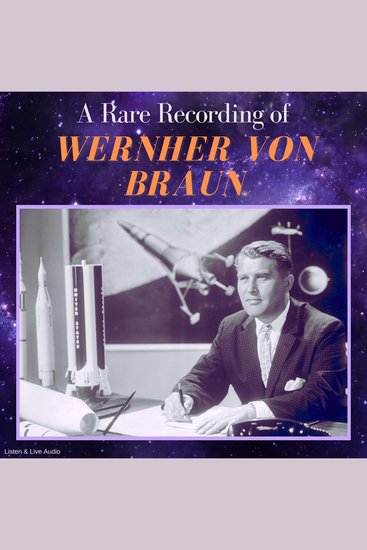
    Wernher von Braun ( March 23, 1912 – June 16, 1977) was a German aerospace engineer and space architect. He was the leading figure in the development of rocket technology in Nazi Germany and a pioneer of space technology and science in the United States. 
    After World War II, von Braun was secretly moved to the US, along with roughly 1,600 other German scientists, engineers, and technicians, as part of Operation Paperclip. He worked for the United States Army on an intermediate-range ballistic missile (IRBM) program, and he developed the rockets that launched the United States' first space satellite Explorer 1. 
    He served as director of the Marshall Space Flight Center and as the chief architect of the Saturn V super heavy-lift launch vehicle that propelled the Apollo spacecraft to the Moon. In 1955, von Braun became a naturalized citizen of the United States. In 1975, von Braun received the National Medal of Science. This recording is from Dr. Von Braun's speech at the 1st Annual SOLE Symposium, September 13, 1966, in Huntsville Alabama.
    Show book
  • Where Are the Little Green Men? - The Adair Hypothesis - cover

    Where Are the Little Green Men?...

    Terry Adair

    • 0
    • 0
    • 0
    This audiobook is narrated by an AI Voice. In a universe teeming with trillions of planets, why is there no evidence of other technological civilizations? Enrico Fermi’s famous paradox has puzzled scientists for decades. In Where Are the Little Green Men?, Terry Adair offers a bold, rigorous answer: The Adair Hypothesis. 
     
    Life may be common—but civilization is not. Advanced technology demands more than intelligence; it requires a rare surplus of dense, stored energy, built through improbable cosmic, geological, and biological coincidences. From the violent birth of planets to the miracle of photosynthesis, ancient carbon burial, and humanity’s energy leaps—coal, oil, gas, fission, and the promise of fusion—Adair traces the fragile chain that allowed us to escape biology and ignite industry. 
     
    The Great Silence isn’t a graveyard of fallen empires. It’s a startling reminder of how rare we may be—and the responsibility that comes with it. A fast-moving, interdisciplinary exploration of cosmology, astrobiology, and energy physics, this book reframes our cosmic solitude not as loneliness, but as extraordinary privilege.
    Show book
  • The Golden Toad - An Ecological Mystery and the Search for a Lost Species - cover

    The Golden Toad - An Ecological...

    Trevor Ritland, Kyle Ritland

    • 0
    • 0
    • 0
    As young boys, Trevor and Kyle Ritland were fascinated by the golden toad of Costa Rica, a brilliant species their biologist father showed them in his projector's slide shows. Native to only one wind-battered ridgeline high on the continental divide above the cloud forests of Monteverde, thousands of golden toads would congregate for a few weeks each year in ephemeral pools among the twisted roots to mate, deposit their offspring, and retreat again beneath the earth. But from one year to the next, the toads disappeared without a trace. Since then, only rumors remain, which beg the question: could the golden toad still be alive? 


    In The Golden Toad, Trevor and Kyle set off to investigate an environmental mystery with unexpected revelations, a story that speaks to our own collective and uncertain future. Guided by Costa Rican naturalists—including the last person to have seen the golden toad alive—Trevor searches for survivors while Kyle hunts the killer, and their paths lead them through an imperiled forest, a deadly pandemic, and a changing climate, intertwining at the site of the golden toad's last emergence deep in Monteverde's Bosque Eterno de Los Niños. 


    The Golden Toad changes the conversation around extinction, climate change, and conservation while exploring environmental grief, resurrection, and hope in a changing world.
    Show book
  • The Year in Tech 2025 - The Insights You Need from Harvard Business Review - cover

    The Year in Tech 2025 - The...

    Harvard Business Review

    • 0
    • 0
    • 0
    A year of HBR's essential thinking on tech—all in one place. 


    Generative AI, biometrics, spatial computing, electric vehicles—new technologies like these are reshaping organizations at the hybrid office, on factory floors, and in the C-suite. What should you and your company be doing now to take advantage of the new opportunities these technologies are creating—and avoid falling victim to disruption? 


    The Year in Tech 2025: The Insights You Need from Harvard Business Review will help you understand what the latest and most important tech innovations mean for your organization and how you can use them to compete and win in today's turbulent business environment. 


    Business is changing. Will you adapt or be left behind? 


    Get up to speed and deepen your understanding of the topics that are shaping your company's future with the Insights You Need from Harvard Business Review series. Featuring HBR's smartest thinking on fast-moving issues—blockchain, cybersecurity, AI, and more—each book provides the foundational introduction and practical case studies your organization needs to compete today and collects the best research, interviews, and analysis to get it ready for tomorrow.
    Show book
  • Burnt - Fighting for Climate Justice - cover

    Burnt - Fighting for Climate...

    Chris Saltmarsh

    • 0
    • 0
    • 0
    Time is up. The climate crisis is no longer a future to be feared, but a devastating reality. We see it in the wildfires in California and floods across Britain—the "once in a generation" extreme weather events that now happen every year. 


    In a world where those in charge are constantly letting us down, real change in our lifetime means taking power into our own hands. The task ahead of us is daunting, but the emergence of a new wave of movements focused on climate justice, equality, and solidarity also brings hope. 


    Asking how we have arrived at this moment, Chris Saltmarsh argues that the profoundly political nature of the environmental crisis has been relentlessly downplayed. After all, how can solar panels save us while capitalism places profit over the future of the planet? Analyzing the failures of NGOs, the limitations of Extinction Rebellion and Youth Strikes, the role of trade unions, and the possibilities of a Green New Deal, Burnt issues a powerful call for a radical collective movement: saving the world is not enough; we must build a better one in the process.
    Show book