Join us on a literary world trip!
Add this book to bookshelf
Grey
Write a new comment Default profile 50px
Grey
Subscribe to read the full book or read the first pages for free!
All characters reduced
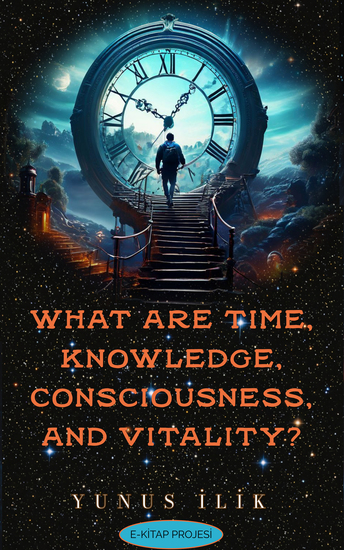
What are Time Knowledge Consciousness and Vitality? - cover

What are Time Knowledge Consciousness and Vitality?

Yunus İlik

Publisher: eKitap Projesi

  • 0
  • 0
  • 0

Summary

 How do the universe and living beings evolve?
 
Matter is energy. The universe's and nature's incomprehensible diversity, the foundation of the multitude of knowledge that condenses and transforms into energy and matter, a space that has partially differentiated through evolution. The different forms that have evolved are, at their core, pure space at various energy field levels. It's plausible that the universe's and energy-matter's evolution started with primitive stars and is still unfolding before our eyes. Perhaps the fundamental question is, "What is the realm of space?" where universes evolve.
 
We are going through a time when the world's consciousness is being reshaped, and life and consciousness are no longer a mystery. Living beings are a whole with their environment, which evolves through matter-energy interactions.
 
How did inanimate matter-energy fields create life? How do we interact with matter-energy fields? What are liveliness, emotions, and consciousness? Why and how did consciousness form? How does our system observe itself? What is an observer?
 
Do other living beings have consciousness? What are instincts? How did they form? How do they operate? Is there a soul? How do we feel and see in our brains? What is time? How is it perceived? How do electricity, light, and electromagnetic fields significantly influence the formation of life and consciousness? Not only plants but essentially all living beings: how do they fundamentally use light and electricity as energy?
 
What is the universal source of knowledge? How is information stored in our brains, and how is our memory formed? Is our brain a knowledge organizer that shapes and organizes information? Why and how can information be organized? Life is fundamentally an organization of matter and energy that has evolved through environmental interactions. Is the fundamental reason behind our problems the nature of the universe? If consciousness understands what it means to be alive, how is it affected by this?
 
What is the purpose that drives living beings, the foundation of life? Is it fundamentally the same with matter and energy, with the evolution of the universe? What are we? Is space fully understandable? If we were to integrate and develop all methods, would our effort to understand space still be considered a reductionist approach, even if it included our future evolution?
 
Why?
Available since: 06/07/2025.
Print length: 200 pages.
Other books that might interest you

  • A Year in a Ditch - Exploring the history wildlife and conservation of a ditch - cover

    A Year in a Ditch - Exploring...

    J C eremy Hobson

    • 0
    • 0
    • 0
    Rivers, canals, and many glorious waterways are championed and admired at every opportunity. Sadly, not so the humble ditch, yet they are the all-important capillaries supplying the veins of our far more visual watercourses. 
    In no way a dry riverbed of hard facts, A Year in a Ditch is informative and a source of knowledge to anyone interested in exploring the delights and habitat created by ditches, many of which are absolutely vital to the success of some of the rarest flora and fauna. Whilst discussing the role of the ditch past, present, and future, it also flows full of relevant quirky notes and detail; old wives tales, quotations, and snippets of poetry. Within these minutes can be found something to fascinate and interest those involved in countryside management, the naturalist, environmentalist, rural explorer, aspiring country dweller—anyone, in fact, who would like to know more about the oft-neglected thousands of miles of ditches that wend their way unobtrusively through the British countryside. 
    ©2016 Whittles Publishing (P)2022 J. C. Jeremy Hobson
    Show book
  • The Ghost in the Telescope - The Story of the Herschel Space Observatory - cover

    The Ghost in the Telescope - The...

    Stephen Eales

    • 0
    • 0
    • 0
    The Ghost in the Telescope is an insider's account of the Herschel Space Observatory, which was launched to answer two of the biggest questions in astronomy: How were the stars and galaxies born? 
     
    Written in an engaging manner for a general audience, this book tells the stories of the telescope itself, the discoveries it made, and the engineers and astronomers who built and used it. 
     
    This book, based on the author's own experience and interviews with the key astronomers and engineers, tells the story of the mission, from its original concept on a piece of paper in Venice to the moment after the end of the mission when the engineers had to decide whether to crash the spacecraft into the Moon. This book describes all the major discoveries made with the telescope and also gives an account, accessible to anyone without previous scientific knowledge, of the latest research into the births of stars and galaxies. 
     
    This book may interest anyone who is curious about astronomy, space missions, and how astronomy is done in practice. It is designed for a general audience and does not require any previous scientific background.
    Show book
  • CHARGE - Why Does Gravity Rule? - cover

    CHARGE - Why Does Gravity Rule?

    Frank Close

    • 0
    • 0
    • 0
    Humans have long been aware of the electric and magnetic forces around us, and scientific investigation showed that the two are intimately connected as electromagnetism. Lightning shows how devastating electricity can be in nature, while humans learned to exploit the flow of negatively charged electrons that make up an electric current. In the early twentieth century, the experiments of Ernest Rutherford showed that at the heart of atoms lies a positively charged nucleus. The positive charge comes from protons. Atoms are neutral because the charges of the electron and proton cancel out. 


    The charges of the proton and electron are opposite and equal, even though the proton is bigger. But why are they equal? This is one of the deepest unresolved puzzles of physics. Frank Close takes us on a journey into the quantum subatomic world of particles. He describes the strong and weak forces that operate alongside electromagnetism, the color and flavor charges, as well as the parallels between them, giving hints of a deeper unity. Seeking an answer to why matter is neutral brings us to fundamental forces and particles, the Standard Model, the Higgs boson, and implications of grand unification for the stability of matter. Close packs in a rich account of our current understanding and the latest ambitious experiments to probe further, and test theoretical possibilities.
    Show book
  • Everything You Know About the Human Body is Wrong - cover

    Everything You Know About the...

    Matt Brown

    • 0
    • 0
    • 0
    A highly entertaining book debunking the many myths about the human body.
    Everything You Know About the Human Body is Wrong debunks the scientific myths we all take for granted. Written by author Matt Brown in his trademark humourous style, this book takes you through all the facts we thought true, from bodily blunders, medical mis-quotes and curious cures. Does giving kids sugar make them go hyper-active? Not at all – there is no proven link! Is there such a thing as being 'double-jointed'? And is it dangerous to swim after eating?
    Covering everything from pseudoscience to recent research, Everything You Know About the Human Body is Wrong shatters a range of illusions we have accepted unquestioningly since childhood and demystifies this most puzzling of subjects.
     
    Show book
  • Good Flies - Favorite Trout Patterns and How They Got That Way - cover

    Good Flies - Favorite Trout...

    John Gierach

    • 0
    • 0
    • 0
    John Gierach is a highly trusted and trustable opinion-maker in fly-fishing. People take what he says to the bank. While most of Gierach's writing is essay-style and reflective, here he gets down to the nitty-gritty: how he ties his favorite flies and why he thinks they work so well for him. There is, thus, an instant reader connection: "Gierach's patterns are good enough for me." 


    Few anglers will skip knowing what a master angler and thinker prefers for his fly box. This title covers a gamut of patterns essential to trout fishing in a variety of circumstances: dry flies, wet flies and nymphs, and streamers. Gierach's legion of fans of his regular magazine column will be highly inclined to buy this title.
    Show book
  • Meningitis - Symptoms Treatment Healing and Recovery - cover

    Meningitis - Symptoms Treatment...

    Lilly Richardsen

    • 0
    • 0
    • 0
    Meningitis is an inflammation of the protective membranes covering the brain and spinal cord, known as the meninges. It can be caused by various infectious agents, including bacteria, viruses, fungi, and parasites. The most common form is viral meningitis, but bacterial meningitis is more severe and can be life-threatening. Understanding meningitis involves recognizing the different types, causes, and how it affects the body. 
    There are several types of meningitis, with bacterial and viral being the most widely recognized. Bacterial meningitis is often more severe, requiring immediate medical attention, as it can result in brain damage, hearing loss, or even death if left untreated. Viral meningitis, though typically less severe, can still cause significant discomfort and requires treatment to manage symptoms. Fungal and parasitic meningitis are less common but are particularly concerning for individuals with weakened immune systems. Each type has its own set of causes, transmission methods, and severity. 
    The causes of meningitis are diverse, with bacteria such as Neisseria meningitidis, Streptococcus pneumoniae, and Haemophilus influenzae being some of the most common culprits in bacterial cases. Viral meningitis is usually caused by enteroviruses, though the herpes simplex virus and HIV can also lead to viral meningitis. Fungal infections, like those caused by Cryptococcus, typically affect individuals with weakened immune systems, such as those living with HIV/AIDS. Meningitis can also result from parasitic infections, although this is extremely rare.
    Show book