Join us on a literary world trip!
Add this book to bookshelf
Grey
Write a new comment Default profile 50px
Grey
Subscribe to read the full book or read the first pages for free!
All characters reduced
The Memorable Thoughts of Socrates - cover

The Memorable Thoughts of Socrates

Xenophon

Translator Edward Bysshe

Publisher: DigiCat

  • 0
  • 0
  • 0

Summary

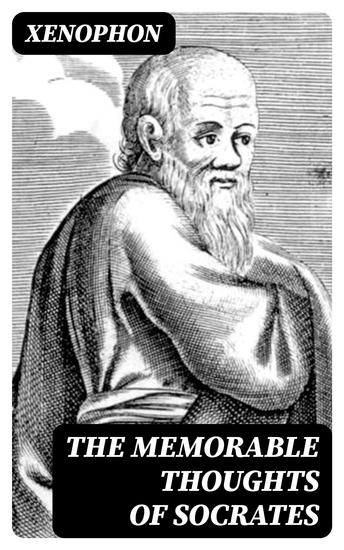
In "The Memorable Thoughts of Socrates," Xenophon presents a series of dialogues that capture the essence of Socratic philosophy, revealing the profound ethical and practical wisdom of Socrates. Unlike Plato's more dramatic portrayals, Xenophon adopts a straightforward narrative style, emphasizing clarity and accessibility while embedding deeper philosophical inquiry within everyday conversations. This work serves as both a companion piece to Plato's dialogues and a standalone exploration of Socratic thought, addressing themes such as virtue, education, and the nature of the good life, all framed through Socrates' distinctive method of questioning and dialogue. Xenophon, an Athenian historian and philosopher, was a student of Socrates who later became a general and a prominent figure in the ancient Greek world. His experiences in the tumultuous political landscape of Greece, combined with personal encounters with Socratic teachings, informed his perspectives on leadership, ethics, and the nature of knowledge. Recognized for his clear prose and practical insights, Xenophon offers a unique portrayal of Socrates that complements the more idealized depiction found in other philosophical texts. I highly recommend "The Memorable Thoughts of Socrates" for anyone interested in ancient philosophy, ethics, or the foundations of Western thought. Xenophon's work not only illuminates Socratic wisdom but also invites readers to engage in their own reflective practice on the nature of morality and personal conduct in contemporary society.
Available since: 09/15/2022.
Print length: 138 pages.
Other books that might interest you

  • The Russian Revolution - The World's Most Influential Revolution The Rise of the Communist Party and the Soviet Union - cover

    The Russian Revolution - The...

    Days of History

    • 0
    • 0
    • 0
    Are you looking to learn more about the momentous events of the Russian Revolution? 
    The ensuing Civil War and the establishment of the new Soviet Union? 
    - Look no further. This book will give you an understanding of this complex but fascinating period of history. 
    We begin with a comprehensive overview of the Russian Revolution, including its causes, participants, and key moments that led to its success. 
    Then we'll explore the aftermath of the revolution, the Red Army’s role in establishing Soviet rule, the formation of the Communist Party, and how it all impacted Russia’s foreign relations.  
    We also take a closer look at two pivotal figures from this time: Vladimir Lenin and Joseph Stalin. 
    This book is perfect for anyone looking to gain in-depth knowledge of one of the 20th century’s most significant revolutions or just curious about what happened during this era.  
    So don't wait any longer—order your copy today!
    Show book
  • A General Introduction to Psychoanalysis - cover

    A General Introduction to...

    Sigmund Freud

    • 0
    • 0
    • 0
    "A General Introduction to Psychoanalysis" by Sigmund Freud offers an accessible yet comprehensive entry into the ground-breaking world of psychoanalytic theory. Through a series of lectures, Freud explores the unconscious mind, dreams, and the mechanisms of repression, providing insights into the human psyche. He delves into the development of neuroses and introduces key concepts such as defence mechanisms and transference. This seminal work serves as an essential foundation for understanding the intricacies of human behaviour and mental processes.
    Show book
  • Anaximander - Secrets of the First Scientist in History - cover

    Anaximander - Secrets of the...

    Hector Davidson

    • 0
    • 0
    • 0
    Anaximander’s legacy is vast and multifaceted, cementing his place as one of the pioneering figures in the history of philosophy and science. As a pre-Socratic philosopher from Miletus, Anaximander made significant contributions that laid the groundwork for future scientific and philosophical inquiry. 
    Anaximander is best known for his revolutionary ideas about the cosmos. He proposed that the universe originated from the apeiron, an indefinite or boundless substance, which he believed was the source of all things. This concept marked a significant departure from the mythological explanations of the cosmos prevalent in his time, suggesting instead a naturalistic origin of the universe. His cosmological model, which included the idea of a cylindrical Earth suspended in space, demonstrated a sophisticated understanding of celestial mechanics for his era. 
    Often regarded as the first true scientist, Anaximander applied rational and empirical approaches to understand natural phenomena. He was one of the first to propose that natural laws govern the world, an idea that forms the cornerstone of scientific inquiry. His work in biology suggested that life originated in water and that humans evolved from fish-like ancestors, anticipating evolutionary theory millennia before Darwin.
    Show book
  • Brief History of Equality A: Book Summary & Analysis - cover

    Brief History of Equality A:...

    Briefly Summaries

    • 0
    • 0
    • 0
    This is a concise summary and analysis of A Brief History of Equality, by Thomas Piketty.
     
    It is not the original book and is not affiliated with or endorsed by Thomas Piketty.
     
    Ideal those seeking a quick and insightful overview.
     
    "A Brief History of Equality" offers a concise yet profound exploration of humanity's long struggle toward a more equitable society. This thought-provoking work delves into centuries of economic and social transformations, highlighting the milestones and setbacks in the quest for equality. With a sharp analysis of wealth distribution, power dynamics, and systemic change, the book argues that progress, though uneven, is achievable through collective effort and informed policy. Accessible and empowering, it serves as both a historical overview and a roadmap for creating a fairer world.
    Show book
  • James I Charles I Commomwealth & Cromwells 1603-1660 - Stuarts Civil War Scaffolds Cromwell and the Odd Beheading (A Comic History of England Bk6) - cover

    James I Charles I Commomwealth &...

    Gilbert Abbott à Beckett

    • 0
    • 0
    • 0
    Step right up for the most uproariously irreverent chapter of Gilbert Abbott A’Beckett’s Comic History of England—where crowns are comedy props and history’s biggest egos trip over their own dogma! 
    Meet James I, the "Wisest Fool in Christendom," who preached divine right while his pet favorite, the Duke of Buckingham, turned the court into a scandalous farce. Then comes Charles I, whose stubbornness cost him his crown (and his head), thanks to a Parliament with a very sharp grievance list—and a little help from the ill-fated Earl of Stafford. 
    Enter Oliver Cromwell, the Puritan party-pooper who banned Christmas, crushed Ireland, and somehow made republicanism duller than a Sunday sermon. But just when you think the chaos can’t get worse, in stumbles Richard Cromwell, his hapless son, who proved that ruling England was not a hereditary talent. Spoiler: The Republic collapses faster than a house of cards in a hurricane. 
    Narrated with wicked wit by Charles Featherstone, this uproarious installment skewers the Stuarts like a royal roast—where kings are klutzes, parliaments are punchlines, and the only thing sacred is the absurdity of power.
    Show book
  • Metropolises in Myth - Resurrecting Nine Fabled Urban Centers from Antiquity's Shadows - cover

    Metropolises in Myth -...

    John Harpoon

    • 0
    • 0
    • 0
    Throughout history, cities have risen and fallen, some leaving behind monumental legacies while others have vanished into myth. The allure of lost cities has captivated imaginations across generations, often blending history with legend. These fabled metropolises, shrouded in mystery and time, offer tantalizing glimpses into what might have been—magnificent civilizations, advanced technologies, and vibrant cultures. Whether concealed beneath the sands of the desert, submerged under the sea, or hidden deep in the jungles, the idea of cities lost to time speaks to humanity's eternal quest for discovery and our fascination with the past. 
    The mystery of lost cities invites both scholars and adventurers to uncover what lies beneath the surface of ancient tales. It fuels our imagination, as each lost city becomes a puzzle—fragments of architecture, scattered relics, and half-forgotten stories that promise to reveal something transformative. But beyond mere exploration, these cities often represent something deeper: the fragility of human ambition, the impermanence of power, and the profound impact of time on civilization. In this quest to resurrect ancient urban centers, we see not just the history of the cities themselves, but also reflections of our own desires and dreams for immortality.
    Show book