Join us on a literary world trip!
Add this book to bookshelf
Grey
Write a new comment Default profile 50px
Grey
Subscribe to read the full book or read the first pages for free!
All characters reduced
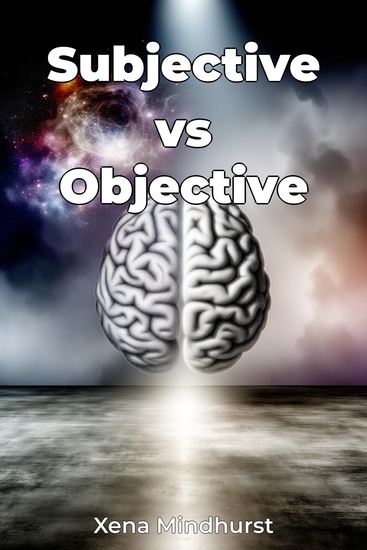
Subjective vs Objective - cover

Subjective vs Objective

Xena Mindhurst

Publisher: Publifye

  • 0
  • 0
  • 0

Summary

"Subjective vs Objective: Unraveling the Mindset Behind Perception and Reality" explores the intricate relationship between subjective experiences and objective truth, challenging readers to reconsider how they perceive and interact with the world. This thought-provoking book delves into the psychological mechanisms underlying our perceptions, drawing on insights from cognitive science, neuroscience, and philosophy to present a nuanced understanding of reality.

 
The book's unique approach lies in its advocacy for integrating both subjective and objective perspectives, rather than treating them as mutually exclusive. It traces the historical roots of this dichotomy and examines its relevance in contemporary society, highlighting how neither a purely subjective nor strictly objective approach suffices in navigating the complexities of human experience.

 
Through case studies, experimental results, and theoretical frameworks, the author illustrates how our perceptions are shaped by cognitive biases, emotional influences, and cultural factors. Structured in three parts, the book progresses from introducing fundamental concepts to exploring psychological mechanisms and finally examining practical applications in fields such as science, ethics, and personal development.

 
This interdisciplinary approach, combined with an accessible writing style, makes the book valuable for a wide audience, from students and professionals to anyone interested in enhancing their critical thinking skills and understanding the nature of perception and reality.
Available since: 10/14/2024.
Print length: 73 pages.

Other books that might interest you

  • The Wannabe Fascists - A Guide to Understanding the Greatest Threat to Democracy - cover

    The Wannabe Fascists - A Guide...

    Federico Finchelstein

    • 0
    • 0
    • 0
    Meet today's almost fascists and learn the warning signs to intercept them on the road from populism to dictatorship. 


    With The Wannabe Fascists, historian Federico Finchelstein offers a precise explanation of why Trumpism and similar movements across the world belong to a new political breed, the last outcome of the combined histories of fascism and populism: the wannabe fascists. This new type of populist politician is typically a legally elected leader who, unlike previous populists who were eager to distance themselves from fascism, turns to totalitarian lies, racism, and illegal means to destroy democracy from within. 


    Drawing on almost three decades of research on the histories of fascism and populism around the world, this book lays out in clear language what the author calls the "four pillars of fascism"—xenophobia, propaganda, political violence, and ultimately dictatorship. Finchelstein carefully explains how and why wannabe fascists like Trump, Bolsonaro, and Modi embrace the first three pillars but don't quite succeed in dictatorship and total suppression of the popular vote. The Wannabe Fascists stresses the importance of preventing despots from reaching this tipping point and offers a clear warning for what's at stake.
    Show book
  • The Loneliness Files - cover

    The Loneliness Files

    Athena Dixon

    • 0
    • 0
    • 0
    What does it mean to be a body behind a screen, lost in the hustle of an online world? In our age of digital hyper-connection, Athena Dixon invites us to consider this question with depth, heart, and ferocity, investigating the gaps that technology cannot fill and confronting a lifetime of loneliness. 


    Living alone as a middle-aged woman without children or pets and working forty hours a week from home, more than three hundred fifty miles from her family and friends, Dixon begins watching mystery videos on YouTube, listening to true crime podcasts, and playing video game walk-throughs just to hear another human voice. She discovers the story of Joyce Carol Vincent, a woman who died alone, her body remaining in front of a glowing television set for three years before the world finally noticed. Searching for connection, Dixon plumbs the depths of communal loneliness, asking essential questions of herself and all of us: How have her past decisions left her so alone? Are we, as humans, linked by a shared loneliness? How do we see the world and our place in it? And finally, how do we find our way back to each other? 


    Searing and searching, The Loneliness Files is a groundbreaking memoir in essays that ultimately brings us together in its piercing, revelatory examination of how and why it is that we break apart.
    Show book
  • Literature after Feminism - cover

    Literature after Feminism

    Rita Felski

    • 0
    • 0
    • 0
    Recent commentators have portrayed feminist critics as grim-faced ideologues who are destroying the study of literature. Feminists, they claim, reduce art to politics and are hostile to any form of aesthetic pleasure. Literature after Feminism is the first work to comprehensively rebut such caricatures, while also offering a clear-eyed assessment of the relative merits of various feminist approaches to literature.Spelling out her main arguments clearly and succinctly, Rita Felski explains how feminism has changed the ways people read and think about literature. She organizes her book around four key questions: Do women and men read differently? How have feminist critics imagined the female author? What does plot have to do with gender? And what do feminists have to say about the relationship between literary and political value? Interweaving incisive commentary with literary examples, Felski advocates a double critical vision that can do justice to the social and political meanings of literature without dismissing or scanting the aesthetic.
    Show book
  • Borders - A Very Short Introduction (2nd Edition) - cover

    Borders - A Very Short...

    Joshua Hagen, Alexander C. Diener

    • 0
    • 0
    • 0
    First published in 2012, Borders: A Very Short Introduction began with the premise that "we live in a very bordered world." The intervening decade has witnessed a flurry of events and developments that continue to highlight the centrality of borders in contemporary domestic and international affairs, as well as the interstices between the two, including sudden surges in migrant and refugees flows; renewed emphasis on traditional border security and wall construction; growing tensions concerning maritime sovereignty; rapid advances in cybersecurity, surveillance, and biometrics; expanded detention and deportation infrastructures; proliferation of transborder organizations; revived populist and nationalist sentiments; and protectionist and integrationist trade practices, to name some prominent examples from recent headlines. 


    This revised edition accounts for recent developments including Brexit, the 2015 migration crisis across Europe, efforts to build a border wall between the United States and Mexico, growing isolationist and nativist sentiments, demands for indigenous homelands, transnational protest movements, Russian cross-border incursions, and insurgencies and rebellions across much of North Africa and Southwest Asia.
    Show book
  • Living Disability - Building Accessible Futures for Everybody - cover

    Living Disability - Building...

    Emily Macrae

    • 0
    • 0
    • 0
    How can we build more accessible cities? Living Disability brings together vibrant perspectives on disability justice and urban systems.
    		 
    A musician and snow removal expert, a queer curator, a public pool aficionado, and a journalist turned city councillor — these are just some of the disabled writers exploring disability justice, analyzing urban systems, and proposing more equitable approaches to city building in this anthology. Essays and interviews push the conversation about accessibility beyond policy papers and compliance checklists to show how disabled people are already creating more inclusive spaces in cities of all sizes.
    		 
    Living Disability is universal in scope but intimate and local in focus, grounded in personal struggles and celebrations. Decisions about public transit, affordable housing, and park design all disproportionately impact disabled communities; by sharing stories and strategies, contributors consider the ways disabled thinkers and doers are embracing overlooked aspects of urban design and tackling the toughest problems facing cities. Each chapter provides context to welcome both disabled and non-disabled readers into conversations about the future of inclusion so that all readers can develop their own understanding of what accessible cities look and feel like. This book appeals to city builders of all stripes committed to learning from and working with underrepresented communities. It equips architects, designers, community leaders, innovators, and citizens with the key concepts they need to collaborate with rather than care for disabled neighbors.
    		 
    “Living Disability is at once hopeful and infuriating, solemn and joyous. The stories shared within these pages point to both the past and future simultaneously — illuminating the struggles and joys and history of disabled life, while putting access barriers on blast in a way that is more necessary than ever. The deep, rich work of this collection lies in its embrace of complexity, community, grief, and also its belief in the capacity of our world (read: us) to change. May these stories touch your heart, kindle the flame of your anger, and move you forward into fighting for the better world we all deserve.” — Amanda Leduc, author of Disfigured: On Fairy Tales, Disability, and Making Space
    Show book
  • Summary: American Prometheus - The Triumph and Tragedy of J Robert Oppenheimer by Kai Bird & Martin J Sherwin: Key Takeaways Summary & Analysis Included - cover

    Summary: American Prometheus -...

    Brooks Bryant

    • 0
    • 0
    • 0
    Disclaimer: This is not the official book, but a summary & it does not accompany the official. 
    Journey into the intricate life of a genius, the making of the atomic bomb, and the drama of the Cold War. 'American Prometheus' unravels the gripping story of J. Robert Oppenheimer — a man heralded for his monumental contribution to the Manhattan Project, only to face a dramatic fall from grace during America's Red Scare. Dive into our comprehensive summary of Kai Bird's Pulitzer-winning biography, where we present the highs and lows of Oppenheimer's life, his groundbreaking discoveries, and the ethical dilemmas that haunted him. 
    Through our concise exploration, encounter the brilliant physicist who forever changed the course of history, the moral ramifications of scientific advancement, and the political machinations of mid-century America. 'American Prometheus' serves as a cautionary tale of genius and its unintended consequences, and our summary brings this tale to life in an accessible, engaging format. 
    Dive deep into the legacy of a man who stood at the crossroads of science and society, whose choices still resonate today. Be prepared to be captivated, enlightened, and provoked.
    Show book