Join us on a literary world trip!
Add this book to bookshelf
Grey
Write a new comment Default profile 50px
Grey
Subscribe to read the full book or read the first pages for free!
All characters reduced
Memory Formation Gaps - cover

Memory Formation Gaps

Xena Mindhurst

Translator A Ai

Publisher: Publifye

  • 0
  • 0
  • 0

Summary

"Memory Formation Gaps" explores how our brains convert experiences into lasting memories, highlighting the gaps in our understanding of this complex process. The book delves into the mechanisms behind synaptic plasticity, the changes in brain circuitry crucial for memory, and examines the roles of brain regions like the hippocampus and amygdala. It questions why some memories fade while others endure, and how neural representations are stabilized over time.

 
The book progresses by first introducing the fundamentals of memory encoding, consolidation, and retrieval. Next, it explores synaptic plasticity at the molecular level, and the systems-level organization of memory across different brain regions. A key focus is on forgetting, examining theories of decay and interference.

 
The book concludes by discussing the clinical implications of memory research for treating memory disorders and cognitive decline. It emphasizes the importance of understanding the limitations of our current knowledge to stimulate new research directions, and improve therapies for neurodegenerative diseases.

 
This book uniquely emphasizes the unsolved mysteries within memory research, going beyond established facts to critically examine the boundaries of our understanding. It draws evidence from human studies, animal models, and neuroimaging data, connecting diverse fields like pharmacology and computer science. By acknowledging these gaps, "Memory Formation Gaps" promotes a nuanced view of memory, crucial for students, researchers, and clinicians in cognitive psychology, neuroscience, and biology.
Available since: 02/13/2025.
Print length: 72 pages.

Other books that might interest you

  • Squirrel Pie - A memoir - cover

    Squirrel Pie - A memoir

    Deborah Brannigan

    • 0
    • 0
    • 0
    Detroit is a thriving blue-collar town in the 1970s, an era when alcoholism and dysfunction thrive behind closed doors. When fifteen-year-old Debbie accepts a new babysitting job she has no idea that it will forever alter her life.  Mac, father of the young children she cares for, slowly begins to groom Debbie with words of praise and flattery. 
    Longing for emotional connection she agrees to run away with Mac, only to find herself trapped in desperate poverty with a violent alcoholic.  She raises three children on roadkill meals and makes herself small and compliant, waiting for someone to save her. 
    When Mac’s violence threatens more than just Debbie's life, she discovers the strength to say, “No more.” Little does she know, however, that leaving her abuser will involve a kidnapping, a murder, and an interstate FBI manhunt. 
    Squirrel Pie is a true story of the painful realities around abuse, addiction, mental illness, and generational trauma. It is also a success story; a story in which perseverance, resilience, compassion, and unexpected allies lead Debbie to a life of healthy connections and choosing joy.
    Show book
  • We Are Controlled - cover

    We Are Controlled

    Raphael Terra

    • 0
    • 0
    • 0
    This audiobook has been recorded using Text to speech (TTS). 
     
    Everything you do and think is controlled by others. Everything you buy. Your work. Your beliefs. Everything is part of a false reality created to control. 
     
    Humanity has no idea it is in fact caught in a massive lie. It is trapped by it’s own inner desires and follows the will of those in power. 
     
    Society is a mirror of man and society is a lie that is far removed from our natural origins. Every country on this planet is being oppressed by clever and powerful elite groups that have been building their empires for centuries. 
     
    They feed us lies and we believe. Eventually we become so deluded we can no longer even see it. 
     
    But there are some who can still see clearly and understand that we live in the ultimate Grand Delusion.
    Show book
  • Could Jo Starting A School For Boys Be A Feminist Act - Little Women Podcast - cover

    Could Jo Starting A School For...

    Niina Niskanen

    • 0
    • 0
    • 0
    Many people wonder why Jo starts a school for boys..even though Little Women mentions how much Jo loves boys many times. In Little Men, we can see how Jo and Friedrich wish that their boys grow to respect women, so could Jo starting a school for boys actually be a feminist act? 
    There are lots of people who say that Friedrich forced Jo to start a school or Friedrich forced Jo to become a teacher. None of that happens in the novel. So have these people even read Little Women? In the book, Jo is the one who says that she wants to start a school. Her exact words are Quote "even before I met my Fritz, I used to think how when I made my fortune and no one needed me at home, I'd hire a big house and pick up some poor fore-long little lads who hadn't any mothers and take care of them and make life jolly for them before it was too late. 
    I see so many of them going to ruin for want of help, and at the right minute. I love them, so to do anything for them, I seem to feel their wants and sympathize with their troubles. I know I should so like to be a mother to them". End quote. In the scene in the book where Jo explains her plans on starting school, she clearly says that what she wants to do is to have a flock of boys that she can nurture, she can take care of them and can be a mother to them and love them. A lot of people erase the maternal elements from Jo's character.
    Show book
  • Freedom Soldiers - The Emancipation of Black Soldiers in Civil War Camps Courts and Prisons - cover

    Freedom Soldiers - The...

    Jonathan Lande

    • 0
    • 0
    • 0
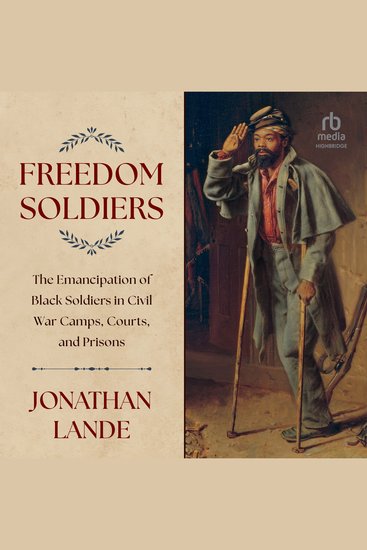
    Almost 200,000 African Americans fought to save the Union, many believing that military service was the pathway to freedom. Yet their journeys for liberation continued. They marched across taxing terrain, performed backbreaking labor, and endured corporeal punishment. They agonized over families still enslaved and suffered virulent diseases. They fought on bravely, yet thousands ran. Chafing against restraints and violence, they briefly liberated themselves.The men examined in Freedom Soldiers took self-granted breaks and, once caught, were tried by the US Army for "desertion." In the courts-martial, they justified their unauthorized departures by telling authorities that they left to temporarily help their families, regain their health, and evade violent officers. Army judges nevertheless convicted freedom seekers. From prisons, the convicted deserters wrote petitions to President Abraham Lincoln and Union officials. These prisoners disputed rulings, offered their continued service to the Union, insisted on the injustice of incarceration, and explained the dire need of kin.Jonathan Lande recovers this subset of soldiers who took leaves of freedom and defended their breaks within the military justice system. He reveals how Black men fought for freedom not only against Confederates but also in US Army camps, courts, and prisons.
    Show book
  • 10 Strange Phenomena You've Always Wanted to Understand - cover

    10 Strange Phenomena You've...

    Benjamin Recker

    • 0
    • 0
    • 0
    Why does cola taste better from a glass bottle? Why can we smell rain before it falls? And why does everything suddenly itch the moment we think about it? In this engaging collection of everyday questions, we get to the bottom of fascinating phenomena from psychology, biology, and sensory perception—clearly explained, entertainingly presented, and full of aha moments.    Hinweis: Dieses Hörbuch verwendet KI-generierte Stimmen.
    Show book
  • Summary of James W Loewen's Lies My Teacher Told Me - cover

    Summary of James W Loewen's Lies...

    Milkyway Media

    • 0
    • 0
    • 0
    Listen now to get the key ideas from James W. Loewen's Lies My Teacher Told Me. 
     
    When a nation misunderstands its past, it distorts its present. In Lies My Teacher Told Me (2018), sociologist and historian James W. Loewen examines how high school textbooks misrepresent US history and why those distortions endure. After analyzing widely used texts, Loewen exposes patterns of omission, misinformation, and uncritical patriotism that drain history of conflict, complexity, and meaning. This revised edition of the bestselling 1995 book expands the discussion with updated material and a new chapter on 9/11 and the Iraq War, revealing how historical myths continue to shape public understanding.
    Show book