Join us on a literary world trip!
Add this book to bookshelf
Grey
Write a new comment Default profile 50px
Grey
Subscribe to read the full book or read the first pages for free!
All characters reduced
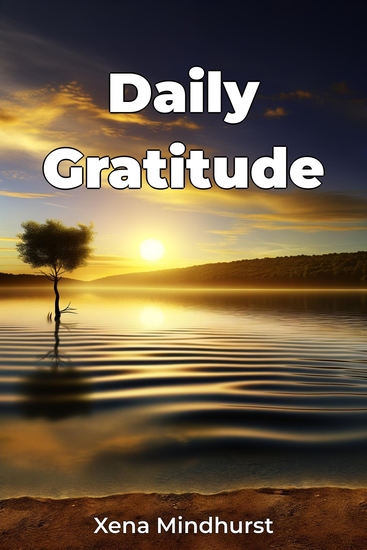
Daily Gratitude - cover

Daily Gratitude

Xena Mindhurst

Translator A AI

Publisher: Publifye

  • 0
  • 0
  • 0

Summary

Daily Gratitude reveals how a simple, science-backed practice can reshape your brain and emotional well-being. At its core, the book argues that gratitude isn’t just a passive feeling but a skill honed through daily habits—like mental exercise for resilience. Blending neuroscience and psychology, it explains how consistent gratitude practices rewire neural pathways, boost emotional regulation, and even reduce stress biomarkers. A standout study cited shows participants who journaled gratitude daily for six weeks reported 25% higher life satisfaction, underscoring its transformative potential. Unlike generic self-help advice, the book demystifies concepts like neuroplasticity with relatable analogies, comparing gratitude to “mental composting” that enriches psychological soil over time.

 
The book’s strength lies in balancing rigor with practicality. It dismisses toxic positivity, offering instead “gritty gratitude”—acknowledging pain while finding small anchors of thankfulness, like appreciating a morning coffee. Structured for busy lives, chapters progress from debunking myths to explaining habit formation, culminating in a 30-day framework with micro-exercises designed for real-world consistency. What sets it apart is its interdisciplinary lens: fMRI studies reveal gratitude’s impact on brain regions tied to empathy, while sociological research hints at broader societal benefits. By merging ancient wisdom with modern science, Daily Gratitude positions itself as a relatable, evidence-based toolkit for anyone seeking calm in chaos—proving that even five mindful minutes can spark lasting change.
Available since: 01/25/2025.
Print length: 67 pages.

Other books that might interest you

  • Dream Hoarders - How the American Upper Middle Class Is Leaving Everyone Else in the Dust Why That Is a Problem and What to Do about It - cover

    Dream Hoarders - How the...

    Richard V. Reeves

    • 0
    • 0
    • 0
    America is becoming a class-based society. 
    It is now conventional to focus on the wealth of the top 1 percent—especially the top 0.01 percent—and how the ultrarich are concentrating income and prosperity, while incomes for most other Americans are stagnant. But the most important, consequential, and widening gap in American society is between the upper-middle class and everyone else. 
    Reeves defines the upper-middle class as those whose incomes are in the top 20 percent of American society. Income is not the only way to measure a society, but in a market economy it is crucial because access to money generally determines who gets the best-quality education, housing, health care, and other necessary goods and services. 
    As Reeves shows, the growing separation between the upper-middle class and everyone else can be seen in family structure, neighborhoods, attitudes, and lifestyle. Those at the top of the income ladder are becoming more effective at passing on their status to their children, reducing overall social mobility. The result is not just an economic divide but a fracturing of American society along class lines. Upper-middle-class children become upper-middle-class adults. 
    These trends matter because the separation and perpetuation of the upper-middle class corrode prospects for more progressive approaches to policy. Various forms of “opportunity hoarding” among the upper-middle class make it harder for others to rise to the top rung. Examples include zoning laws and schooling, occupational licensing, college application procedures, and the allocation of internships. Upper-middle-class opportunity hoarding, Reeves argues, results in a less competitive economy as well as a less open society. 
    Inequality is inevitable and can even be good, within limits. But Reeves argues that society can take effective action to reduce opportunity hoarding and thus promote broader opportunity. This fascinating book shows how American society has become the very class-defined society that earlier Americans rebelled against—and what can be done to restore a more equitable society.
    Show book
  • A Futa in the Mix - cover

    A Futa in the Mix

    Carol East, Carl

    • 0
    • 0
    • 0
    When Andrew discovers that his girlfriend is having an affair he spies on her to see who it could be and is shocked to find that she's seeing another woman who just happens to be a hermaphrodite. 
     
    This story is graphic in nature and is intended for adults only. All Characters depicted are 18 or older. Enjoy
    Show book
  • A Rare Recording of John Wanamaker Telling a Leo Tolstoy Anecdote - cover

    A Rare Recording of John...

    John Wanamaker

    • 0
    • 0
    • 0
    Unable to make the 1908 Pennsylvania German Society's annual gathering due to illness, their president-- businessman, religious leader, and politician, John Wanamaker--sent in a message he recorded "through this wonderful invention of Mr. Edison on the Edison phonograph." This recording recalls an anecdote of Leo Tolstoy's, in which the Russian writer stopped at the roadside and asked a farmer who was ploughing, "Friend, what would you do today if you knew positively you would die tomorrow?" 
     
    John Wanamaker (July 11, 1838 - December 12, 1922), born in Philadelphia, was a religious, civic, and political figure, as well as, founder of one of the first American department stores. He was considered a proponent of advertising and a "pioneer in marketing." In addition, Wanamaker served as U.S. Postmaster General from 1889 to 1893 during the term of U.S. President Benjamin Harrison.
    Show book
  • Africa on the Precipice - The Blueprint to Steer the Continent and Diaspora to Redemption - cover

    Africa on the Precipice - The...

    Nnamdi Chiekwu

    • 0
    • 0
    • 0
    Africa on the Precipice (ATP) provides commentary on global geopolitics, economics, and world history, using African interests as a lens to give a different perspective on world events. The book specifically explores how and why Africa has not fared well in the ‘battle of civilizations’ (or global geopolitics) from the 15th century until present times. ATP also presents a bold blueprint to make African countries dominant on the international stage through an ideology originated by the author called ‘Afro-Hegemonism’.  
    ATP sounds the alarm for African countries that they must undergo transformational socioeconomic restructuring by 2030. The consequence of not doing so, will see Africans continue to be a global underclass in a geopolitical landscape that is quickly evolving. Moreover, the ultimate price for not embracing revolutionary change now, could see Africans permanently lose their sovereignty, treasure, and freedom in the 21st century.
    Show book
  • Aldoux Huxley’s Philosophy - cover

    Aldoux Huxley’s Philosophy

    Introbooks Team

    • 0
    • 0
    • 0
    Aldous Leonard Huxley (26 July 1894 – 22 November 1963) was an English philosopher and writer. He published nearly 50 books, both works of non-fiction and novels, as well as lengthy articles, essays, and poems. Raised into the influential Huxley family, he received a degree in English literature at Balliol College, Oxford. He wrote poetry and short stories at the beginning of his career and edited Oxford Poetry's literary journal, before releasing satire, screenplays, and travel writing. He lived the last part of his career, residing in Los Angeles from 1937 until his death. 
    By just the end of his career, Huxley was generally regarded as one of the leading thinkers of his time. He was proposed seven times for the Nobel Prize in Literature and was appointed Companion of Literature by the Royal Society of Literature in the year. He was interested in metaphysical universalism and mysticism, discussing these topics through works such as The Perennial Philosophy (1945), which explores the commonalities between Western and Eastern mysticism, and The Doors of Perception (1954), which interprets his mystical encounter of mescaline.  
    He introduced his vision of dystopia and utopia in his most popular novel Brave New World (1932), and his final novel Island (1962), respectively.
    Show book
  • ADHD Workbook: The Practical Guide for Parents & School Teachers for Managing ADHD in Kids and Making them Better - cover

    ADHD Workbook: The Practical...

    Seor Janice

    • 0
    • 0
    • 0
    Have you read several books on managing ADHD in children, but despite countless efforts to help your child cope and comprehend better in school by paying attention to instructions and detail information, you’re still struggling with everyday issues like homework, chores, getting him or her concentrate when been talked to, and simply getting along without pushback and power struggles?What if you could work with your child, motivating and engage your kids in the process, to create positive change once and for all? For millions of kids who live with ADHD, feelings of loneliness, frustration, and helplessness are all too common. This book is designed for parents and teachers to help kids with ADHD develop essential skills for managing their ADHD symptoms, while also providing a powerful message of hope and encouragement for their future.This book is to help kids reframe the way they think about their ADHD issue, and discover that they have special talents that are unique to them. With fun activities that engage their busy minds, This book offers parents, teachers a better understanding of kids with ADHD, their ADHD, and the simple things they can do to feel more confident and in control.
    Show book